For quality control and safety teams, ASTM A6 tolerances are more than technical details—they directly affect steel acceptance, fit-up, structural performance, and project risk.
Understanding astm a6 tolerances helps inspectors verify dimensional compliance, prevent costly disputes, and ensure every beam, channel, or angle delivered to site meets the required standard before installation.
In today’s steel market, tighter project schedules and stricter compliance checks make dimensional accuracy a growing priority.
That is why astm a6 tolerances now matter far beyond the mill. They shape acceptance decisions, fabrication outcomes, and downstream construction efficiency.
Why steel acceptance is becoming more sensitive to astm a6 tolerances
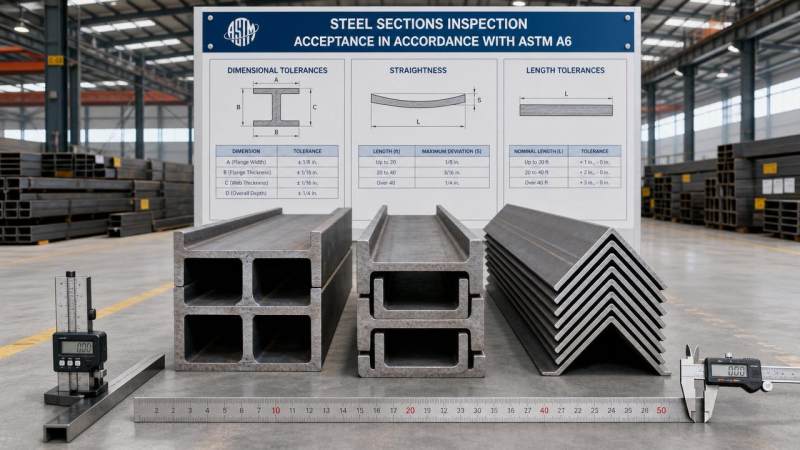
Steel acceptance has changed in recent years because projects now rely on closer tolerances across fabrication, transport, and erection stages.
Digital detailing, CNC processing, and modular construction reduce room for dimensional variation. Small deviations can stop assembly or force expensive site corrections.
At the same time, contract documents often reference ASTM standards more explicitly than before. This puts astm a6 tolerances at the center of inspection records.
When dimensions fall outside permitted ranges, acceptance is no longer a judgment call. It becomes a documented compliance issue.
The market signals behind stricter dimensional scrutiny
Several industry signals explain why astm a6 tolerances receive greater attention during delivery and receiving inspections.
- Higher use of pre-engineered and pre-drilled steel components.
- More international sourcing with multi-standard documentation.
- Reduced site rework tolerance due to labor and schedule pressure.
- Greater emphasis on traceable quality records and dispute prevention.
- Closer integration between design software and fabrication dimensions.
These signals show that astm a6 tolerances are now a practical control point, not just a reference note inside technical specifications.
What astm a6 tolerances actually control in steel products
ASTM A6 covers general requirements for rolled structural steel bars, plates, shapes, and sheet piling.
In acceptance work, astm a6 tolerances commonly apply to dimensions that directly influence fit and function.
This is why astm a6 tolerances should be reviewed together with material grade, section type, and end-use requirements.
Why tolerance compliance affects more than pass or fail decisions
The effect of astm a6 tolerances extends into nearly every business stage after rolling.
A section may appear usable, yet still create hidden cost through rework, shim adjustments, delayed welding, or rejected assemblies.
Tolerance nonconformance also affects coating performance. Uneven geometry can complicate galvanizing coverage, painting consistency, and bolt-hole alignment.
In structural applications, dimensional variation can accumulate across multiple members, making the final frame harder to align safely.
Where the impact shows up first
- Receiving inspections and unloading checks.
- Shop cutting, drilling, and coping operations.
- Connection assembly and bolt installation.
- Final field alignment and erection speed.
The main drivers pushing astm a6 tolerances into daily quality decisions
How this trend changes evaluation of channels, beams, and sections
Rolled channels used in buildings and mechanical structures face the same tolerance pressure as larger beams.
For example, Structural Steel Channel sections used in building structure, vehicle manufacturing, or room beam applications need dimensional stability for easier joining.
Available sizes such as 5-40# and 6.5-30#, with lengths of 6m, 9m, 12m, or custom supply, must still be checked against applicable astm a6 tolerances.
This matters whether the material is A36, A572 Gr50, Q235B, Q345B, S235JR, or S355JR, because grade compliance does not replace dimensional compliance.
Products with galvanized or painted finishes also benefit from proper shape control, especially in corrosive service environments.
What should receive closer attention during incoming steel acceptance
Acceptance teams should focus on measurable checkpoints tied directly to astm a6 tolerances and project drawings.
- Confirm the correct standard edition in purchase and inspection documents.
- Check section dimensions at multiple positions, not one point only.
- Verify length, sweep, camber, and end condition before unloading approval.
- Compare mill certificates with actual markings and delivered section type.
- Separate dimensional issues from chemistry or tensile property issues.
- Document any deviation with photos, measurements, and reference clauses.
These steps reduce confusion when a piece is acceptable by grade but questionable by geometry.
How to judge borderline cases without creating project delays
Not every deviation leads to rejection, but every deviation should be evaluated consistently.
A practical review path can help balance compliance, schedule, and structural intent.
- Identify the exact astm a6 tolerances clause involved.
- Measure again using verified tools and documented points.
- Check whether fabrication or design function is affected.
- Review possible engineering disposition or repair limits.
- Record the final decision for traceability.
This approach avoids emotional acceptance decisions and supports faster resolution of dimensional disputes.
What reliable steel partners are doing differently now
Reliable suppliers increasingly build tolerance awareness into production planning, inspection, and export documentation.
Hongteng Fengda, a structural steel manufacturer and exporter from China, supports global projects with standard and customized steel solutions.
Its product range includes angles, channels, beams, cold formed profiles, and custom components under ASTM, EN, JIS, and GB frameworks.
That kind of multi-standard capability becomes valuable when buyers need stable production, dependable lead times, and lower sourcing risk.
For sections requiring tensile strength of at least 520MPa or corrosion-resistant finishes, early dimensional control helps protect downstream quality.
The next smart move is to treat astm a6 tolerances as a risk filter
The industry direction is clear. Dimensional compliance is becoming a frontline control issue in structural steel acceptance.
Teams that understand astm a6 tolerances can reduce claims, avoid fit-up delays, and protect structural performance from the first delivery onward.
The most effective next step is simple: align purchase specifications, inspection methods, and supplier communication around the exact tolerance requirements.
When astm a6 tolerances are checked early and consistently, steel acceptance becomes faster, clearer, and far less risky.
Please give us a message


Please enter what you want to find