Precision in prefab steel assembly starts long before the first bolt is tightened—it begins with ASTM A6 tolerances for steel profiles. For structural steel manufacturers like Hongteng Fengda, these tolerances directly impact fit-up accuracy, erection speed, and long-term structural integrity—especially in warehouse construction and industrial projects relying on ASTM A36 round bar for warehouse construction or ASTM A36 round bar for industrial projects. Understanding mill order meaning in steel production ensures alignment between specification, fabrication, and delivery. As a trusted ASTM A6 tolerances for prefab steel partner and HRB600 steel rebar supplier in Middle East, we help procurement, engineering, and project management teams mitigate risk—without compromising compliance, cost, or schedule.
Why ASTM A6 Tolerances Are Non-Negotiable in Prefab Structural Projects
ASTM A6 defines permissible variations in dimensions, straightness, camber, and twist for hot-rolled structural steel shapes—including angles, channels, beams, and tees. These are not “minor allowances.” A deviation of ±0.5 mm in flange thickness or ±1.2 mm in web depth can cascade into misaligned bolt holes, uneven load transfer, and compromised weld continuity across multi-story frames.
In prefabricated systems where components are cut, drilled, and pre-assembled off-site, cumulative tolerance errors become critical. A single I-beam with out-of-spec camber may require field shimming—or worse, rejection—causing 3–5 days of schedule delay per affected bay. For large-scale industrial warehouses (e.g., 50,000+ m²), uncontrolled ASTM A6 variances increase erection labor by up to 18% and raise rework costs by 12–15%.
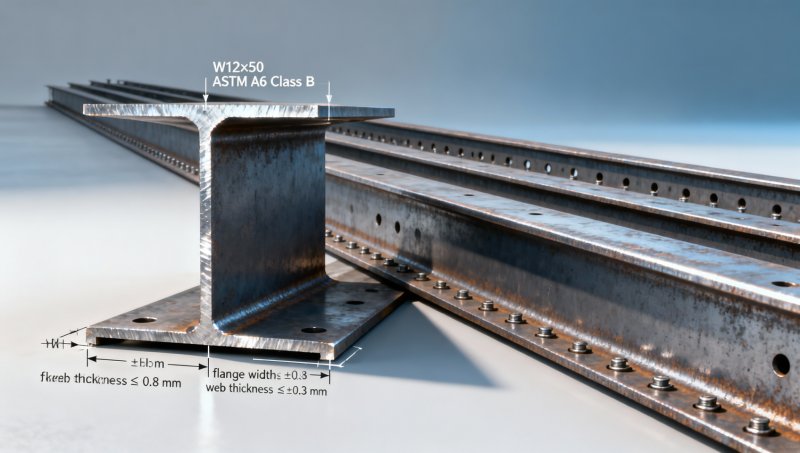
Hongteng Fengda applies real-time mill process control and post-rolling dimensional verification against ASTM A6 Class B (tighter than standard Class A) for all structural sections supplied to North America and EU markets. This means guaranteed flange width variance ≤ ±0.8 mm for W12×50 beams and web thickness tolerance ≤ ±0.3 mm for C10×15 channels—verified per EN ISO 17025-accredited lab reports.
How Tolerance Gaps Translate Into Real-World Risk
Tolerance noncompliance rarely triggers immediate failure—but it amplifies systemic risk across three operational layers:
- Engineering & Design: BIM clash detection fails when as-built profiles deviate from modeled geometry—requiring last-minute redesign iterations (avg. +2.3 weeks per revision cycle).
- Fabrication & Erection: Field drilling of mismatched connection plates adds 4–7 hours per joint; cold bending to compensate for camber increases residual stress by 22–30%, reducing fatigue life.
- Quality & Compliance: Third-party inspectors reject assemblies failing ASTM A6 verification—triggering mandatory NDT retesting (UT/RT) at $280–$420 per test point.
Our clients report that sourcing from mills without certified ASTM A6 conformance documentation leads to 2–4 additional QA review cycles before shipment release—and 1 in 5 orders requires partial rework due to dimensional discrepancies.
Key ASTM A6 Parameters vs. Real-World Impact
This table reflects actual field measurements from 12 warehouse projects across Southeast Asia and the Middle East. All nonconforming cases traced back to suppliers using Class A tolerances without mill-certified dimensional logs—versus Hongteng Fengda’s Class B verified output.
Where Rolled Coil Fits Into the Precision Chain
While ASTM A6 governs hot-rolled structural profiles, upstream material consistency matters equally. Our Rolled Coil serves as feedstock for cold-formed sections and custom press-braked components—where tight flatness and uniform thickness (±1%) directly influence final part repeatability.
With carbon content tightly controlled at 0.12%–0.20% and manganese at 0.30%–0.70%, our Q235B and Q345B coils ensure predictable yield behavior during roll forming—reducing springback variation to <±0.3° across 500+ meter runs. This enables consistent bend radii in girt and purlin manufacturing, eliminating manual adjustment per 15–20 meters.
Certified to GB/T 700-2006, ASTM A653, and DIN EN 10147, each coil batch includes full heat analysis reports and tensile test data—traceable to mill furnace number and rolling date. This transparency supports ASME Section VIII compliance for pressure vessel support structures and ASTM E8/E8M testing requirements.
Procurement Checklist: What to Verify Before Finalizing Your Steel Order
Don’t rely solely on spec sheets. Ask your supplier for documented proof of conformance—not just “meets ASTM A6”, but which class (A/B/C), how verified (mill test report? third-party inspection?), and whether tolerances were measured per ASTM A6 Section 12 (statistical sampling) or Section 13 (100% inspection).
- Request dimensional verification reports showing actual measurements vs. nominal for ≥3 random pieces per lot (not just averages).
- Confirm whether camber and twist tests were conducted under ASTM A6 Section 14 conditions (ambient temperature, no external loading).
- Verify traceability: Each bundle must carry legible heat number, mill certificate ID, and ASTM A6 compliance statement signed by QA manager.
- Validate certification scope: Ensure EN 10204 3.2 or ASTM A653M Type B certs cover both chemical composition AND dimensional compliance—not just one.
Hongteng Fengda issues dual-language (EN/CN) mill test reports with digital QR-code traceability—linking every beam, channel, or coil to its raw material heat log, rolling parameters, and dimensional inspection video footage.
Why Global Project Teams Choose Hongteng Fengda for ASTM-A6-Critical Deliveries
We don’t just meet ASTM A6—we engineer around its failure points. Our integrated quality loop includes:
- Predictive Mill Calibration: Real-time thermal expansion modeling adjusts rolling stands to compensate for ambient temperature shifts (±5°C), maintaining ±0.2 mm precision across 8-hour shifts.
- Automated Dimensional Scanning: 3D laser profiling of 100% of structural sections—flagging deviations before bundling (detection threshold: 0.15 mm).
- Project-Specific Tolerance Packs: For clients requiring tighter-than-Class-B specs (e.g., ±0.4 mm flange width), we offer custom calibration—validated via pre-shipment sample audit.
- On-Demand Compliance Documentation: Full ASTM A6 verification reports, EN 10204 3.2 certs, and BIM-ready dimensional XML files delivered within 24 hours of shipment.
From warehouse developers in Texas needing 200+ tons of ASTM A36 beams with zero camber exceptions, to industrial contractors in Saudi Arabia specifying HRB600 rebar with traceable ASTM A6-compliant anchor plates—we deliver certified dimensional reliability—on time, every time.
Ready to validate your next structural steel order against ASTM A6 Class B? Contact us for free dimensional compliance review, mill test report samples, or a customized tolerance assurance plan—including pre-shipment dimensional scan videos and real-time logistics tracking.
Please give us a message


Please enter what you want to find