Understanding ASTM A106 Gr B chemical composition is essential when evaluating weldability, strength, and fabrication performance in industrial piping projects. Whether you are comparing ASTM A106 Gr.B specification details, checking an ASTM A106 Gr.B equivalent, or sourcing reliable ASTM A106 Gr B pipe, the right material data helps reduce risk, improve quality control, and support better purchasing and engineering decisions.
For engineers, buyers, QC teams, fabricators, and project managers, weldability is not a secondary issue. It directly affects joint integrity, repair frequency, fabrication speed, and total installed cost. In pressure piping, even a small variation in carbon, manganese, phosphorus, sulfur, or silicon can change preheating needs, filler metal selection, and heat-affected zone behavior.
This is especially relevant when projects involve international sourcing, substitute material reviews, or mixed-standard procurement. A professional steel supplier with stable quality control can help reduce inconsistencies between mill lots, support documentation review, and align the purchased material with actual welding and service requirements.
What ASTM A106 Gr B Chemical Composition Means in Practical Welding Terms
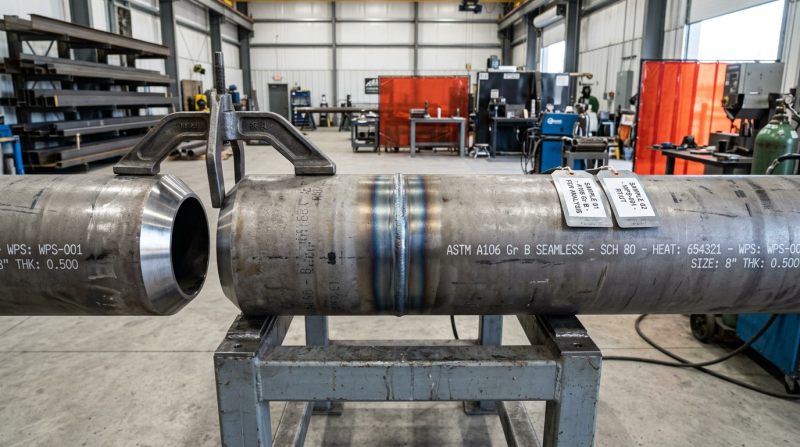
ASTM A106 Grade B is a seamless carbon steel pipe commonly used for high-temperature service. In practical fabrication, its chemical composition matters because welding performance is not determined by strength alone. Weldability is influenced by how alloying and residual elements affect hardness, cracking tendency, arc stability, and post-weld properties.
Typical ASTM A106 Gr B chemistry is controlled within standard limits, with carbon often around 0.30% maximum, manganese approximately 0.29% to 1.06%, phosphorus up to 0.035%, sulfur up to 0.035%, and silicon at a practical residual or controlled level depending on production route. These numbers may look modest, but in pipe welding, a 0.05% to 0.10% shift in carbon or manganese can noticeably affect fit-up response and heat input sensitivity.
When buyers only compare tensile strength or price per ton, they may miss the more important fabrication variables. A pipe that meets the minimum mechanical requirement can still create higher welding costs if it requires stricter preheat control, slower travel speed, or more repair welds. That is why technical evaluation should include both chemistry review and welding procedure compatibility.
Why chemistry drives weldability
The core reason is simple: composition affects microstructure. Higher carbon increases hardness and strength, but it also raises the risk of cold cracking, especially in restrained joints or low ambient temperatures below 10°C. Manganese improves strength and deoxidation, yet excessive levels can also raise hardenability. Phosphorus and sulfur are kept low because they reduce toughness and increase crack sensitivity in the weld zone.
Main fabrication concerns
- Root pass stability during GTAW, SMAW, or GMAW operations
- Heat-affected zone hardness after multi-pass welding
- Need for preheat, typically in the 50°C to 150°C range depending on wall thickness and restraint
- Repair rate impact on schedule, labor hours, and NDT acceptance
The table below shows how key elements in ASTM A106 Gr B usually affect field and shop welding decisions.
For most industrial users, the key takeaway is that ASTM A106 Gr B weldability is manageable and widely accepted, but only when chemistry stays within reliable process control limits and welding procedures are matched to the real pipe condition, wall thickness, and service environment.
How Specific Elements Influence Preheat, Filler Selection, and Repair Rates
In fabrication shops and site erection work, chemical composition translates directly into welding instructions. If carbon equivalent trends upward, welding teams may need preheat, lower-hydrogen consumables, tighter interpass temperature control, and more disciplined joint cleaning. These steps increase labor time per weld but are often necessary to prevent cracking and hardness-related failures.
For example, a thinner ASTM A106 Gr B pipe with wall thickness under 12.7 mm may be welded without aggressive preheat in many standard conditions. However, when the wall thickness increases to 25 mm or more, or when restraint is high, preheat in the 80°C to 120°C range may be considered depending on procedure qualification and ambient conditions. Chemical composition is one of the main reasons those decisions change from one project to another.
Another often overlooked point is repair frequency. Pipes from inconsistent sources can show wider chemistry variation from heat to heat. Even when each batch technically complies with ASTM limits, welding behavior may differ enough to cause fit-up complaints, uneven penetration response, or more NDT repairs. A 2% to 5% increase in weld repair rate can have a visible effect on schedule in a large piping package.
Element-by-element practical impact
Carbon is the first value many welding engineers review because it strongly influences hardness in the heat-affected zone. Manganese matters for toughness and deoxidation, but it also changes the response to heat input. Sulfur and phosphorus need close control because they can contribute to crack-prone behavior and inferior weld metal ductility.
Typical review points before welding
- Check mill test certificate chemistry, not only grade name.
- Review wall thickness, bevel condition, and joint restraint.
- Confirm WPS and PQR suitability for the actual heat range supplied.
- Set preheat and interpass controls when composition and thickness require it.
- Verify filler metal compatibility with service temperature and code requirements.
The next table connects composition-related factors with their likely shop-floor consequences.
For procurement teams, this means the lowest unit price is not always the lowest installed cost. A more stable chemistry range can reduce rework, shorten welding cycles, and improve first-pass acceptance, especially on projects with hundreds of joints or compressed completion dates.
How to Evaluate ASTM A106 Gr.B Specification, Equivalents, and Supplier Consistency
When teams compare ASTM A106 Gr.B specification details with possible equivalents, they should avoid a one-dimensional grade match. Equivalent materials may align in basic mechanical properties but still vary in chemistry control philosophy, manufacturing route, weldability margin, and code acceptance. That matters for cross-border sourcing, bid-stage substitutions, and mixed-material installations.
A useful review process includes at least 4 dimensions: standard compliance, chemistry range, mechanical property consistency, and weld procedure compatibility. Some buyers also add 2 more checkpoints: documentation quality and traceability by heat number. These extra steps are important when material will be installed in refinery, power, boiler, or process piping systems.
Supplier consistency is just as important as specification compliance. A manufacturer with modern production control, stable raw material management, and repeatable testing procedures is better positioned to deliver similar weld behavior across multiple shipments. This helps EPC contractors and distributors avoid mixing lots that respond differently during fabrication.
What buyers and engineers should compare
- Chemical composition ranges across several heats, not only one sample certificate
- Tensile and yield values relative to project design margin
- Seamless manufacturing quality, bevel preparation, and dimensional tolerances
- NDT, hydrotest, marking, traceability, and document completeness
In broader steel procurement, the same discipline applies to flat and structural products. For instance, when a project also requires formed components, panels, or fabrication blanks, engineers may compare material chemistry and processability in products such as High Carbon Steel Plate . Although its application differs from ASTM A106 Gr B pipe, the same principle remains valid: chemical limits, surface condition, and mechanical response should be reviewed against the actual forming or welding process rather than purchasing on price alone.
Typical supplier evaluation checklist
- Confirm compliance with ASTM requirements and requested supplementary needs.
- Request mill test certificates with heat-by-heat chemistry values.
- Check whether delivery schedules fit the project window, often 2 to 6 weeks depending on size mix.
- Review packaging, marking, and anti-damage measures for export shipments.
- Assess communication speed for technical clarifications and claim handling.
The table below can be used by procurement, QA, and engineering teams during supplier comparison.
For global buyers, working with an experienced Chinese steel manufacturer and exporter can be practical when the supplier understands international standards such as ASTM, EN, JIS, and GB, and can support both standard supply and customized project requirements with consistent quality control.
Common Welding Risks, Quality Control Priorities, and Project-Level Recommendations
The most common mistake in ASTM A106 Gr B pipe projects is assuming that all compliant material welds the same way. In reality, weldability is influenced by chemistry, wall thickness, ambient temperature, joint design, welding process, and welder discipline. That is why quality control should start before fabrication begins, not after defects appear during radiography or ultrasonic testing.
From a project management perspective, three areas deserve close attention: incoming material verification, welding procedure alignment, and repair trend monitoring. If the repair rate rises above a planned threshold, such as 3% to 4% of tested joints, teams should review chemistry variation, consumable handling, and heat input control before simply blaming workmanship.
For operators and site supervisors, cleanliness and temperature control remain fundamental. Moisture on electrodes, contaminated bevels, poor root gap control, or welding in windy conditions can turn a normally weldable ASTM A106 Gr B pipe into a recurring quality problem. Chemistry sets the baseline, but execution determines whether that baseline is achieved.
Risk points that should be monitored
- Low-temperature site welding without proper preheat verification
- Mixed heats with noticeably different welding response in the same spool package
- Improper filler storage leading to hydrogen-related defects
- Overlooking wall thickness effect when using a standard WPS across multiple sizes
- Delayed detection of hardness or cracking in the heat-affected zone
FAQ for technical and purchasing teams
How should buyers judge whether ASTM A106 Gr B is easy to weld?
Start with chemistry, especially carbon and manganese, then review wall thickness and the intended welding method. A pipe that is straightforward to weld at 6 mm thickness may need more control at 30 mm thickness. Ask for the mill certificate, check welding procedure compatibility, and confirm whether the project requires preheat or PWHT.
Is ASTM A106 Gr.B equivalent always safe to substitute?
Not automatically. Equivalent grades may be acceptable only after confirming chemical limits, mechanical properties, code compliance, and welding impact. A substitute should be reviewed by engineering, QA, and procurement together rather than approved only on basic strength values.
What documents should a reliable supplier provide?
At minimum, buyers should expect a mill test certificate, dimensional details, marking and traceability information, and shipment documentation. For critical projects, additional inspection records or third-party witness arrangements may be required depending on the contract and destination market.
Companies sourcing from China often prefer suppliers that can combine manufacturing discipline with export coordination. Hongteng Fengda, as a structural steel manufacturer and exporter, supports global buyers with stable production capacity, standard-based quality control, and customized supply solutions across construction and industrial steel products. That sourcing model helps reduce delays, documentation gaps, and cross-border communication risk.
In related fabrication programs, buyers may also need formed or cold-rolled steel for housings, brackets, or equipment panels. Products such as High Carbon Steel Plate are often selected based on tensile strength, surface finish, and forming performance, with common width ranges from 100 mm to 3000 mm and thickness from 0.1 mm to 400 mm. The broader lesson is consistent across steel categories: composition and processing data should always guide the final purchasing decision.
Final Selection Advice for Buyers, Fabricators, and Decision-Makers
ASTM A106 Gr B chemical composition affects weldability because each element changes how the pipe behaves under heat, restraint, and service conditions. For project teams, the right decision is rarely based on grade name alone. It comes from combining chemistry review, welding procedure planning, supplier consistency, and realistic quality control targets.
If your project involves industrial piping, plant fabrication, or export procurement, focus on 4 essentials: verify heat-by-heat chemistry, match the material to the actual welding condition, evaluate suppliers beyond unit price, and monitor repair trends early. These steps help reduce rework, improve delivery performance, and protect total project cost.
For buyers looking for dependable steel supply from China, a manufacturer with modern facilities, strict QC, and familiarity with ASTM, EN, JIS, and GB requirements can add real value during both technical review and commercial execution. If you need support with steel material selection, customized specifications, or export-ready supply planning, contact us to get a tailored solution, discuss product details, and explore more reliable steel sourcing options for your next project.
Please give us a message


Please enter what you want to find