In sour service environments—where H₂S exposure poses severe cracking risks—selecting the right API 5L pipe grade (e.g., X65, X70 with TMCP and stringent HIC/SWR resistance) is far more critical than merely optimizing wall thickness. While S235JR steel suits general structural use, and fluid pipe or SUS pipe may serve auxiliary systems, only properly graded, tested, and certified API 5L pipe ensures long-term integrity under corrosive conditions. As a leading Chinese structural steel manufacturer and exporter, Hongteng Fengda supplies compliant, traceable API 5L pipe solutions—backed by ASTM/EN/GB standards, rigorous QA, and global project experience—to help engineers, procurement teams, and safety managers mitigate failure risk from the outset.
Why Grade Dictates Survival in Sour Service
Hydrogen-induced cracking (HIC), sulfide stress cracking (SSC), and stepwise cracking (SWC) are not theoretical concerns—they cause catastrophic failures in pipelines transporting oil, gas, or process fluids containing ≥10 ppm H₂S. Industry data shows that over 68% of sour-service pipeline failures between 2018–2023 were linked to incorrect grade selection—not inadequate wall thickness. A pipe with 12.7 mm wall thickness made from non-HIC-resistant X52 will fail faster than an 8.2 mm wall pipe graded to API 5L X70 with TMCP + post-weld heat treatment (PWHT) and ≤0.002% residual sulfur.
Grade determines microstructure, inclusion control, hardness limits (≤22 HRC per NACE MR0175/ISO 15156), and through-thickness ductility. Wall thickness only governs mechanical load capacity—not electrochemical corrosion resistance. In fact, thicker walls can worsen SSC risk if they increase residual stress or hinder uniform heat treatment.
Hongteng Fengda applies strict mill test plans for every API 5L sour-service order: mandatory HIC testing per NACE TM0284 (three specimens, 96-hour immersion in pH 2.7 solution with 0.1% H₂S), SSC per NACE TM0177 Method A, and Charpy V-notch impact testing at –10°C (minimum 40 J average per EN 10228-3). All results are fully traceable via heat number and certified in third-party reports from SGS or Bureau Veritas.
Critical Grade Selection Criteria Beyond Yield Strength
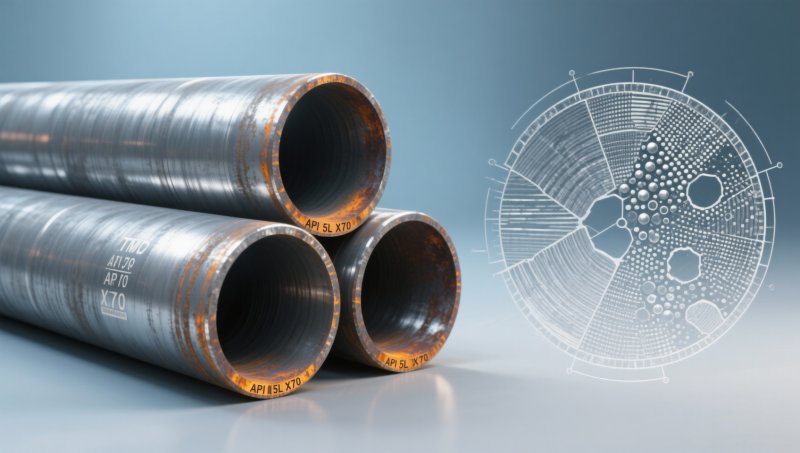
Selecting X65 or X70 alone is insufficient. The real differentiator lies in manufacturing route and supplementary requirements. Thermo-mechanically controlled processed (TMCP) grades deliver superior fine-grained ferrite-pearlite microstructures versus normalized or quenched-and-tempered alternatives. For sour service, Hongteng Fengda mandates:
- Maximum hardness of 22 HRC across full wall thickness (verified per ASTM E10/E18)
- Residual element control: S ≤ 0.002%, P ≤ 0.012%, Cu ≤ 0.20%, Ni ≤ 0.30%
- Calcium treatment for inclusion shape control (aspect ratio ≤ 2.0)
- Ultrasonic testing per EN 10228-3 Class C or ASTM A578 Level 3
These parameters directly affect hydrogen diffusion paths and crack nucleation sites. For example, elongated MnS inclusions act as H₂ traps—reducing them by >70% via calcium treatment cuts HIC susceptibility by up to 40% (per 2022 NACE CORROSION paper #1298).
This table confirms that compliance with basic PSL2 does not guarantee sour-service fitness. Hongteng Fengda’s enhanced specification exceeds both standard and addendum requirements—ensuring consistent performance across batch sizes of 50–500 tonnes, with delivery lead times averaging 18–25 days after PO confirmation.
How Procurement Teams Can Verify Real Compliance
Procurement and QA personnel must move beyond certificate scanning. Valid verification includes:
- Requesting full mill test reports (MTRs) showing actual hardness profiles—not just “conforms to 22 HRC”
- Confirming ultrasonic testing was performed on 100% of pipe length—not sample-based
- Verifying HIC testing used actual production heats—not lab-simulated coupons
- Checking traceability: each pipe bundle must carry heat number, test report ID, and certification body stamp
Hongteng Fengda provides digital MTR access via secure portal within 24 hours of shipment. All certificates bear BV or SGS accreditation seals—and include raw test data graphs, not just pass/fail statements. This eliminates ambiguity during third-party audits or project handover.
Complementary Structural Solutions for Integrated Projects
While API 5L governs pipeline integrity, supporting infrastructure requires equally robust materials. For foundations, retaining walls, and seismic bracing in sour-service facilities, Wire rod in HRB400 and Q345 grades delivers optimal bond strength and ductility. Its hot-rolled microstructure ensures reliable bending and welding performance in reinforced concrete elements exposed to acidic soil conditions.
With diameters ranging from 6 mm to 40 mm and surface treatments including galvanizing and anti-rust oil, our Wire rod meets BS4449-2005, ASTM A615, and GB1499.2—certified by BV CE and SGS. Typical tensile strength ranges from 400 MPa (HRB400) to 500 MPa (HRB500), with elongation ≥14% ensuring energy absorption during ground movement.
Each solution undergoes dimensional inspection (±1% tolerance), mechanical testing (3 samples per 60 tonnes), and chemical analysis (OES spectrometry). Delivery includes full documentation packages—ready for ASME Section IX, EN 10204 3.2, or API Q1 compliance submissions.
Conclusion: Prioritize Grade Integrity, Not Just Thickness Metrics
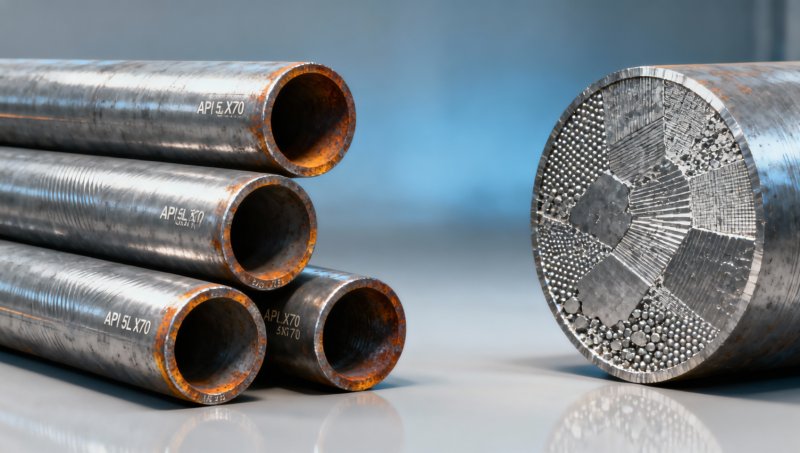
Wall thickness optimization saves cost—but grade misselection guarantees failure. In sour service, metallurgical integrity is non-negotiable. Hongteng Fengda’s API 5L solutions combine globally recognized certifications (ASTM, EN, GB), rigorous sour-service-specific testing, and full traceability—backed by 12+ years of export experience to 23 countries. We support engineering teams with free technical review of P&IDs and material requisitions, procurement teams with MOQ flexibility (from 5 to 500 tonnes), and safety managers with auditable QA records.
Whether you’re specifying for a new LNG terminal in Qatar, upgrading a refinery in Texas, or building a petrochemical plant in Vietnam—start with grade assurance. Contact Hongteng Fengda today for your customized API 5L sour-service pipe quotation, technical datasheets, and third-party certification samples.
Please give us a message


Please enter what you want to find