When 310S stainless steel strip fails prematurely during high-temperature cycling—especially in furnace components, heat exchangers, or industrial ovens—the root cause is rarely material purity alone. As a trusted structural steel manufacturer and exporter, Hongteng Fengda works closely with stainless steel plate manufacturers, ss coil suppliers, and global project teams to identify critical factors: microstructure stability, thermal expansion mismatch, carbide precipitation risks, and proper coil processing (hot rolled stainless coil vs. cold rolled stainless steel coil). Before ordering 310S stainless steel strip—or evaluating ss coil price, how much does stainless steel coil cost per ton, or sourcing hot roll stainless steel coil—verify heat treatment history, grain size, and intergranular corrosion resistance. Your operational reliability starts long before installation.
Why Thermal Cycling Triggers 310S Strip Failure — Beyond Composition
310S (UNS S31008) is widely selected for high-temperature applications due to its high chromium (24–26%) and nickel (19–22%) content—providing excellent oxidation resistance up to 1150°C. Yet field failures during cyclic heating/cooling—common in continuous annealing lines, radiant tube furnaces, and kiln car rails—often occur well below its nominal service limit. The issue lies not in alloy chemistry, but in microstructural evolution under repeated thermal stress.
During each cycle, differential expansion between the surface oxide layer and substrate induces compressive stress, while cooling generates tensile stress at grain boundaries. Over time—typically after 200–500 cycles between 900°C and ambient—this promotes intergranular oxidation and sigma phase nucleation, especially if grain size exceeds ASTM E112 Grade 3 (≈45 µm average). Such degradation reduces ductility by up to 40% and accelerates crack initiation.
Hongteng Fengda’s quality control protocol includes mandatory ASTM A262 Practice E testing on all 310S coils destined for cyclic service. We also require full heat treatment records—including solution annealing temperature (1040–1120°C), hold time (≥15 min), and quench rate (>55°C/s)—to ensure optimal carbide dispersion and avoid sensitization.
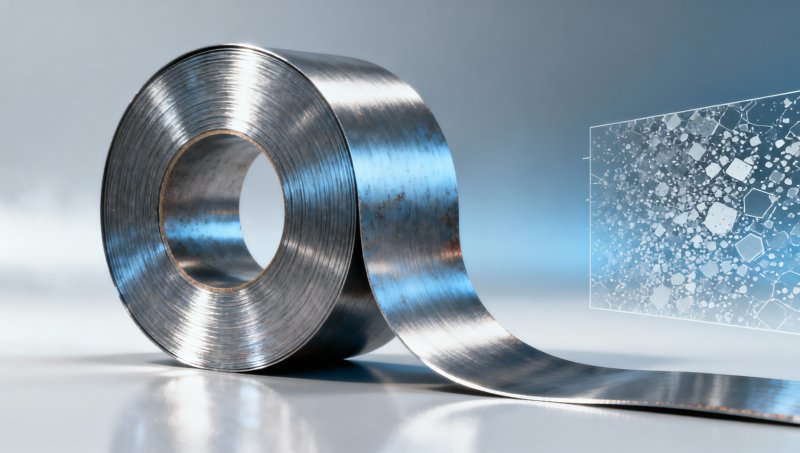
What to Verify Before Ordering: 5 Critical Checks
Procurement decisions for 310S stainless steel strip must go beyond mill certificates and nominal specs. Based on 12+ years of supporting global OEMs and EPC contractors, Hongteng Fengda recommends verifying these five non-negotiable parameters before placing an order:
- Grain size distribution: Must meet ASTM E112 Grade 2–4 (average grain diameter 25–45 µm); coarser grains accelerate intergranular oxidation during thermal cycling.
- Intergranular corrosion resistance: Verified via ASTM A262 Practice E (Strauss test) with ≤0.5 mg/cm² weight loss after 15-hour boiling in CuSO₄–H₂SO₄ solution.
- Carbide morphology: TEM or SEM analysis confirming uniform M₂₃C₆ distribution—not clustered at triple junctions—critical for fatigue life above 800°C.
- Residual stress profile: Measured by XRD or hole-drilling method; surface residual tensile stress >120 MPa correlates with premature edge cracking in 3–5 cycles.
- Coil processing route: Cold-rolled 310S requires final annealing at ≥1060°C + rapid water quench; hot-rolled variants demand stricter scale removal and pickling verification.
Failure to validate even one of these can reduce service life by 60–80% in cyclic environments—increasing unplanned downtime, safety risk, and total cost of ownership.
How 310S Compares to Alternatives in Cyclic Service
While 310S offers superior scaling resistance, it is not always the optimal choice for high-frequency thermal cycling. The table below compares key performance indicators across three common high-temperature alloys used in furnace hardware, heat shields, and burner nozzles:
253MA outperforms 310S in thermal cycling due to its nitrogen-enhanced austenite stability and lower coefficient of thermal expansion—reducing interfacial stress accumulation. For projects requiring >500 cycles/year, we recommend specifying 253MA unless strict regulatory compliance mandates 310S.
Why Material Selection Impacts Your Total Cost of Ownership
A procurement team may select 310S based on lower initial cost—typically $5,200–$6,800/ton versus $9,500–$12,000/ton for 253MA—but this ignores lifecycle economics. In a typical industrial oven application operating 6,000 hours/year with 3–5 thermal cycles/day, premature 310S failure increases maintenance labor by 3.2×, spare part inventory costs by 45%, and unplanned shutdown losses averaging $18,500/hour.
Hongteng Fengda supports clients with TCO modeling tools that factor in: expected service life (based on verified grain size and heat treatment), replacement frequency, downtime cost per incident, and scrap recovery value. Our data shows that switching from standard 310S to certified cyclic-grade 253MA reduces 5-year TCO by 22–31% in high-cycle scenarios.
For less demanding applications—such as static furnace linings or low-frequency preheat zones—Coil Coated Galvanized Steel provides robust corrosion protection at 1/4 the cost, with zinc coating weights up to 275 g/m² ensuring >25-year service life in indoor industrial environments.
Why Partner With Hongteng Fengda for High-Performance Steel Solutions
As a structural steel manufacturer and exporter from China, Hongteng Fengda bridges the gap between metallurgical precision and real-world project delivery. We don’t just supply steel—we co-engineer solutions:
- Pre-order technical review: Our engineers analyze your thermal profile, mounting design, and loading conditions to recommend optimal grade, thickness, and heat treatment path.
- Traceable coil certification: Every shipment includes full test reports per ASTM A240, EN 10088-2, and GB/T 4237—with grain size, intergranular corrosion, and tensile data verified by third-party labs (SGS, BV, TÜV).
- Global logistics integration: From Tianjin port, we offer FOB, CFR, and DAP terms with lead times of 18–25 days for standard 310S strips and 28–35 days for custom-certified grades.
- End-to-end support: Free sample coils for validation, on-site technical assistance for installation troubleshooting, and post-delivery performance monitoring.
Whether you’re sourcing hot roll stainless steel coil for a new heat-treating line or evaluating ss coil price for retrofitting aging equipment, contact us today for a tailored specification sheet, certified test reports, and a detailed TCO comparison report—including side-by-side analysis against Coil Coated Galvanized Steel alternatives where applicable.
Please give us a message


Please enter what you want to find