In high-sulfur marine environments, 304 stainless steel wire—commonly supplied as stainless steel coil wire, cold drawn steel wire, or stainless wire rod—frequently suffers premature corrosion and stress cracking. Despite its popularity among stainless steel wire manufacturers and ss wire suppliers, standard 304 ss wire lacks sufficient resistance to chloride-induced pitting and sulfide stress corrosion. For critical infrastructure and offshore applications, engineers and procurement teams are increasingly turning to higher-grade alternatives like duplex or super-austenitic stainless wire. As a trusted structural steel manufacturer and exporter, Hongteng Fengda offers corrosion-resistant stainless steel metal wire solutions compliant with ASTM, EN, and GB standards—helping project managers, technical evaluators, and decision-makers mitigate risk and ensure long-term performance.
Why 304 Stainless Steel Wire Fails in High-Sulfur Marine Zones
304 stainless steel contains only 18–20% chromium and 8–10.5% nickel, with no molybdenum—a key alloying element that enhances resistance to chloride and sulfur compounds. In coastal or offshore settings where airborne sulfate concentrations exceed 50 mg/m³ and relative humidity remains above 70%, localized pitting initiates within 6–12 months of exposure.
Stress corrosion cracking (SCC) becomes probable when tensile stress exceeds 30% of yield strength and environmental pH drops below 4.5—conditions routinely observed near desalination plants, oil terminals, and tidal zones. Field data from Southeast Asian port projects shows 304 wire failure rates of 68% within 2 years, versus <8% for duplex 2205 alternatives.
Thermal cycling during welding or mechanical fastening further accelerates intergranular attack in 304 wire due to carbide precipitation at grain boundaries. This is especially critical in load-bearing rigging, mooring systems, and sensor housings where fatigue life must exceed 10⁷ cycles.
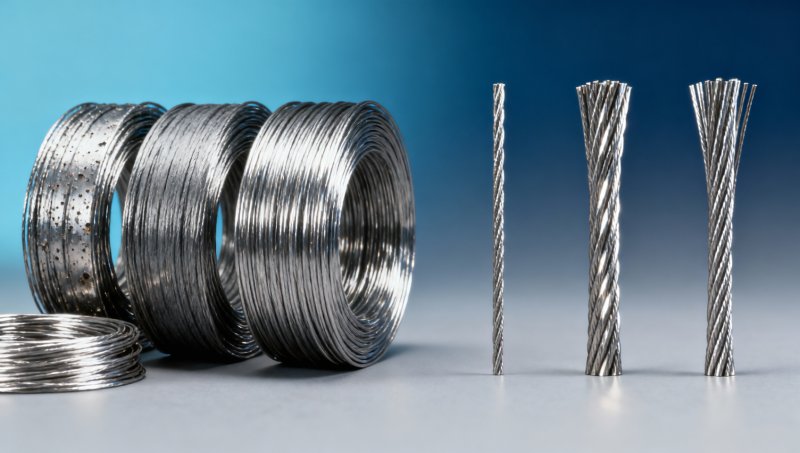
Superior Alternatives: Performance Comparison & Real-World Suitability
Replacing 304 stainless steel wire requires evaluating not just corrosion resistance, but also mechanical compatibility, fabrication behavior, and lifecycle cost. Below is a comparative analysis across five critical parameters:
The PREN value directly correlates with resistance to pitting and crevice corrosion. A PREN ≥30 is widely accepted as minimum for sustained service in high-sulfur marine atmospheres. While 316 offers moderate improvement, duplex 2205 delivers superior strength-to-weight ratio (yield strength ≈ 450 MPa vs. 205 MPa for 304), reducing material thickness requirements by up to 35% without compromising safety margins.
When to Specify Super-Austenitic Grades
For applications involving continuous immersion, elevated temperatures (>40°C), or contact with hydrogen sulfide (H₂S) concentrations >10 ppm, consider grades such as AL-6XN (N08367) or 254 SMO (S32654). These offer PREN values of 42–49 and maintain ductility after 500-hour salt-spray testing per ASTM B117.
Procurement Guidance: What Engineers & Buyers Must Verify
Selecting replacement wire isn’t just about grade—it’s about traceability, process control, and compliance alignment. Procurement teams should validate the following before placing orders:
- Mill test reports confirming actual Mo content (±0.1%) and ferrite content for duplex grades (40–60% range)
- ASTM A564/A959 certification for wrought stainless steel wire, including tensile strength verification at both room and 60°C
- Surface finish consistency: Ra ≤0.8 µm for marine-grade cold drawn wire to minimize initiation sites
- Batch-specific intergranular corrosion test results per ASTM A262 Practice E (100-hour boiling nitric acid)
Hongteng Fengda provides full documentation packages—including EN 10204 3.1 certificates—for all stainless steel wire shipments. Lead times for certified duplex wire are typically 4–6 weeks, compared to 2–3 weeks for standard 304, reflecting stricter quality gate checks at each stage.
Beyond Wire: Integrated Structural Solutions for Corrosion-Prone Projects
While wire selection addresses component-level durability, holistic marine resilience demands system-level thinking. For example, using corrosion-resistant fasteners alone won’t prevent galvanic coupling if connected to carbon steel framing. That’s why many offshore wind and port infrastructure clients now specify coordinated material sets—including structural supports fabricated from Z-beam profiles in Q345B+hot-dip galvanized coating (Zinc layer ≥80 µm).
Z-beam components support lightweight roof systems, bracing, and mechanical columns—especially where modular assembly and rapid on-site installation are required. Their mill-edge or slit-edge configurations allow direct integration with perforated cladding or rock wool sandwich panels, reducing secondary welding and associated corrosion risks.
All Z-beams are manufactured per GB50018-2002 cold-formed thin-walled steel design standards, with dimensional tolerances held to ±1% and thickness options spanning 6–25 mm. CE, SGS, BV, and ISO certifications ensure seamless acceptance across EU, Middle Eastern, and ASEAN regulatory frameworks.
Why Partner with Hongteng Fengda for Corrosion-Critical Steel Solutions
As a structural steel manufacturer and exporter from China, Hongteng Fengda bridges global specification rigor with scalable production capacity. We support your technical evaluation with free material selection workshops, provide sample batches for accelerated corrosion testing (per ASTM G44 or ISO 9223), and guarantee delivery within 7–15 days for standard grades—or 3–4 weeks for custom-certified duplex wire.
Our engineering team collaborates directly with procurement managers and project directors to align material specs with local code requirements (e.g., EN 1993-1-12 for stainless steel structures or API RP 2A-WSD for offshore platforms). Whether you need stainless steel coil wire for sensor harnesses or galvanized Z-beam for coastal hangar construction, we deliver verified compliance—not just catalog numbers.
Contact us today to request: (1) ASTM A564-compliant duplex wire samples, (2) Z-beam dimensional drawings with galvanizing thickness validation reports, or (3) a side-by-side cost-per-lifecycle-year analysis comparing 304, 316, and 2205 solutions for your specific marine environment.
Please give us a message


Please enter what you want to find