A 250 mm I-beam does not have one universal weight per meter. The dimension usually identifies the beam’s nominal depth, but its mass depends on the entire cross-section: flange width, flange thickness, web thickness, and the curved transitions between the web and flanges. Two beams described as “250 mm” can therefore have substantially different weights without either specification being incorrect.
The decisive detail is the section series and full designation. A narrow-flange beam, a wide-flange H-section, and a heavier section within another national system may all be described as approximately 250 mm deep. Comparing their weights before identifying their geometry is not a like-for-like comparison.
What “250 mm” tells you—and what it leaves out
Beam depth is the distance between the outside faces of the two flanges. It is useful for identifying the approximate size of a section, but it does not describe how much steel lies inside that outline.
A complete dimensional description needs several measurements:
- Depth, h: the overall height of the section.
- Flange width, b: the width of the top and bottom horizontal elements.
- Web thickness, tw: the thickness of the vertical element connecting the flanges.
- Flange thickness, tf: the flange thickness as defined by the applicable dimensional standard.
- Root radius, r: the curved transition where each flange joins the web.
A 250 mm-deep beam with 125 mm-wide flanges contains much less steel than a section of the same depth with 250 mm-wide flanges, unless other dimensions compensate for the difference. Increasing the flange or web thickness adds further cross-sectional area without necessarily changing the nominal depth.
Terminology introduces another source of confusion. Supplier listings may use “I-beam” broadly for both narrow-flange I-sections and wide-flange H-sections. The commercial name alone is therefore insufficient to establish the weight.
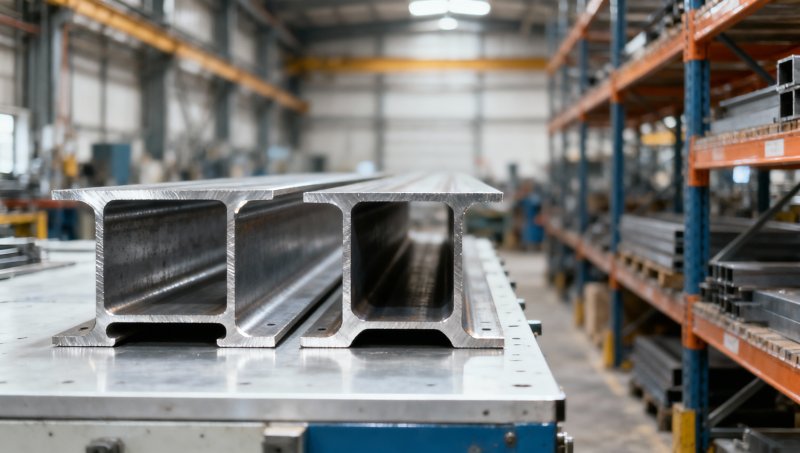
Weight comes from cross-sectional area, not depth alone
For a steel section of uniform cross-section, theoretical mass per meter is calculated from its cross-sectional area and the density used by the section table. Using the conventional structural-steel density of 7,850 kg/m³:
Mass per meter, kg/m = cross-sectional area, mm² × 0.00785
If the area is given in square centimeters, the equivalent calculation is:
Mass per meter, kg/m = cross-sectional area, cm² × 0.785
A simplified parallel-flange section can be treated as two flange rectangles and one web rectangle:
Approximate area = 2btf + (h − 2tf)tw
This expression makes the source of weight differences visible. Wider flanges increase the first term. A thicker web increases the second. Flange thickness affects both terms because thicker flanges reduce the clear web height while adding substantially more flange material.
For a hypothetical section measuring 250 × 125 × 6 × 9 mm, the rectangular approximation gives:
Area ≈ 2 × 125 × 9 + (250 − 18) × 6 = 3,642 mm²
Mass ≈ 3,642 × 0.00785 = 28.59 kg/m
A published rolled-section value can be higher because the simplified calculation excludes the root fillets and other details of the standardized profile. A commonly tabulated JIS H-section with these dimensions has a nominal mass of approximately 29.6 kg/m. That difference is not evidence of a supplier error; it shows why a rectangular estimate should not replace the correct section table.
For tapered-flange sections, the same simplified formula is less suitable because flange thickness changes across the width. Their area must account for the specified taper and radii.
How section series produce different answers
A section series is a standardized family of beam geometries. The series controls how depth, flange width, thickness, and radii change from one designation to another. National systems do not all organize these families in the same way.
European IPE sections are parallel-flange I-sections with relatively narrow flanges. HE sections have wider flanges, with different weight families such as HEA and HEB. Japanese dimensional tables include H-sections identified through dimensions such as depth × width × web thickness × flange thickness. American W-shape designations combine a nominal depth in inches with a nominal mass in pounds per foot.
Chinese section tables also distinguish between I-sections and H-sections. Some I-section designations use letter suffixes to identify dimensional variants within a nominal size. Omitting that suffix can leave the weight unresolved even when the nominal depth is known.
The following examples show why a search for “250 mm i beam weight per meter” can return several legitimate but incompatible values. The European examples deliberately include nearby sizes to illustrate the difference between a series designation and actual depth.
These are nominal table values for the specified profiles, not a universal conversion chart. European section dimensions and masses should be checked against the applicable EN 10365 table; JIS H-section dimensions and masses should be checked against JIS G 3192 and the supplier’s declared specification.
The two JIS examples are both 250 mm deep, yet one weighs more than twice as much per meter as the other. The wider flanges and greater thicknesses explain the difference. The HEA example illustrates a separate issue: HEA 260 has an actual depth of 250 mm, so the designation number must not automatically be interpreted as the measured depth.
The conventional IPE series, meanwhile, includes IPE 240 and IPE 270 rather than a standard IPE 250 designation. A listing described as “IPE 250” needs clarification: it could be loose commercial wording, another section family, or a nonstandard profile.
Different standards do not simply assign different weights to identical beams
A national standard does not make an otherwise identical steel cross-section significantly heavier merely by naming it differently. When tables show substantially different masses, the underlying geometries usually differ.
Standards matter because they define the geometry being referenced, the designation system, and the applicable dimensional requirements. Separate standards may govern steel grade, manufacturing tolerances, or delivery conditions. These functions should not be confused.
For example, specifying a material grade does not fully specify a beam section. A reference to ASTM A36 identifies material requirements, not a unique 250 mm beam geometry. Likewise, changing between common structural-steel grades does not explain a large difference in theoretical mass for the same nominal dimensions.
This distinction is especially important in cross-border comparisons. Two offers can both state a recognized steel grade and still describe different flange widths, web thicknesses, or section families. Material compliance and dimensional equivalence are separate checks.
Why supplier figures can disagree even for the same designation
Once the complete designation and dimensions match, smaller discrepancies require a different explanation. They may reflect rounding, theoretical versus measured mass, coatings, or an incorrectly copied table entry.
Rounding: one table may state 29.6 kg/m while another shows additional decimal places. A small difference of this kind is not equivalent to a change from 29.6 to 72.4 kg/m.
Manufacturing tolerances: rolled beams are produced within permitted dimensional and other applicable tolerances. Actual dimensions and mass can therefore differ from the nominal table values. The allowable departure depends on the governing standard and delivery agreement; it should not be assumed to be a universal percentage.
Surface treatment: published section masses generally describe the uncoated steel section. Galvanizing or another coating adds mass. That addition should be identified separately rather than treated as a different section-series weight.
Commercial measurement basis: an offer may use theoretical weight calculated from section tables, whereas shipment records may use actual weighing. Both can be valid reporting methods, but they should not be compared without identifying the basis.
For a plain, solid-web beam, a large discrepancy should trigger a geometry check before being attributed to tolerances. The same review should establish whether the item is hot-rolled or welded. A welded section can use selected plate thicknesses and may not match the geometry or mass of a rolled section with a similar overall depth.
A practical way to verify a quoted weight
The most useful starting point is the complete section designation, supported by dimensions. “250 mm I-beam, 12 m length” still leaves too much unresolved. “H 250 × 125 × 6 × 9 mm, dimensional standard JIS G 3192, nominal mass 29.6 kg/m” gives a much clearer basis for checking the quantity.
A specification or quotation should establish:
- The section family and complete designation, including any suffix.
- The governing dimensional standard and applicable edition.
- The nominal depth, flange width, web thickness, and flange thickness.
- Whether the beam is hot-rolled or fabricated by welding.
- The stated mass per meter and whether billing uses theoretical or actual weight.
- The supplied length and whether coating mass is included.
Cross-sectional area provides a useful independent check. If a table lists 37.70 cm², multiplying by 0.785 gives approximately 29.59 kg/m, consistent with a rounded value of 29.6 kg/m. If the area and stated weight do not reconcile, check the units and table row before relying on the figure.
Unit conversion also matters. A value expressed in pounds per foot must be multiplied by approximately 1.48816 to obtain kilograms per meter. Reading an American designation’s weight number directly as kg/m produces a substantial error.
The consequences become clear at full beam length. At 12 m, a section weighing 29.6 kg/m has a nominal mass of 355.2 kg. A section weighing 72.4 kg/m has a nominal mass of 868.8 kg. Their identical 250 mm depth does not make their shipment weight, handling requirements, or material quantity interchangeable.
Matching weight is not the same as matching performance
Weight is a useful quantity check, but it is not a complete measure of structural equivalence. Two sections of similar mass can distribute steel differently between the web and flanges, producing different bending properties, stability behavior, and connection geometry.
A heavier 250 mm section is therefore not automatically an acceptable substitute for a lighter one. Flange width can affect connection fit-up, while flange and web proportions affect structural behavior. Any substitution must be assessed against the specified section properties and design requirements, not just kilograms per meter.
The reliable answer to a 250 mm beam-weight question is a value attached to a complete section identity. Establish that identity, confirm its dimensions in the relevant table, and distinguish nominal mass from actual delivered weight. Only then do differences between suppliers become meaningful rather than differences between unrelated beams.
Please give us a message


Please enter what you want to find