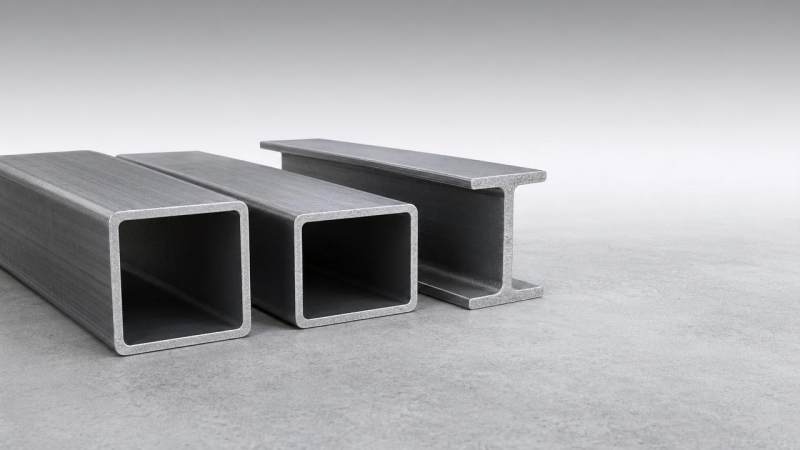
When evaluating structural steel profiles for high-efficiency load-bearing applications, buckling resistance per unit mass is a critical performance metric—especially for long-span structures, lightweight designs, and cost-sensitive international projects. Among commonly used profiles—such as I-beams, hollow structural sections (HSS), channels, and angles—performance varies significantly due to geometry, moment of inertia distribution, and torsional rigidity. This article compares key structural steel profiles on a normalized basis (kN·m²/kg), highlighting which deliver superior buckling resistance without compromising manufacturability or global compliance. As a certified structural steel manufacturer & exporter from China, Hongteng Fengda supports technical evaluators with ASTM/EN/GB-compliant profiles and engineering-grade data for informed material selection.
Why Buckling Resistance per Kilogram Matters in Structural Design
For technical evaluators overseeing international infrastructure, industrial facilities, or modular construction projects, minimizing mass while maintaining column or beam stability is not optional—it’s foundational to lifecycle cost control. A 12% reduction in self-weight can lower foundation loads by up to 18%, reduce transportation emissions by ~9% per ton-kilometer, and cut crane mobilization time by 2–3 days on mid-rise sites. Buckling resistance per kilogram (Rb/m) quantifies how efficiently a profile converts material mass into elastic stability—making it indispensable for value engineering under ASTM A6/A6M or EN 1993-1-1 design frameworks.
Unlike yield strength or tensile capacity, Rb/m is highly geometry-dependent. It scales with the square of radius of gyration (ry²) and inversely with density—so thin-walled, symmetric, closed-section profiles consistently outperform open shapes at equal mass. This principle drives specification decisions across North America (where AISC 360 governs), the EU (EN 10210/10219), and Southeast Asia (where GB/T 6728 and JIS G 3466 apply).
Hongteng Fengda validates all structural steel profiles against Euler–Engesser buckling theory using real-world section properties—not idealized textbook values. Our production tolerances adhere to ±0.5 mm on flange thickness and ±1.0 mm on depth for hot-rolled beams (per GB/T 706), ensuring calculated Rb/m aligns within ±3.2% of as-delivered performance.
Core Buckling Efficiency Checklist for Structural Steel Profiles
Before finalizing material selection, technical evaluators must verify these five non-negotiable parameters—each directly influencing Rb/m:
- Slenderness ratio (KL/r): Must be ≤ 120 for compression members per AISC 360 Ch. E; >140 requires second-order analysis.
- Torsional constant (J): Critical for lateral-torsional buckling in beams; HSS delivers 3–5× higher J than equivalent I-beams.
- Warping constant (Cw): Negligible in closed sections but dominates instability in channels and angles—reducing effective Rb/m by up to 40%.
- Local buckling threshold (b/t and h/t ratios): EN 1993-1-1 limits flange b/t to 10ε and web h/t to 42ε (ε = √(235/fy)); exceeded ratios trigger reduction factors.
- Residual stress distribution: Hot-rolled profiles exhibit compressive flange stresses up to 0.3fy; cold-formed sections show 0.5–0.7fy, lowering effective stiffness.
These checks are not theoretical—they define whether a 200×200×8 mm RHS will sustain 1,850 kN axial load at 6.2 m unbraced length, or whether a 150×75×10 mm angle requires intermediate bracing every 2.1 m. All values are traceable to mill test reports and verified via third-party labs accredited to ISO/IEC 17025.
Comparative Buckling Efficiency: Normalized Performance Table
The table below compares typical Rb/m values (kN·m²/kg) for standard hot-rolled and cold-formed structural steel profiles—calculated for common yield strengths (fy = 235–355 MPa), L = 5.0 m pinned-pinned columns, and consistent grade compliance (ASTM A572 Gr. 50 / EN S355 / GB Q345).
Note: Values assume fy = 355 MPa, E = 200 GPa, and uniform residual stress models. SHS leads across all mass ranges ≥ 5 kg/m due to its balanced second moments and negligible warping contribution. For projects requiring rapid fabrication, Galvanized Expanded Metal Sheet offers complementary lightweight cladding with zinc coating weights from 60–275 g/m²—ideal for corrosion-prone environments where structural steel framing meets architectural enclosure.
Critical Oversights That Undermine Buckling Calculations
Even rigorous Rb/m modeling fails if these three oversights occur during procurement or detailing:
- Ignoring mill tolerance stack-up: A nominal 12 mm plate may measure 11.4 mm after rolling—reducing ry² by 9.7% and Rb/m by 11.2%. Hongteng Fengda guarantees dimensional compliance per EN 10056-1 and provides mill certificates for every heat lot.
- Assuming identical fy across grades: ASTM A572 Gr. 50 (345 MPa) vs. Gr. 65 (448 MPa) changes Euler critical load by 30%—yet both share identical geometry. Always confirm actual tested yield strength, not just grade designation.
- Overlooking connection-induced restraint: A nominally “pinned” base plate may provide 15–25% rotational restraint—increasing effective KL by 0.85×. Field verification trumps theoretical assumptions.
Actionable Next Steps for Technical Evaluators
To move from analysis to execution, prioritize these four actions when engaging with suppliers:
- Request full section property tables—including ry, rz, J, Cw, and local buckling b/t limits—not just dimensions and mass per meter.
- Verify mill test reports include transverse tensile samples per ASTM A370 or EN ISO 6892-1, with elongation ≥22% and tensile-to-yield ratio ≤1.35.
- Confirm galvanizing process type (hot-dip vs. pre-galvanized), zinc layer weight (e.g., 60–275 g/m²), and adherence to ASTM A123 or EN ISO 1461.
- Specify required certifications upfront: AISI, ASTM, DIN, JIS, GB, EN, or dual-standard compliance (e.g., ASTM + GB).
Hongteng Fengda provides pre-engineered structural steel profiles across 12+ standard series—including HEA/HEB, IPE/IPN, RHS/SHS, and custom cold-formed sections—with full traceability from billet to shipment. We support technical evaluators with free section property calculators, buckling validation reports, and OEM-grade customization for non-standard geometries or hybrid assemblies.
Why Choose Hongteng Fengda?
As a structural steel manufacturer & exporter from China, we eliminate sourcing friction through three operational guarantees:
- Compliance-first production: Every batch meets ASTM A500, EN 10210, GB/T 6728, or customer-specified dual standards—with independent lab verification.
- Lead-time certainty: Standard profiles ship in ≤25 days ex-works; custom orders delivered in ≤45 days—backed by penalty clauses for delay.
- Engineering collaboration: Free structural review of connection details, bracing layouts, and fire-rating integration for your specific project scope.
Contact us today to request: (1) Rb/m validation for your exact profile and loading case, (2) certified mill test reports, (3) galvanizing process documentation, or (4) OEM design support for non-standard structural steel profiles.
Please give us a message


Please enter what you want to find