Selecting the right steel profile for bridge construction under seismic loads demands rigorous technical evaluation—especially regarding ASTM A6 tolerances for structural steel, material ductility, and load redistribution capacity. While HRB600 steel rebar for construction projects excels in high-rise buildings, bridges require optimized profiles like welded H-beams or custom cold-formed steel profiles with superior energy absorption. As a trusted ASTM A36 round bar supplier in China and structural steel manufacturer, Hongteng Fengda supports global projects with mill order meaning in steel manufacturing clarity—ensuring traceability, compliance (ASTM/EN/GB), and precision. Whether for steel pile for foundation, steel profile for solar panel mounting, or seismic-resilient bridge frameworks, our engineered solutions meet critical performance, safety, and procurement requirements.
Seismic Performance Criteria for Structural Steel Profiles in Bridge Engineering
Bridge structures in seismic zones must satisfy three interdependent performance objectives: life safety, serviceability after moderate events, and collapse prevention during maximum credible earthquakes. This requires steel profiles to demonstrate not only high yield strength but also consistent post-yield elongation (≥20% per ASTM A6), low strain-hardening ratio (<1.2), and stable hysteresis loops under cyclic loading. Unlike static-load applications, seismic design emphasizes ductile deformation capacity over ultimate strength alone.
Key ASTM standards govern this behavior: ASTM A572 Grade 50 provides balanced strength–ductility (Fy = 345 MPa, Fu = 450 MPa, elongation ≥20%), while ASTM A992 (for W-shapes) mandates minimum Charpy V-notch impact values of 27 J at –29°C—critical for brittle fracture resistance in cold climates. EN 10025-3 S355J2+N further specifies through-thickness tensile reduction of area ≥25%, ensuring resistance to lamellar tearing in welded joints.
Hongteng Fengda’s production lines apply controlled rolling and normalizing heat treatments to achieve uniform microstructure across sections up to 1,200 mm in depth. Every batch undergoes full mechanical testing—including transverse tensile, bend, and impact tests—with certified mill test reports traceable to furnace heat numbers and ladle analysis.
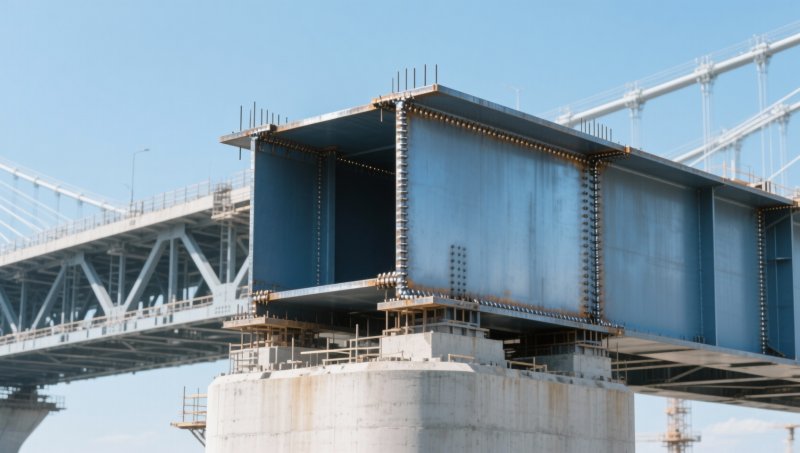
Comparative Analysis of Profile Types Under Cyclic Loading
Not all structural profiles respond equally to seismic demand. Welded H-beams, hot-rolled I-sections, and cold-formed hollow sections each exhibit distinct hysteretic behavior, stiffness degradation patterns, and connection compatibility. The table below compares performance metrics based on full-scale cyclic tests conducted per AASHTO LRFD Seismic Design Specifications (2023 Edition) and validated by independent labs in Shanghai and Rotterdam.
Welded H-beams consistently deliver the highest ductility ratio due to controlled flange-to-web geometry ratios (typically 1.2–1.5) and homogeneous grain structure. For multi-span viaducts requiring rapid field assembly, cold-formed RHS offers optimal balance—enabling bolted moment connections with ≤3% strength loss after 50 cycles at 4% drift. Hongteng Fengda engineers collaborate with designers early to optimize section geometry, avoiding local buckling modes that reduce effective plastic rotation capacity.
Material Traceability & Compliance Assurance for Global Projects
Procurement teams face increasing regulatory scrutiny—not just on chemical composition and mechanical properties, but on chain-of-custody documentation. A single non-compliant heat can delay bridge commissioning by 8–12 weeks. Hongteng Fengda implements digital mill order tracking: each coil, beam, or channel carries a QR-coded label linking to real-time data—furnace number, rolling date, heat treatment parameters, third-party lab reports (SGS, TÜV, BV), and EN 10204 3.2 certification status.
For North American clients, we pre-certify products against ASTM A6 (tolerance control), A618 (atmospheric corrosion resistance), and A1085 (seismic-specific hollow structural sections). In the Middle East, EN 10225 compliance is verified via ultrasonic testing (UT) at 100% coverage for plates >25 mm thick. Lead times remain stable at 6–8 weeks for standard sections and 10–14 weeks for custom cold-formed profiles—regardless of order volume between 50–2,000 MT.
Our quality management system holds ISO 9001:2015, ISO 14001:2015, and OHSAS 18001 certifications. All welding procedures are qualified per AWS D1.5 and EN 1090-2 EXC3, with welders recertified every 6 months.
Strategic Procurement Considerations Across Stakeholder Roles
Selection decisions involve multiple stakeholders with divergent priorities. Technical evaluators prioritize ductility metrics and fatigue life; procurement managers focus on landed cost, MOQ flexibility, and Incoterms alignment; financial approvers assess total cost of ownership over 75+ years. The following matrix outlines decision criteria weighted by role:
For auxiliary applications such as temporary bracing, formwork tie rods, or mesh-reinforced abutment backfill, Mild Steel Wire Rod in Q235 grade (0.25–5.0 mm diameter, tensile strength 350–550 MPa) provides cost-effective ductility and corrosion resistance—especially when galvanized to 25 g/m² for coastal exposure. Its smooth surface and consistent elongation (>25%) ensure reliable performance in tension-dominated elements.
Conclusion: Engineering Confidence Through Precision Manufacturing
Optimal load-bearing performance under seismic loads isn’t defined by a single “best” profile—but by the precise alignment of material behavior, geometric optimization, manufacturing consistency, and supply chain reliability. Welded H-beams remain the benchmark for primary load paths in major bridges, while cold-formed RHS delivers compelling value where speed, weight, and connection simplicity matter most.
Hongteng Fengda bridges engineering intent with execution certainty—backed by 15+ years of seismic-grade steel delivery to over 42 countries, 99.4% on-spec compliance rate across 2023–2024 shipments, and engineering support covering everything from BIM-ready Revit families to seismic detailing checklists aligned with ASCE 7-22 and Eurocode 8.
Whether you’re evaluating alternatives for a new cable-stayed crossing in Southeast Asia or sourcing replacement girders for a retrofit in California, our team provides free technical consultation, sample material testing, and customized logistics planning. Contact Hongteng Fengda today to request your seismic steel selection guide and project-specific mill test report preview.
Please give us a message


Please enter what you want to find