Choosing the right steel conduit for electrical wiring affects safety, durability, installation efficiency, and long-term cost. From project planners to buyers comparing an electrical conduit pipe price list, understanding conduit types, standards, and applications is essential. This guide explains how to select the best steel conduit for electrical wiring while connecting your needs with reliable structural steel solutions from a trusted steel profile manufacturer.
In industrial buildings, commercial facilities, infrastructure projects, and heavy-duty manufacturing environments, conduit is not just a protective tube. It is a steel-based safety component that influences mechanical protection, grounding continuity, corrosion resistance, and service life over 10, 20, or even 30 years. For procurement teams and engineers, the best choice depends on installation conditions, code compliance, total cost, and the reliability of the steel supply chain.
For global buyers, the challenge is often broader than comparing EMT, IMC, or RMC. They also need to assess material consistency, coating quality, dimensional tolerance, standard compliance, and delivery stability. A qualified structural steel manufacturer with export experience can help reduce sourcing risk, especially when projects require coordinated steel sections, profiles, and fabricated components under ASTM, EN, JIS, or GB standards.
Understanding the Main Types of Steel Conduit
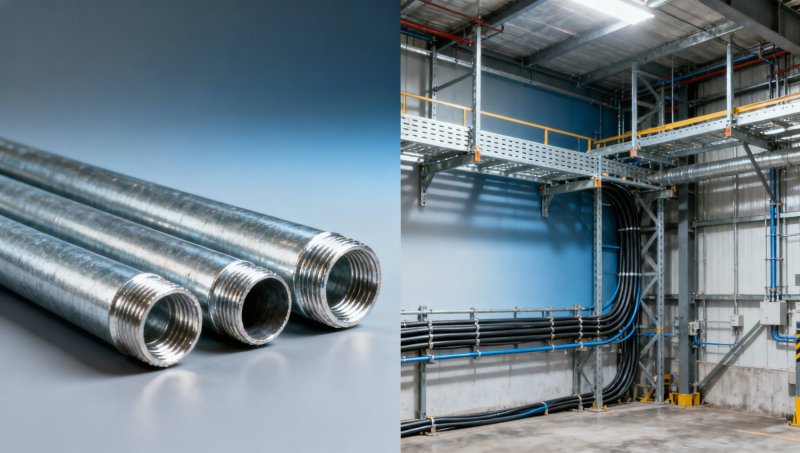
Steel conduit for electrical wiring is commonly divided into three major categories: Electrical Metallic Tubing (EMT), Intermediate Metal Conduit (IMC), and Rigid Metal Conduit (RMC). Each type serves a different balance of wall thickness, impact resistance, weight, and installation cost. In most project specifications, these three options cover more than 90% of standard steel conduit selection needs.
EMT is the lightest of the three and is widely used for indoor commercial wiring where severe mechanical damage is unlikely. It is easier to bend and faster to install, which can reduce labor time by 15% to 30% in straightforward routing conditions. However, it is not the first choice for harsh industrial sites, exposed outdoor runs, or locations with high physical impact risk.
IMC provides a middle-ground solution. It offers stronger wall thickness than EMT while remaining lighter than RMC. This makes it attractive in projects where corrosion resistance and mechanical protection matter, but installers still want manageable handling during field assembly. In many commercial and industrial projects, IMC supports a practical cost-performance balance over medium to long conduit runs.
RMC is the heaviest and most robust steel conduit option. It is commonly selected for exposed outdoor installations, utility areas, petrochemical environments, and critical infrastructure where conduit may face vibration, impact, moisture, or corrosive exposure. Although material and installation costs are higher, RMC often lowers risk in environments where failure is expensive or dangerous.
Typical selection differences
The practical choice depends on 4 key variables: installation location, expected mechanical stress, corrosion exposure, and budget. It is also important to confirm whether the conduit must act as an equipment grounding path, whether threaded joints are required, and whether local code references favor a specific conduit type for fire-rated or hazardous locations.
The following table compares the three main conduit types from an engineering and purchasing perspective.
This comparison shows that there is no single universal answer. The best steel conduit for electrical wiring is the one that fits the actual service environment, compliance requirement, and lifecycle budget of the project rather than simply the lowest purchase price per meter.
How to Match Conduit Type to Electrical and Site Conditions
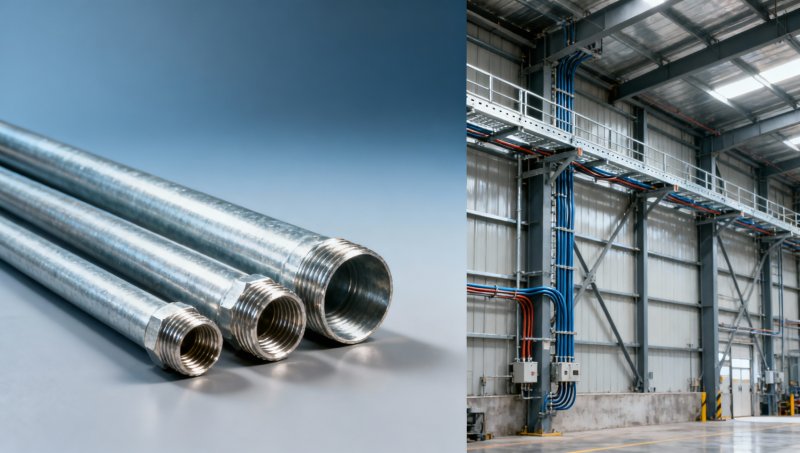
A correct conduit decision starts with the site, not the catalog. The same 25 mm or 32 mm conduit may perform very differently in a dry indoor corridor versus a coastal industrial platform. Engineers and buyers should review at least 5 conditions before approval: moisture, chemical exposure, impact risk, UV exposure, and temperature fluctuation.
For indoor building services, EMT often delivers adequate protection if the installation is concealed above ceilings or within partitions. In these cases, the priority is usually installation efficiency, bendability, and fit-out speed. When contractors must complete long routes in a 7- to 15-day schedule window, lighter conduit can reduce handling fatigue and improve progress.
For factories, logistics hubs, energy projects, and outdoor utility runs, IMC or RMC is usually more suitable. These environments may include forklift traffic, machine vibration, occasional washdown, or moderate corrosion. In petrochemical plants or marine-adjacent facilities, galvanized coatings, threading quality, and sealing performance become critical decision points rather than optional upgrades.
Another practical factor is future maintenance. If a conduit route will remain accessible and may need cable replacement after 5 to 10 years, selecting a mechanically stronger conduit with stable internal smoothness can reduce pulling resistance and avoid costly rework. Maintenance managers often prefer a slightly higher upfront conduit grade if it lowers shutdown risk later.
Site-based selection checklist
- Use EMT for low-impact indoor runs where speed and lower installed cost are the main priorities.
- Choose IMC when you need stronger protection than EMT but want lower weight than rigid conduit.
- Select RMC for exposed, hazardous, or high-abuse areas where conduit integrity is mission-critical.
- Check whether galvanizing, threading, and fittings match local code and corrosion class expectations.
- Review bend radius, pulling distance, and access points if future rewiring is likely within 1 to 2 maintenance cycles.
A note on steel supply integration
Projects that use conduit often require coordinated steel materials beyond the electrical scope. For example, support frames, brackets, channels, and reinforcement-related materials may be sourced together to improve cost control. In some manufacturing and construction chains, products such as Wire Rod are also purchased for structural steel bar applications, building material processing, or fabrication support. Typical grades may include Q235, Q345, HRB400, HRB500, ASTM A615 Grade 60, and BS4449 500B, with common standards such as ASTM, GB, EN, DIN, and JIS.
This matters because buyers increasingly prefer suppliers that understand steel performance across multiple categories. Material characteristics like carbon content in the 0.06% to 0.22% range, weldability, formability, dimensional consistency, and export documentation can influence the reliability of the broader steel package delivered to a project, even when the immediate focus is conduit selection.
Standards, Material Quality, and What Buyers Should Verify
Conduit performance is only as dependable as the material and manufacturing behind it. Buyers should verify not just the conduit type, but also compliance with the relevant market standard, coating integrity, dimensional tolerance, and traceable inspection process. In international sourcing, the difference between nominal compliance and consistent production quality can affect safety, installation fit, and customs acceptance.
For steel-related procurement, standard alignment is essential. Depending on destination market and project specification, references may include ASTM, EN, JIS, or GB requirements. While exact conduit standards vary by region and application, the broader principle remains the same: steel products should be manufactured under controlled processes with measurable tolerances, documented inspections, and stable coating performance.
A practical quality review should cover at least 6 checkpoints: outside diameter consistency, wall thickness range, zinc coating condition, thread precision where applicable, straightness, and packaging protection during transport. For export buyers, packaging is not a minor detail. Poor bundling or insufficient end protection can lead to deformation, damaged threads, or coating defects before the material even reaches the job site.
A manufacturer with modern processing lines and strict quality control can better support global projects that require repeat orders over several months. This is especially valuable for distributors, EPC contractors, and industrial buyers who need dependable lead times, stable product performance, and documentation that supports inspection, warehousing, and onward resale.
What to confirm before issuing a purchase order
The table below summarizes the most important verification points for steel conduit sourcing and how each one affects project execution.
The key conclusion is clear: conduit selection should never be reduced to a simple price comparison. Quality verification protects both electrical safety and procurement efficiency. A lower quote can become expensive if it creates rejection, field mismatch, coating failure, or schedule delay during installation.
Cost, Lifecycle Value, and Procurement Decision Factors
When buyers compare an electrical conduit pipe price list, unit price is only the starting point. Total installed cost usually combines material price, fittings, labor time, transport, waste rate, corrosion exposure, and maintenance frequency. On many projects, the cheapest conduit per ton or per meter does not produce the lowest total cost over a 10-year operating period.
EMT may save money in labor-intensive indoor projects because it is lighter and simpler to handle. RMC, on the other hand, may justify its higher upfront cost in outdoor or high-risk environments by reducing damage, replacement, and downtime. The financial decision should therefore match the consequence of failure. In a warehouse office, a conduit issue may be inconvenient; in a petrochemical unit, it may be serious and costly.
Procurement teams should also evaluate supplier consistency. A manufacturer that can support repeated batches over 2 to 4 project phases helps avoid mixed quality and specification drift. This is particularly useful when structural steel products, profiles, beams, channels, and related steel materials need to be sourced from a coordinated supplier base for easier documentation and logistics planning.
From a B2B sourcing perspective, lead time reliability often has the same value as a modest price reduction. A delayed conduit delivery can interrupt cable pulling, panel installation, ceiling closure, and final commissioning. For project managers, losing even 5 to 7 days in a critical sequence may cost more than a small difference in unit price.
Four practical procurement criteria
- Match conduit type to environment rather than choosing a single option for every area of the project.
- Compare installed cost, not only purchase price, especially where labor rates are high or access is difficult.
- Verify production stability, documentation, and export packaging if shipments are crossing regions or climates.
- Favor suppliers that can support custom steel solutions, coordinated deliveries, and standard compliance across categories.
Why supplier capability matters in steel projects
For global construction and industrial projects, conduit procurement is often part of a larger steel purchasing plan. Experienced Chinese structural steel manufacturers can support standard products and OEM solutions, including angle steel, channel steel, steel beams, cold formed profiles, and custom fabricated components. This integrated capability helps buyers reduce sourcing complexity, especially when multiple steel items must arrive within one coordinated delivery schedule.
A supplier with modern facilities, strict quality control, and export experience to North America, Europe, the Middle East, and Southeast Asia can provide more than product availability. It can support documentation, stable production capacity, predictable lead time, and lower sourcing risk for distributors, contractors, and enterprise buyers making multi-stage investment decisions.
Common Mistakes, Implementation Advice, and Final Selection Guidance
One common mistake is choosing conduit by habit rather than by environment. Some teams specify EMT everywhere to reduce cost, then discover later that exposed service yards, loading areas, or washdown zones require a stronger solution. Another mistake is over-specifying RMC in low-risk interior spaces, which increases labor and material cost without meaningful performance gain.
A second mistake is ignoring compatibility between conduit and fittings. Even high-quality steel conduit can underperform if the coupling, locknut, thread, or protective finish does not match the installation requirement. For long-term durability, the system should be assessed as a complete assembly, not as individual line items purchased from unrelated sources without verification.
Implementation should follow a simple 3-step approach: define the site condition, shortlist acceptable conduit grades, and verify supplier quality controls before order release. On larger projects, it is useful to divide areas into at least 3 exposure classes such as indoor low-risk, sheltered industrial, and exposed heavy-duty. This avoids both under-specification and unnecessary overspending.
For buyers and project leaders seeking dependable steel support, the best partner is one that combines material knowledge, manufacturing discipline, and export execution. Hongteng Fengda serves global construction, industrial, and manufacturing projects with structural steel products, custom solutions, and standards-based quality management. That kind of supply stability is valuable when conduit decisions are part of a wider steel procurement strategy.
FAQ
Which steel conduit is usually best for commercial buildings?
For many indoor commercial applications, EMT is often the most practical choice because it balances protection, installation speed, and cost. However, areas exposed to impact, moisture, or service equipment may require IMC or RMC in selected zones rather than a single conduit type throughout the building.
When should RMC be preferred over IMC?
RMC is generally preferred when the environment involves high physical abuse, severe outdoor exposure, or critical safety expectations. Examples include industrial utility areas, infrastructure installations, and some petrochemical or energy facilities where mechanical robustness and long-term protection outweigh higher installation effort.
What should buyers check on a conduit quotation?
A quotation should be checked for conduit type, nominal size, wall category, finish or galvanizing, standard reference, fitting inclusion, packaging method, and delivery lead time. Buyers should also confirm whether inspection documents are available and whether the supplier can maintain the same specification across repeat orders.
How long is a typical lead time for steel conduit supply?
Lead times vary by size range, order quantity, and coating requirement, but many standard export orders fall within roughly 2 to 6 weeks. For projects with phased delivery, early technical confirmation can reduce revision delays and improve production planning accuracy.
Selecting the best steel conduit for electrical wiring means aligning conduit type, steel quality, site exposure, installation method, and lifecycle cost. EMT, IMC, and RMC each have clear strengths, but the right answer depends on where and how the system will operate. For professional buyers, the safest decision comes from combining technical review with dependable steel supply capability.
If you are evaluating conduit-related steel requirements alongside structural sections, custom profiles, or OEM steel components, working with an experienced manufacturer can simplify sourcing and improve consistency. Contact Hongteng Fengda to get a tailored steel solution, discuss project specifications, and learn more about reliable export-ready products for construction and industrial applications.
Please give us a message


Please enter what you want to find