For technical evaluators comparing load-bearing options, structural steel pipe often delivers clear advantages over standard tube in strength, consistency, and code compliance. In demanding construction and industrial applications, choosing the right section affects safety, fabrication efficiency, and total project cost. This article explains where structural steel pipe performs better and what factors matter most in specification and sourcing.
In the steel industry, section choice is never only about shape. It is about load path, connection method, fabrication tolerance, corrosion exposure, and required standards. A wrong comparison between structural steel pipe and standard tube can lead to overdesign, rework, or compliance issues.
Hongteng Fengda, a structural steel manufacturer and exporter from China, supplies reliable steel products and custom solutions for global construction and industrial use. With production aligned to ASTM, EN, JIS, and GB, the company supports projects that need stable quality, practical engineering support, and dependable delivery.
When load-bearing frames demand higher reliability
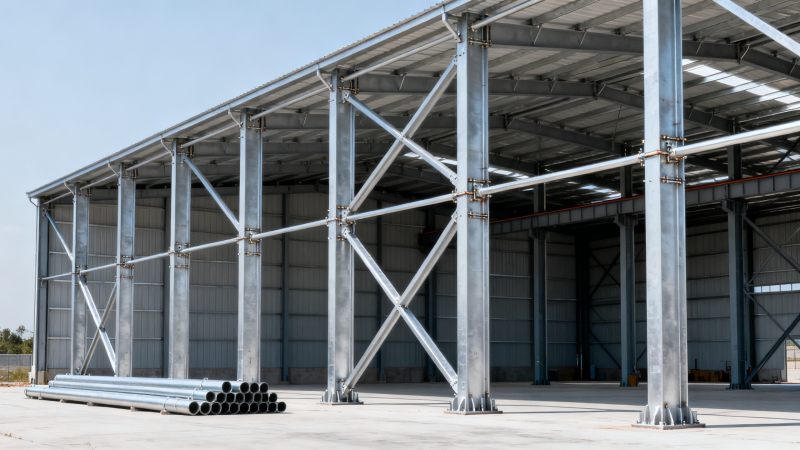
Structural steel pipe works better than standard tube when the member must carry significant axial, bending, or combined loads. Its geometry distributes stress evenly around the section. That improves performance in columns, braces, piles, and heavy support frames.
Standard tube can still perform well in lighter fabricated products. However, it is often selected for furniture, general fabrication, or noncritical structures. In those cases, appearance and dimensional convenience may matter more than structural certification.
The key difference is not round versus square alone. It is whether the product is intended, tested, and supplied for structural duty. Structural steel pipe is commonly specified where design codes, welding qualification, and predictable mechanical properties are essential.
Which application scenes favor structural steel pipe most
Building columns and exposed support members
For open building frames, structural steel pipe provides strong compression resistance and good torsional stability. It is especially effective where members remain visible and architects want clean lines with fewer projecting edges.
Round sections also reduce local stress concentration under some loading conditions. This can help in canopies, terminal structures, stadium features, and industrial halls that use exposed steel supports.
Bracing systems under dynamic or wind loads
Bracing members often face tension, compression, and vibration. Structural steel pipe performs well because its symmetric shape behaves consistently regardless of loading direction. That supports stable design in towers, plant structures, and seismic frames.
Standard tube may be usable in some bracing layouts, but specification review becomes more important. If the project requires structural grade verification, pipe usually offers a clearer path for engineering approval.
Industrial racks, equipment supports, and utility frames
In heavy-duty industrial settings, structural steel pipe is often preferred for supports exposed to impact, vibration, or outdoor weather. It combines reliable strength with simple detailing for welded nodes, base plates, and stiffened connections.
Where process lines or utilities run through compact layouts, round structural sections also reduce snag points. That can improve maintenance access and lower coating damage in congested installations.
Where standard tube may fall short in real project conditions
A standard tube may match basic dimensions, yet still underperform in structural service. The issue often appears during design review, welding, inspection, or loading verification rather than during initial price comparison.
- Mechanical properties may not align with structural design assumptions.
- Material traceability can be weaker for code-governed applications.
- Section suitability may be limited under combined load cases.
- Inspection acceptance may become more difficult on regulated projects.
- Lifecycle cost can increase through reinforcement, rework, or replacement.
These problems matter most in construction, plant engineering, transport infrastructure, and marine-adjacent fabrication. In such scenes, a lower purchase price can be offset quickly by engineering complications.
How scene-based requirements change the section decision
Different projects ask different questions. Some value bending resistance. Others prioritize connection simplicity, transportation efficiency, or corrosion control. The best decision comes from matching section type to service conditions rather than comparing catalog names only.
Not every project should default to pipe. Some frames benefit more from open sections or wide flange members. For long-span bending members, section geometry must match the load path carefully.
In many steel structure projects, combining sections is the smarter solution. For example, columns or braces may use structural steel pipe, while primary beams use H Section Beam for efficient bending resistance and practical connection detailing.
This inserted option is widely used in mechanical manufacture, steel structures, shipbuilding, bridging, and automobile chassis. Available grades include Q235, Q345B, Q460C, SS400, S275JR, S355JR, A572, and A992, with hot rolled and cold rolled specifications.
Typical size ranges include flange thickness 8-64mm, web thickness 5-36.5mm, flange width 50-400mm, web width 100-900mm, and lengths from 1m to 12m or as required. Standards include JIS G3101, EN10025, ASTM A36, ASTM A572, and ASTM A992.
What to check before specifying structural steel pipe
A good specification starts with project conditions, not only section size. Before confirming structural steel pipe, review these decision points carefully:
- Confirm the governing standard and required grade.
- Check whether loads are axial, bending, torsional, or combined.
- Review weld details, end preparation, and connection plates.
- Evaluate corrosion exposure and coating system compatibility.
- Verify dimensional tolerances and inspection documents.
- Consider transport length, fabrication sequence, and installation access.
These checks help avoid common substitution mistakes. They also make supplier comparison more meaningful, because the evaluation moves beyond nominal diameter and unit price.
Frequent misjudgments in steel section selection
Assuming similar dimensions mean equal structural value
This is one of the most common errors. Two sections may look similar on a drawing, yet differ in grade, tolerances, testing, and design acceptance. Structural steel pipe should be judged by verified structural performance, not shape alone.
Ignoring fabrication and inspection consequences
A cheaper tube can become expensive if fit-up is inconsistent or records do not satisfy project documentation. In regulated work, compliance delay can affect the entire schedule.
Choosing one section for every member
Efficient steel design rarely depends on one universal profile. Structural steel pipe may be ideal for braces and columns, while other members need beams, channels, or custom cold formed profiles.
Practical sourcing guidance for better project outcomes
When structural steel pipe is the better choice, supplier capability matters as much as product type. Stable production, grade consistency, and document control reduce risk across fabrication and installation.
- Request standard compliance by ASTM, EN, JIS, or GB as needed.
- Ask for mill test data and dimensional tolerance confirmation.
- Review customization capability for cut length or prefabricated components.
- Check lead times for mixed-section orders in one project package.
- Compare total delivered value, not only ex-works price.
Hongteng Fengda supports global construction, industrial, and manufacturing projects with structural steel products, OEM solutions, and strict quality control. This helps reduce sourcing risk while keeping schedules and costs under better control.
Conclusion: where structural steel pipe clearly performs better
Structural steel pipe performs better than standard tube in scenes that demand verified load-bearing capacity, reliable code compliance, stable fabrication quality, and durable field performance. It is especially valuable in columns, braces, industrial supports, and exposed structural systems.
The right decision comes from matching section behavior to real service conditions. If a project includes mixed structural needs, combining structural steel pipe with beams and other profiles often delivers the best result.
For the next step, prepare load conditions, standards, dimensions, and application scenes first. Then compare section options with a supplier that can support material selection, customization, and documentation with consistent export quality.
Please give us a message


Please enter what you want to find