For project managers balancing ventilation, protection, and budget control, galvanized expanded metal sheet offers a practical solution for demanding construction and industrial applications. Its open mesh design improves airflow while maintaining reliable security, making it suitable for walkways, machine guards, fencing, platforms, and ventilation enclosures. Understanding where this durable steel material performs best can help teams select safer, longer-lasting components and reduce maintenance risks across the project lifecycle.
The material is often specified too broadly: “galvanized mesh” may appear on a drawing without defining opening size, strand dimensions, structural role, galvanizing method, edge treatment, or fixing arrangement. That is where avoidable problems begin. Expanded metal can be an efficient architectural screen, a robust equipment guard, or a load-bearing access surface, but those are not interchangeable applications. Its value comes from matching the mesh geometry to the actual balance required between free air movement, visibility, intrusion resistance, fall protection, and corrosion exposure.
Why expanded metal works differently from woven mesh or perforated sheet
Expanded metal is produced by simultaneously slitting and stretching a solid steel sheet. Rather than creating holes by punching out material, the process forms a continuous lattice of strands and bonds. This gives the sheet several practical advantages: there are no loose wire intersections, material waste is relatively limited compared with perforation, and the mesh can retain useful rigidity across a broad panel.
For site applications, the distinction matters. Woven wire mesh is frequently selected for light fencing and containment because it is flexible and economical. Perforated sheet can deliver controlled hole patterns and a cleaner visual finish, but it may require a heavier base sheet to achieve comparable stiffness. Expanded metal generally occupies the middle ground: more open than a solid or perforated panel, more rigid than many wire meshes, and capable of resisting casual impact or climbing when properly framed.
Galvanizing adds a zinc coating that protects the underlying steel from corrosion. In construction and industrial environments, this is usually the reason expanded metal is considered for external screens, plant-area barriers, service platforms, and utility enclosures. The coating is not a guarantee of indefinite corrosion resistance; its expected service life depends on coating type, zinc mass or thickness, atmospheric conditions, trapped moisture, chemical exposure, abrasion, and whether fabrication after galvanizing leaves exposed steel at cut edges or welds.
Ventilated security enclosures are one of the strongest use cases
Electrical equipment, compressors, generators, pumps, HVAC plant, and process skids frequently need both airflow and restricted access. A solid steel enclosure protects equipment but can create heat buildup, increase fan loads, and complicate maintenance. A lightly built wire fence permits ventilation but may be insufficient where equipment must be protected from impact, tampering, thrown objects, or unauthorized access.
Galvanized expanded metal sheet is particularly effective where a protective cage or louver-like enclosure needs to remain substantially open. The diamond openings allow air to pass in multiple directions, while the angled strand profile can make direct hand access more difficult than the nominal opening dimension alone suggests. It also provides a visual barrier without completely obscuring inspection of equipment, indicator lights, leaks, vibration, or unauthorized activity.
However, the correct mesh should not be selected by open-area percentage alone. For ventilation equipment, the project team should ask the mechanical designer for the allowable pressure drop and required intake or exhaust area. A mesh with high apparent openness can still restrict airflow when installed behind louvers, filters, insect screens, or acoustic treatment. Conversely, a large opening that maximizes airflow may not meet the required finger-safe or tool-resistant access condition around moving or energized parts.
Where guarding is related to machinery, the opening, distance from the hazard, and panel rigidity should be assessed against applicable machine-safeguarding requirements in the destination jurisdiction. Standards and safety rules vary by market and application. A supplier’s generic mesh designation is not evidence that a completed guard meets a particular safeguarding obligation. The design must consider the full assembly, including frame gaps, access doors, hinges, locks, fixing intervals, and the possibility of panel deformation under force.
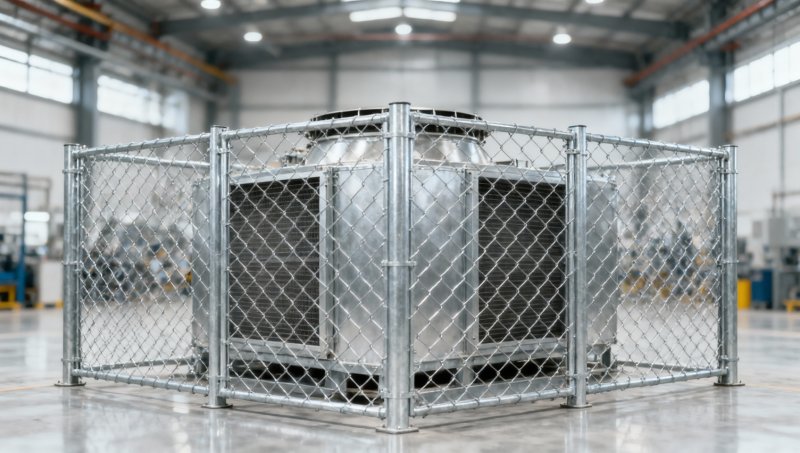
Plant-room screens need more than a corrosion-resistant panel
Outdoor mechanical yards and rooftop plant rooms are a common application because they combine the need for air circulation, visual screening, equipment security, and wind resistance. Expanded metal panels can be fixed to galvanized steel frames to form compound walls around condensers, transformers, ventilation units, and pumping systems. They are less prone than solid cladding to creating wind loads from a fully enclosed surface, although the supporting structure must still be designed for local wind actions.
The key project issue is that the mesh is usually not the governing structural element. Frame posts, rails, anchor bolts, connection details, gate frames, and base conditions determine whether the screen remains stable over time. A sheet that looks heavy in a sample can oil-can, sag, or rattle if it spans too far between supports. In exposed locations, repeated wind vibration may wear zinc coatings at contact points and loosen self-drilling screws or light-duty clips.
Good specifications identify the direction in which the long way of diamond is to be installed, the maximum unsupported span, the border treatment, and the fixing pattern. Flattened expanded metal provides a more level face and is often easier to integrate into framed panels. Raised expanded metal has a more pronounced three-dimensional profile and can provide greater stiffness in some configurations, but it can retain debris and may not be suitable where a smooth contact surface is required.
For rooftop installations, drainage and access must be considered before the enclosure is ordered. Screens should not block maintenance routes, fire-service access, equipment replacement paths, or roof drainage outlets. If the enclosure requires removable sections, those sections need a defined lifting method and connection system; otherwise, a simple maintenance task may turn into cutting and rework on site.
Where airflow and personnel protection overlap: walkways and platforms
Expanded metal is also used in access ways where open flooring helps prevent standing water, mud, snow, and process debris from collecting on the surface. In industrial facilities, it may be used for stair treads, maintenance platforms, catwalks, ladder cages, and service walkways. The open pattern can improve drainage and permit light transmission to lower levels, which can be valuable in congested steelwork.
This is an application where terminology causes risk. Light expanded metal sheet intended for screening is not automatically suitable for pedestrian loads. Load-bearing expanded metal is commonly manufactured in heavier gauges and specific mesh configurations, often with a raised surface that can offer improved slip resistance. The required support spacing, span direction, live load, concentrated load, deflection limit, and support detailing must be determined by the responsible designer.
Selection also depends on the footwear and operating environment. A raised pattern may improve traction in dirty or wet conditions, yet larger openings can create concerns for high heels, small tools, dropped components, or certain wheel loads. In food, pharmaceutical, or clean-process environments, open raised surfaces can be harder to wash down than alternatives. In corrosive washdown zones, galvanized steel may not provide the life expectancy required, and stainless steel or a different access solution may be more appropriate.
Galvanized expanded metal should therefore be treated as a system component, not a generic “anti-slip mesh.” The handrails, kick plates, supporting steel, stair geometry, and edge transitions all affect safety. In many cases, the greatest practical benefit is not simply traction: it is the ability to maintain drainage and visual awareness below the walking level while retaining a durable steel access surface.
Fencing, boundary protection, and controlled-access zones
For industrial compounds, storage yards, utility facilities, and service corridors, expanded metal can provide a more robust alternative to ordinary chain-link fencing where visibility and airflow remain necessary. It can be used as infill within welded frames, mounted to structural posts, or fitted around gates, service voids, and vulnerable equipment areas.
Its security performance depends substantially on aperture size and framing. Large-diamond expanded metal is useful where the primary objective is delineation and ventilation. It is less suitable where preventing hand access, climbing, or insertion of tools is central to the brief. Smaller openings improve resistance to access but reduce transparency and airflow, add material weight, and can increase cost. A heavier strand improves resistance to deformation, but only if the frame and fixings transfer that resistance into the overall barrier.
For a security-sensitive perimeter, a galvanized expanded metal sheet should not be assumed to replace a tested security system. Attack resistance may depend on defined threat levels, anti-climb features, anti-cut performance, gate integrity, locking hardware, surveillance coverage, and response arrangements. Expanded metal is often an effective component of a layered solution, particularly for internal segregation, equipment compounds, and secondary barriers, rather than a standalone answer to every perimeter-security requirement.
There is also an operational advantage over opaque fencing. Security personnel and maintenance teams can observe activity and conditions through the panel. That visibility can reduce the need to open gates for basic checks and can help identify stored materials, obstructions, or equipment faults. Yet this same transparency may be undesirable where visual screening is required, such as waste areas, sensitive operations, or architectural facades. In those cases, a denser mesh, secondary cladding, or a different screening system should be assessed.
Machine guards and partition walls demand careful detail control
Manufacturing plants frequently use expanded metal around conveyors, rotating equipment, robotic cells, belt drives, and material-handling zones. It is durable, easy to cut into framed panels, and allows operators to observe processes without opening a guard. For non-contact partitions between production areas, the material can also permit light and air movement while maintaining a clear physical boundary.
The main error is to judge a machine guard by the sheet itself rather than the installed arrangement. A guard may use appropriate mesh yet remain unsafe because it can be removed without tools, deflect into the danger zone, has excessive clearance at the floor, or incorporates an access door without suitable interlocking. Cut edges need attention as well. Freshly cut expanded metal can be sharp, while projecting strands can catch clothing or create laceration hazards. Framed edges, folded returns, edge channels, or properly finished trim are often necessary.
Where welding or drilling is carried out after hot-dip galvanizing, local coating damage must be addressed using an approved repair method consistent with the project specification and applicable coating guidance. Repairing visible damage is not merely cosmetic: exposed steel at frequently wet joints, welds, and cut edges can become the starting point for premature corrosion.
Corrosion performance: galvanizing is a decision, not a blanket assurance
“Galvanized” can refer to different coating processes. Pre-galvanized sheet is coated before expansion and fabrication; it is widely used and can be cost-effective, but cut edges and stretched areas deserve evaluation. Hot-dip galvanizing after fabrication generally coats the completed component, including many cut edges and welds, and may be preferred for heavier outdoor assemblies. The surface appearance, coating thickness, dimensional tolerances, and cost can differ significantly between these routes.
For indoor dry environments, either may offer adequate service life when correctly specified. For external industrial sites, coastal areas, chemical plants, animal housing, swimming-pool environments, and zones exposed to de-icing salts, coating selection becomes more consequential. Chlorides, acidic fumes, persistent condensation, and abrasive cleaning can shorten zinc-coating life. Trapped water between overlapping components can create local corrosion problems even when the general atmosphere is moderate.
A practical specification should define the environmental exposure, required coating system, post-fabrication treatment, and any need for duplex protection such as paint over galvanizing. It should also state whether colour consistency is important. Hot-dip galvanized surfaces can vary in appearance due to steel chemistry and process conditions; visual uniformity should not be confused with corrosion performance.
What should be confirmed before issuing a purchase order
Expanded metal is frequently quoted by nominal sheet size and weight, but those details do not fully define the item. The procurement package should identify the base steel grade where relevant, mesh designation, long-way and short-way opening dimensions, strand width and thickness, raised or flattened form, sheet orientation, panel dimensions, edge condition, galvanizing method, coating requirement, and tolerances.
For fabricated panels, include frame sections, weld requirements, gate details, hinges, latches, fasteners, anchor interfaces, and whether panels are supplied loose or as numbered assemblies. This reduces the common site problem of receiving sheets that are technically correct but installed in the wrong orientation or unable to align with the supporting steelwork.
Samples can be useful, but they should be used intelligently. A small coupon helps assess appearance, aperture, sharpness, and coating finish. It does not demonstrate full-panel stiffness, wind behavior, gate sag, or load capacity. For critical assemblies, shop drawings and connection details should be reviewed before production. When the system serves a safety function, inspection and acceptance criteria should be established early rather than left to visual judgment at delivery.
Using the material where it creates measurable project value
Galvanized expanded metal sheet improves airflow and security most effectively when the project needs both functions in the same physical barrier. Equipment enclosures, ventilated plant screens, guarded machinery, industrial partitions, access platforms, and protected service areas are all credible applications—but each calls for a different mesh, coating route, and support design.
The material is less compelling where exact airflow control, high acoustic attenuation, hygienic cleanability, high-security certification, or long-term resistance to severe chemical exposure is the primary requirement. In those situations, it may still form part of the solution, but it should not be selected simply because it is familiar and readily available.
The best results come from defining the performance problem before choosing the pattern: how much air must move, what must be prevented from entering, what loads and impacts are expected, how the panel will be supported, and what corrosion conditions will exist over the operating life. Once those questions are answered, expanded metal becomes more than a generic steel mesh—it becomes a practical means of reducing enclosure complexity while preserving access, visibility, ventilation, and protection.
Please give us a message


Please enter what you want to find