In roof framing, Z section steel is widely evaluated for its strength-to-weight efficiency, installation flexibility, and suitability as purlins or secondary structural members.
Its role depends on span, roof slope, wind uplift, snow load, connection design, and compliance with project standards.
Understanding where Z section steel fits helps improve structural performance, material cost control, and construction efficiency in steel roofing systems.
Where Z section steel fits in practical roof framing decisions
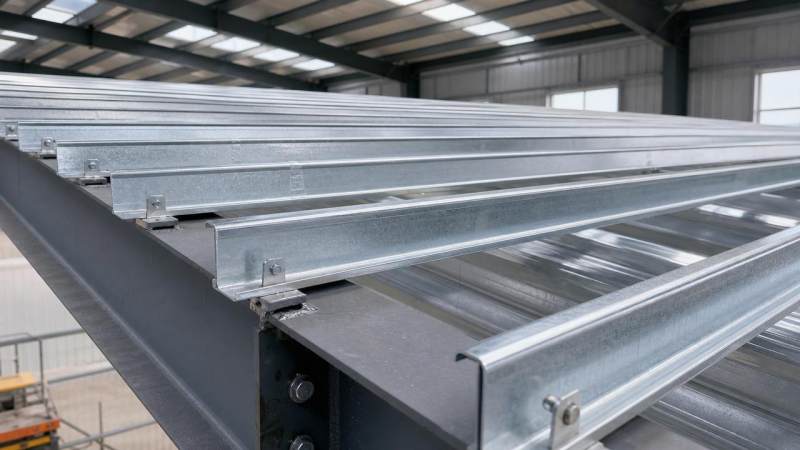
Z section steel usually fits between the primary frame and the roof cladding.
It often works as a purlin, supporting roof sheets and transferring loads to rafters or portal frames.
The Z-shaped profile provides a good balance between bending capacity and low self-weight.
This makes Z section steel practical for industrial buildings, warehouses, workshops, agricultural sheds, and commercial roofing projects.
It is especially useful where long roof runs require repeatable, easy-to-install secondary members.
The profile also allows lapping over supports, improving continuity and reducing deflection under suitable design conditions.
Scenario background: why roof framing needs different choices
Roof framing is not a single-condition decision.
A light warehouse roof and a coastal factory roof may need very different member sizes and coatings.
Z section steel performs well when its geometry, thickness, spacing, and finish match the actual loading environment.
Span length is one of the first judgment points.
Longer spans increase bending demand, deflection sensitivity, and fastener stress at the roof sheet interface.
Roof slope also matters because drainage, sheet layout, and uplift behavior affect purlin performance.
In low-slope roofs, deflection control and water ponding checks become more important.
In high-wind areas, Z section steel must be checked against suction forces and connection pull-out risks.
Typical scenario 1: Z section steel as roof purlins
The most common roof framing role for Z section steel is as a purlin.
Purlins carry roof sheeting, insulation systems, service loads, and environmental loads.
In this scenario, the main judgment points are spacing, section depth, material thickness, and support condition.
Lapped Z section steel can improve continuity across supports when detailed correctly.
This may reduce mid-span deflection and improve load distribution in repetitive roof bays.
However, lap length, bolt arrangement, and installation sequence must follow engineering requirements.
Core checks for purlin use
- Confirm dead load from sheets, insulation, solar systems, and accessories.
- Check live load, snow load, wind uplift, and maintenance load.
- Limit deflection according to roof sheet and waterproofing requirements.
- Coordinate fastener type, hole position, and anti-corrosion protection.
Typical scenario 2: secondary framing in industrial roofs
In industrial buildings, Z section steel often supports broad roof areas with repeated bay spacing.
Factories, logistics centers, and storage halls benefit from its predictable fabrication and fast site assembly.
The profile is suitable where structural efficiency and consistent delivery are important.
For industrial roofs, equipment loads may change the design assumption.
Ventilators, skylights, suspended pipes, cable trays, and solar panels can create concentrated loads.
Z section steel should not be selected only by roof area or previous project habits.
Each attachment point should be reviewed to avoid local overstress and serviceability problems.
Typical scenario 3: warehouses, sheds, and lightweight roof systems
Warehouses and sheds often need economical roof framing with quick installation.
Z section steel is a strong fit because it reduces unnecessary self-weight.
Lower self-weight can reduce load transferred to rafters, columns, and foundations.
For lightweight roofs, the key is not only strength.
Installation tolerance, roof sheet compatibility, and bracing arrangement are equally important.
Thin-gauge Z section steel may be efficient, but it needs careful handling during transportation and erection.
Correct stacking, lifting, and temporary fixing help prevent twisting or accidental deformation.
Typical scenario 4: roofs in corrosive or exposed environments
Outdoor roofs face humidity, temperature cycling, airborne pollution, and sometimes salt exposure.
In these conditions, the coating or material finish can be as important as section capacity.
Galvanized Z section steel is commonly considered for general protection in exposed roof framing.
Project conditions may require specific zinc coating mass, paint system, or alternative corrosion protection.
Fasteners and brackets must match the corrosion strategy.
A durable purlin with unsuitable bolts can still create early failure points.
Drainage details should also prevent standing water near laps, holes, and roof penetrations.
Product and material coordination in steel roof projects
Roof framing projects often involve multiple steel forms, not only Z section steel.
Brackets, supports, platforms, trims, and equipment interfaces may require bars, angles, channels, or custom profiles.
For stainless components in associated fabrication work, 306 Stainless Square steel rod can be reviewed for suitable applications.
Its supplied information includes 201 stainless steel material and options for square, round, hexagon, and flat forms.
Typical uses include construction, automotive parts, outdoor decoration engineering, kitchenware, medical instruments, and manufacturing applications.
Listed technical values include tensile strength ≥520 MPa, yield strength ≥275 MPa, and elongation of about 55–60%.
Surface options include black, bright polished, rough turning, mattness treatment, No. 4, and BA finishes.
Standards may include ASTM, AISI, JIS, GB, DIN, and EN, depending on order requirements.
Different roof framing scenarios and selection differences
This comparison shows why Z section steel should be selected by scenario, not only by nominal size.
A smaller profile may work in one roof but fail serviceability checks in another.
Scenario-based adaptation advice for Z section steel
A practical selection process starts with the building layout and loading data.
Then the Z section steel size can be matched with roof sheet type and connection method.
- Define span, bay spacing, roof slope, and purlin direction.
- Confirm dead, live, wind, snow, and equipment loads.
- Check strength, deflection, lateral stability, and local buckling.
- Review lap length, bolt grade, hole tolerance, and end support details.
- Select surface protection according to exposure and maintenance expectations.
- Verify compliance with ASTM, EN, JIS, GB, or project-specific standards.
Z section steel also needs coordination with bracing systems.
Sag rods, bridging, anti-sag bars, and roof sheets can influence lateral restraint.
Ignoring restraint assumptions may cause a mismatch between calculation and site behavior.
Common misjudgments when applying Z section steel
One common mistake is treating all roof purlins as interchangeable products.
Z section steel has advantages, but the final result depends on detailing and loading assumptions.
Another mistake is choosing section thickness only by price.
Lower material cost may increase deflection, vibration, installation damage, or later maintenance cost.
Wind uplift is also frequently underestimated.
Roof edges, corners, and openings may experience higher suction than internal zones.
Connection design should reflect these different wind pressure areas.
A further overlooked point is transportation length.
Very long Z section steel members may reduce joints but complicate container loading and site handling.
How Hongteng Fengda supports roof framing decisions
Hongteng Fengda manufactures and exports structural steel products from China for global construction and industrial projects.
The supply range includes angle steel, channel steel, steel beams, cold formed profiles, and customized structural components.
For Z section steel applications, stable production and dimensional consistency are important for smooth roof installation.
Consistent hole position, profile accuracy, and surface quality help reduce site adjustment work.
Products can be supplied according to major standards, including ASTM, EN, JIS, and GB.
Customized sizes, OEM requirements, and project-based packaging can support cross-border construction schedules.
Action guide: making Z section steel work in the right roof scenario
Z section steel fits roof framing best when the scenario is clearly defined before ordering.
The next step is to prepare drawings, load data, span details, coating requirements, and applicable standards.
With these inputs, section size, thickness, length, punching, and packaging can be reviewed more accurately.
For efficient roof framing, match Z section steel to real loads, site exposure, installation method, and lifecycle expectations.
A clear specification helps reduce sourcing risk, control cost, and support reliable steel roof construction.
Please give us a message


Please enter what you want to find