Where cold formed steel channel fits structural work
Selecting the right cold formed steel channel for structural work depends on load requirements, span conditions, connection design, corrosion environment, and compliance with project standards.
Technical evaluation should go beyond dimensions. Material grade, forming accuracy, tolerances, surface condition, and supplier quality control all affect performance.
This article explains where cold formed steel channel is most suitable in construction and industrial applications, with practical guidance for specification and sourcing.
Basic definition and structural characteristics
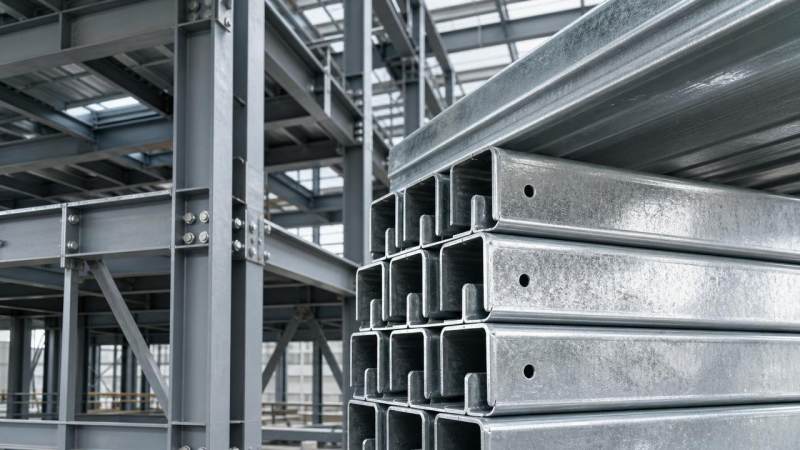
A cold formed steel channel is produced by bending steel sheet or strip at room temperature into a channel-shaped section.
Unlike hot rolled channel, it is formed from thinner material with precise profiles and flexible dimensional options.
The section usually includes a web, two flanges, and sometimes lips for added stiffness and improved buckling resistance.
Cold formed steel channel is valued when projects need lighter framing, repeatable geometry, fast installation, and efficient material use.
Its structural behavior depends on local buckling, effective section properties, connection detailing, and bracing conditions.
For this reason, cold formed steel channel should be selected through engineering review, not only by matching nominal size.
Typical section forms
- Plain channel for secondary framing, edging, and light supports.
- Lipped channel for improved compression and bending performance.
- Back-to-back channel assemblies for columns or stronger support members.
- Custom cold formed profiles for project-specific assembly needs.
Industry background and current evaluation points
Structural steel work increasingly requires lighter members, predictable tolerances, and faster site assembly.
Cold formed steel channel fits this direction because it can reduce dead load while maintaining practical strength.
In global projects, standards alignment is also important. Common references include ASTM, EN, JIS, and GB systems.
Hongteng Fengda supplies structural steel products from China for construction, industrial, and manufacturing projects worldwide.
Its product range includes angle steel, channel steel, steel beams, cold formed steel profiles, and customized components.
A reliable cold formed steel channel supply chain helps reduce sourcing uncertainty and supports consistent lead times.
Application value in structural work
Cold formed steel channel is often used where moderate loads, controlled spans, and efficient installation are priorities.
It is especially useful in secondary structures that support cladding, partitions, platforms, conveyors, or service equipment.
The main value is not only weight reduction. Consistent profile geometry also supports repeatable fabrication and modular assembly.
When properly designed, cold formed steel channel can improve project economy without compromising required safety margins.
Key business and engineering benefits
- Lower self-weight reduces handling effort and load on supporting structures.
- Accurate forming improves alignment during prefabrication and site installation.
- Custom lengths reduce cutting waste and speed up assembly.
- Compatible coatings help extend service life in exposed conditions.
- Standardized production supports stable quality across repeat orders.
Cold formed steel channel also supports OEM fabrication when special hole patterns, lengths, or profile dimensions are required.
For export projects, clear packaging, marking, and mill documentation are important parts of delivery reliability.
Typical structural scenarios and suitable uses
The following scenarios show where cold formed steel channel commonly provides practical structural value.
Cold formed steel channel is not always the best choice for heavy primary beams or long unsupported spans.
Hot rolled sections may be preferred when high concentrated loads or severe impact conditions dominate.
The final choice should compare section capacity, connection design, fabrication cost, installation method, and inspection needs.
Connection design and fabrication considerations
Connection detailing is critical for cold formed steel channel because thin sections can be sensitive to local deformation.
Bolted, screwed, welded, or bracketed connections must match the material thickness and project loading conditions.
Hole placement should respect edge distance, spacing, and potential tear-out risks.
Welding cold formed steel channel requires attention to heat input, coating condition, distortion, and qualified procedures.
For repeated assemblies, pre-punched holes can improve installation speed and reduce site measurement errors.
Specification checklist
- Confirm steel grade, yield strength, and applicable standard.
- Define web height, flange width, lip size, and thickness.
- State length tolerance, straightness, twist, and camber limits.
- Specify galvanizing, painting, or other corrosion protection.
- Request inspection documents and heat traceability when required.
A complete cold formed steel channel specification reduces redesign, rework, and disputes during delivery inspection.
Related floor and platform material selection
Structural framing is often combined with plates, decking, or grating in platforms and equipment areas.
Where anti-skid performance matters, patterned steel plate may complement cold formed steel channel support systems.
For example, S335JR Patterned steel plate is used in transportation, construction, machinery, shipbuilding, and equipment floors.
Available thickness is commonly 2-8mm, with lengths from 2m to 12m and widths from 600mm to 1800mm.
Its patterned surface supports anti-skid function, decorative appearance, enhanced performance, and steel-saving design.
Standards may include ASTM, DIN, JIS, BS, GB/T, ISO, SGS, and BV documentation.
Combining plate selection with cold formed steel channel design helps create safer and more efficient working surfaces.
Practical sourcing and quality control guidance
A dependable supplier should control raw material sourcing, forming accuracy, cutting quality, packaging, and shipment coordination.
Cold formed steel channel requires stable tooling and consistent process control to maintain section geometry.
Inspection should include dimensions, thickness, surface condition, straightness, coating quality, and marking accuracy.
For international orders, drawings should clearly state units, standards, tolerances, packing method, and document requirements.
Hongteng Fengda supports standard specifications and OEM solutions for global structural steel projects.
Modern manufacturing facilities and strict quality control help keep cold formed steel channel deliveries consistent.
Common risks to avoid
- Selecting only by nominal size without checking design capacity.
- Ignoring local buckling in compression or bending members.
- Using unclear tolerances that cause fit-up problems on site.
- Underestimating corrosion exposure in outdoor or coastal projects.
- Accepting shipments without adequate certification or traceability.
Clear technical communication is the simplest way to improve cold formed steel channel procurement results.
Summary and next steps for specification
Cold formed steel channel fits structural work that needs light weight, accurate profiles, controlled costs, and efficient installation.
It is most effective in secondary framing, modular structures, equipment supports, industrial platforms, and engineered light structures.
The best results come from matching section properties with load cases, span limits, bracing, connection design, and environment.
Before ordering cold formed steel channel, prepare drawings, standards, grades, dimensions, tolerances, coating needs, and inspection requirements.
Hongteng Fengda can support structural steel sourcing with channel steel, cold formed profiles, beams, angle steel, and customized components.
For reliable project planning, share technical requirements early and confirm production details before final procurement.
Please give us a message


Please enter what you want to find