From food processing lines to fabrication shops and chemical equipment, 304 stainless steel coil for industrial use stands out where corrosion resistance, formability, and clean surface performance matter most. For operators and end users, choosing the right coil means easier processing, longer service life, and lower maintenance, making it a dependable material across demanding industrial environments.
For most users, the practical answer is simple: 304 performs best in wet, mildly corrosive, hygiene-sensitive, and fabrication-heavy industrial settings. It is not the cheapest option, but it is often the safest all-around choice.
When operators ask whether 304 stainless steel coil for industrial use is the right material, they usually want to know three things: will it resist corrosion, will it process easily, and will it reduce daily maintenance trouble.
This article focuses on those real questions. Instead of repeating textbook definitions, it explains where 304 coil delivers the most value, where its limits appear, and how users can judge fit before production problems begin.
Where does 304 stainless steel coil perform best in real industrial work?
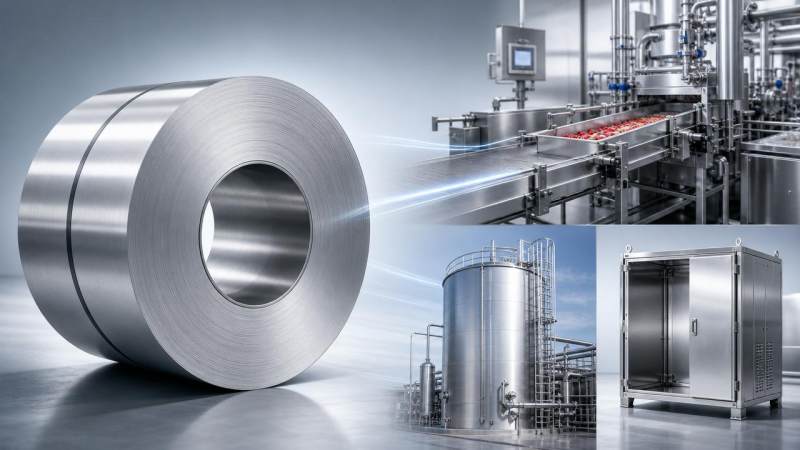
304 stainless steel coil performs especially well in environments that combine moisture, frequent cleaning, light chemical exposure, and repeated forming or welding. These conditions are common in many factories, workshops, and process plants.
In food processing, 304 is widely used for covers, hoppers, conveyors, tables, tanks, and guarding panels. Operators value it because the surface stays clean, resists rust under normal washing routines, and supports hygiene control.
In commercial kitchens and beverage facilities, it handles steam, splashes, detergent cleaning, and regular handling better than ordinary carbon steel. This reduces staining, improves appearance, and helps equipment stay serviceable over time.
In fabrication shops, 304 coil is a strong choice when parts need bending, rolling, stamping, or light drawing. Its good formability allows users to produce casings, ducts, liners, channels, and custom components with fewer cracking concerns.
Chemical equipment makers also use 304 where exposure is moderate rather than extreme. It performs well with many organic chemicals, cleaning agents, and water-based media, provided chloride concentration and temperature remain within reasonable limits.
For architectural and industrial interiors, 304 coil is useful where appearance matters along with corrosion resistance. Panels, trims, machine covers, and enclosures benefit from its smooth finish and stable long-term visual performance.
It also performs well in pharmaceutical support equipment, water handling accessories, ventilation systems, and general industrial housings. In these applications, the balance between workability, cleanliness, and service life often makes 304 the preferred material.
Why do operators and end users often prefer 304 over ordinary steel?
The main reason is reliability in daily use. Carbon steel may cost less at the start, but in wet or cleaned environments it usually needs coating, repainting, or faster replacement once corrosion begins.
304 stainless steel coil for industrial use avoids many of those problems. Its chromium and nickel content create a protective passive layer that helps the surface resist oxidation and ordinary industrial moisture without depending on paint.
For operators, that means less concern about rust contamination on nearby products, fewer shutdowns for touch-up maintenance, and less effort spent managing cosmetic or surface-related failures on exposed equipment parts.
Another advantage is easier sanitation. In industries where surfaces must be wiped, washed, or disinfected regularly, 304 supports smoother cleaning routines than painted steel, especially when scratches or chipped coatings would otherwise trap residue.
Formability also matters. Users who process coil into finished parts often find 304 forgiving enough for common shaping operations, especially when correct tooling, bend radius, and surface protection are used during fabrication.
Weldability is another practical benefit. Many industrial assemblies require on-site or workshop welding, and 304 generally supports consistent weld quality when procedures and filler selection match the application.
In short, users prefer 304 not because it is perfect for every environment, but because it solves multiple operational problems at once: corrosion control, workable fabrication, better cleanliness, and a lower maintenance burden.
Which industrial environments get the strongest performance from 304 coil?
The strongest performance usually appears in environments described as “moderately corrosive but not extreme.” This includes humid indoor areas, washdown zones, food contact surroundings, and fabrication applications with frequent handling.
Food and packaging plants are among the best examples. Here, surfaces must remain clean, stable, and visually acceptable while facing water, mild cleaners, and repetitive production contact.
Equipment exposed to condensation also benefits. In ventilation components, ducts, machine cladding, and moisture-prone covers, 304 can significantly outlast plain steel and reduce the need for coating repair.
Process tanks and frames used around non-aggressive chemicals are another good fit. If the media are not strongly chloride-based or highly acidic, 304 often gives a dependable service life with manageable maintenance.
Transport and storage components used indoors can also benefit. Shelving, bins, cabinets, and work platforms made from 304 maintain structural integrity and surface condition better in damp working environments.
Users in light manufacturing often choose 304 for guards, brackets, covers, and formed housings because the material balances appearance, durability, and manufacturability without requiring complicated post-treatment.
Where combined steel systems are used, stainless components may work alongside carbon steel structures. In many industrial buildings, stainless equipment parts are supported by structural members such as Z-beam sections in roof, wall, bracket, or light framing applications.
That combination is common in large workshops and plant buildings, where corrosion-resistant processing parts are paired with structural profiles made in grades such as Q235B, Q345B, S275, S355, A36, or A572 for cost-efficient support systems.
When is 304 stainless steel coil not the best choice?
This is an important question because users often assume stainless means corrosion-proof in every setting. It does not. 304 has limits, especially where chlorides, salt deposits, or strong chemicals are involved.
Marine and coastal environments can be difficult if salt exposure is constant. Chlorides may cause pitting or crevice corrosion, especially if surfaces stay wet and are not cleaned regularly.
High-chloride cleaning processes can also create trouble. If equipment is washed with aggressive chloride-containing chemicals, 304 may lose its long-term advantage and a higher alloy grade could be more suitable.
Very acidic or high-temperature chemical service may also exceed its capability. In those conditions, users should compare alternative stainless grades based on exact media, concentration, and operating temperature.
Another limitation appears when surface damage is ignored. Deep scratches, iron contamination from tools, or poor weld cleanup can reduce corrosion resistance and cause early staining even when the base material is correct.
Applications requiring very high strength at low weight may also point toward other materials or engineered structural steels, especially if corrosion is not the main performance concern.
So the best decision is not simply “choose stainless.” It is “match the environment, fabrication method, and maintenance reality to the right material grade.” For many jobs that will still be 304, but not for all.
What should operators check before choosing 304 stainless steel coil for industrial use?
Start with the actual environment, not the product label. Ask what the material will touch every day: water, detergent, steam, food residue, oil, solvent, chloride, acid, or outdoor air.
Then look at fabrication needs. If the coil will be cut, bent, rolled, stamped, or welded, users should confirm thickness, temper condition, finish, and dimensional consistency before committing to production.
Surface finish matters more than many buyers expect. A suitable finish can improve cleanability, appearance, and downstream forming performance. It can also reduce rejection if visual quality is important.
Users should also confirm edge condition, because mill edge and slit edge may affect handling, safety, and later processing. Coil width, inner diameter, and packaging method should match shop equipment and storage practice.
Thickness tolerance matters in repeat production. In parts that must fit tightly or maintain stable forming results, variation can create setup changes, scrap, or welding inconsistency. Reliable supply quality saves time on the floor.
Ask whether the supplier can document compliance with relevant standards and quality control systems. For international industrial projects, consistency is often as important as nominal material grade.
Finally, think in total operating cost rather than purchase price alone. If 304 reduces corrosion failures, cleaning labor, coating work, and part replacement, it may deliver better long-term value than cheaper alternatives.
How can users get the best service life from 304 coil after installation?
Good material selection is only the first step. Service life depends heavily on fabrication quality, installation detail, and cleaning practice. Many premature failures are caused by handling mistakes rather than wrong grade alone.
Keep the surface free from carbon steel contamination during processing. Shared tools, dirty tables, or grinding dust from ordinary steel can embed iron particles and cause localized rust staining later.
Use suitable tooling and protective films where appearance matters. This helps reduce deep scratches that may collect residue or create cleaning difficulties in sanitary or visible industrial applications.
After welding, proper cleaning and passivation practices may be needed depending on service conditions. Heat tint and residue should not be ignored when corrosion resistance is important.
Design also influences performance. Avoid stagnant crevices, trapped moisture, and poorly drained horizontal surfaces where contamination can build up. Even good stainless performs better when the design supports drying and cleaning.
Use cleaning chemicals appropriate for stainless steel. Operators should avoid unnecessarily aggressive chloride-based agents if alternatives exist, especially in plants with frequent washdown schedules.
Routine inspection is still useful. Stainless reduces maintenance, but it does not eliminate it. Early spotting of deposits, staining, or damage can prevent larger problems and preserve long-term performance.
How should buyers compare suppliers when sourcing 304 coil for industrial projects?
Users should compare more than price per ton. A low quote loses value quickly if the material creates forming problems, weld inconsistency, surface defects, or delivery delays that interrupt production.
Look for suppliers with stable manufacturing control, clear specification communication, and export experience. For global buyers, dependable packaging, documentation, and lead time performance are critical practical factors.
It also helps when a supplier understands how stainless products fit into broader industrial and structural projects. Many facilities combine stainless processing parts with carbon steel framing, channels, beams, and customized support members.
Companies with wider steel manufacturing capability can often support this coordination better, especially when buyers need both corrosion-resistant components and structural products under one sourcing plan.
Hongteng Fengda, as a structural steel manufacturer and exporter from China, supports global construction, industrial, and manufacturing projects with standardized and customized steel solutions backed by controlled production and international standard compliance.
For users, this kind of supply capability helps reduce sourcing risk. It supports clearer technical matching, more predictable delivery, and better coordination between plant equipment materials and the surrounding steel structure system.
Final judgment: where does 304 perform best, and how should users decide?
304 stainless steel coil performs best where industrial users need a practical balance of corrosion resistance, cleanability, formability, and everyday durability. That makes it especially effective in food processing, light chemical service, fabrication, and humid indoor environments.
It is not the universal answer for every harsh condition, especially where chlorides, marine exposure, or aggressive chemicals dominate. But in a wide range of normal industrial applications, it remains one of the most dependable all-around choices.
If you are selecting 304 stainless steel coil for industrial use, focus on the real service environment, required fabrication process, surface quality, and maintenance conditions. Those factors will tell you far more than price alone.
When matched correctly, 304 coil helps operators process more smoothly, clean more easily, and keep equipment in service longer. That is where its real industrial value shows up: not in theory, but in daily performance.
Please give us a message


Please enter what you want to find