Choosing the right retaining wall solution can directly affect project safety, schedule, and overall cost control. For project managers overseeing construction, infrastructure, or waterfront works, steel sheet piles for retaining walls offer a practical balance of strength, speed, and adaptability. Their ability to support deep excavations, resist lateral pressure, and perform in challenging soil conditions makes them a reliable option for many temporary and permanent structures. Understanding when to use them helps reduce engineering risks and improve project efficiency.
What are steel sheet piles for retaining walls?
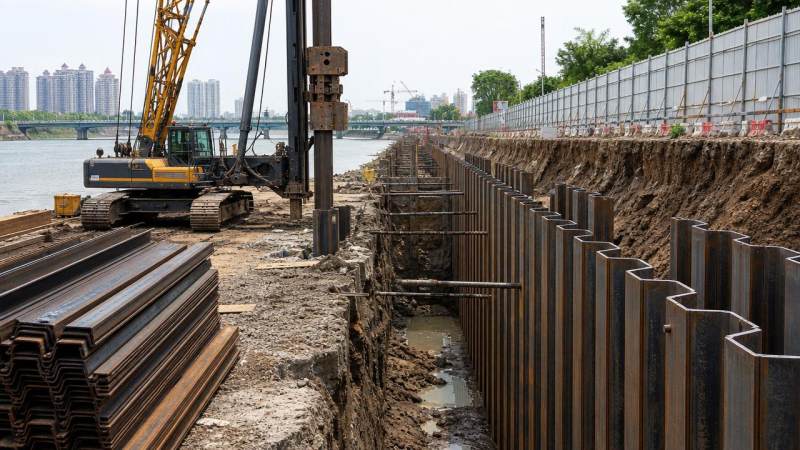
Steel sheet piles for retaining walls are interlocking steel sections driven into the ground to form a continuous barrier.
They resist soil pressure, groundwater pressure, and surcharge loads from nearby structures, equipment, or traffic.
The interlocks create a stable wall line, while the embedded depth provides passive resistance below excavation level.
Common profiles include U-type, Z-type, straight web, and combined systems with beams or pipe piles.
Steel sheet piles for retaining walls can be installed as cantilever walls, anchored walls, braced cofferdams, or tied-back systems.
The final design depends on retained height, soil type, groundwater level, corrosion allowance, and service life.
Compared with many concrete retaining systems, sheet piling often requires less excavation and less curing time.
This makes it useful where access, schedule, or site disruption must be tightly controlled.
When should steel sheet piles for retaining walls be considered?
Steel sheet piles for retaining walls are especially suitable when excavation support must be installed quickly.
They are also valuable where soil movement could affect adjacent roads, utilities, foundations, or waterfront structures.
Projects with limited working space often benefit from their slim wall section and vertical installation method.
For temporary works, sheet piles can often be extracted, reused, and redeployed on future projects.
For permanent works, coating, galvanizing, cathodic protection, or corrosion allowance can extend service performance.
- Deep basement excavations in urban areas.
- Riverbanks, quay walls, docks, and marine works.
- Road widening projects near existing slopes.
- Flood protection walls and embankment reinforcement.
- Temporary cofferdams for bridge or pipeline construction.
Steel sheet piles for retaining walls are often selected when both earth retention and water control are required.
Although interlocks are not always fully watertight, sealants can reduce seepage in sensitive applications.
How do soil and groundwater conditions affect the choice?
Soil conditions strongly influence whether steel sheet piles for retaining walls are technically and economically suitable.
They perform well in many sands, silts, clays, and mixed soils when driving resistance is manageable.
Dense gravel, boulders, or shallow rock can make installation difficult without pre-drilling or alternative methods.
Soft clay may require longer embedment, anchors, or internal bracing to control deformation.
High groundwater conditions often support the use of steel sheet piles for retaining walls.
The wall can limit lateral water inflow and improve excavation safety when combined with dewatering design.
However, hydrostatic pressure must be included in engineering calculations, especially for deep or sealed excavations.
A geotechnical investigation should confirm soil layers, groundwater level, driving conditions, and possible obstructions.
Without reliable ground data, retaining wall design can underestimate movement, embedment depth, or anchor demand.
How do steel sheet piles compare with concrete retaining walls?
Steel sheet piles for retaining walls and concrete walls solve similar problems, but their construction logic differs.
Concrete walls usually need excavation, formwork, reinforcement, pouring, curing, and often a wider construction footprint.
Sheet piles are installed first, then excavation proceeds with the wall already supporting the ground.
This sequencing can reduce temporary slope requirements and help protect nearby assets.
Concrete can still be preferred for architectural finishes, massive gravity walls, or low-corrosion environments.
Steel sheet piles for retaining walls are stronger choices when speed, depth, and constrained access matter more.
What design factors should be checked before selection?
Before choosing steel sheet piles for retaining walls, several engineering and procurement factors should be reviewed together.
The retained height determines bending moment, section modulus, anchor demand, and pile length.
Surcharge loads from cranes, trucks, buildings, stockpiles, or railways can significantly increase lateral pressure.
Vibration limits may influence whether impact driving, vibratory driving, pressing, or pre-augering is suitable.
Corrosion exposure must be considered in marine, industrial, acidic soil, or deicing salt environments.
For permanent steel sheet piles for retaining walls, designers often specify coatings or sacrificial steel thickness.
Material consistency also matters across connected steel elements, walers, tie rods, frames, and fabricated supports.
Hongteng Fengda supplies structural steel products and customized components for global construction and industrial projects.
For related steel fabrication needs, Hot Rolled Coil Hrc can support formed and fabricated steel applications.
Available carbon steel grades include Q195, Q345 series, Q420 series, A36-A992 series, S235JR-S355JR, SS400-SS540, and A500.
The coil range covers 0.17mm-3.5mm thickness and 600mm-1250mm width, with ASTM, JIS, EN, ISO, and CE standards.
This supports projects requiring stable supply, controlled tolerance, export experience, and coordinated structural steel sourcing.
What are common mistakes when using steel sheet piles?
A common mistake is treating steel sheet piles for retaining walls as a standard product only.
In practice, section choice must match soil behavior, wall height, installation method, and deformation limits.
Another mistake is ignoring nearby structures that may be sensitive to vibration or settlement.
Driving equipment should be selected after reviewing site restrictions, soil resistance, and noise requirements.
Some projects underestimate corrosion, especially in splash zones or polluted groundwater environments.
Others overlook interlock condition, alignment control, corner details, or connection design for walers and anchors.
- Do not select piles only by price per ton.
- Check total installed cost, including equipment and bracing.
- Confirm pile length, grade, profile, and interlock compatibility.
- Review extraction plans for temporary walls.
- Include monitoring for deep or sensitive excavations.
Steel sheet piles for retaining walls work best when design, supply, logistics, and installation planning are aligned early.
How can cost and schedule be evaluated?
Cost evaluation should include more than the purchase price of steel sheet piles for retaining walls.
Important items include mobilization, driving equipment, temporary bracing, anchors, coatings, cutting, splicing, and extraction.
For temporary applications, reuse value may reduce the effective project cost substantially.
For permanent applications, longer service life may justify higher steel grade, coating, or corrosion protection.
Schedule value can be equally important, especially where delayed excavation affects the entire construction sequence.
Steel sheet piles for retaining walls can shorten enabling works and allow faster progress below ground level.
Conclusion: when are they the right retaining wall choice?
Steel sheet piles for retaining walls are a strong option where speed, strength, and installation flexibility are priorities.
They are especially useful for deep excavations, waterfront works, constrained sites, temporary cofferdams, and groundwater-sensitive projects.
They should be selected through engineering review, not by section weight or material cost alone.
The best decision considers soil data, load conditions, corrosion exposure, driving method, schedule, and lifecycle value.
For dependable structural steel sourcing, Hongteng Fengda provides standard and customized steel products for international projects.
Share drawings, specifications, steel grades, quantities, and delivery requirements to start a practical retaining wall material review.
Please give us a message


Please enter what you want to find