Choosing the right wire rope strength is critical for safety, service life, and cost control. When comparing Galvanized Steel Wire Rope 1470Mpa to 1960Mpa, users and operators need to understand how tensile grade affects load capacity, flexibility, wear resistance, and application suitability. This guide explains when to use each option so you can match rope performance to real working conditions with greater confidence.
Why tensile grade matters in steel wire rope selection
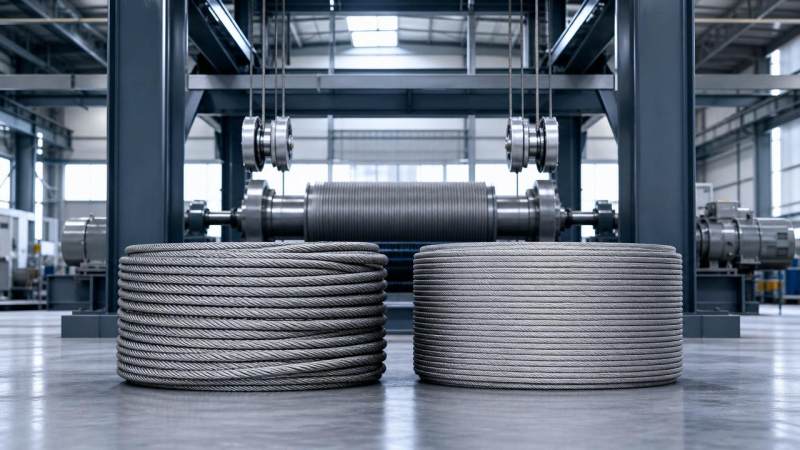
Tensile grade defines the strength level of the individual wires used in a rope. In practice, it influences breaking force, fatigue behavior, abrasion response, and bending performance.
The comparison of Galvanized Steel Wire Rope 1470Mpa to 1960Mpa is not only about higher strength. It is about choosing the right balance between load demand, pulley diameter, service environment, and replacement cycle.
A higher grade rope can carry more load at the same diameter. However, a lower grade may perform better where repeated bending, shock loading, or easier handling is more important.
Use this checklist before choosing 1470Mpa or 1960Mpa wire rope
Start with the application instead of the catalog. The following checklist helps narrow the correct choice between Galvanized Steel Wire Rope 1470Mpa to 1960Mpa.
- Check required working load and safety factor first. If the system needs higher breaking force without increasing rope diameter, 1960Mpa is often the more efficient option.
- Measure sheave and drum diameter carefully. Smaller bending radii create more fatigue stress, which can make 1470Mpa more suitable in frequent bending conditions.
- Review duty cycle and movement frequency. Lifting systems with constant cycling may favor better flexibility and fatigue tolerance over maximum static strength alone.
- Assess wear, corrosion, and surface exposure. Galvanizing protects both grades, but outdoor use, marine splash, and dirty environments still affect lifespan and inspection intervals.
- Confirm end terminations and hardware compatibility. Sockets, clips, wedges, and drums must match the rope grade and construction to avoid premature failure.
- Compare total operating cost, not only unit price. A stronger rope may reduce diameter or extend replacement time, but only if installation conditions support it.
- Inspect shock loading risk. Sudden starts, stops, and impact loads can reduce service life, especially when rope selection is based on static numbers alone.
When to use 1470Mpa wire rope
1470Mpa wire rope is commonly selected when flexibility and bending performance matter more than the highest possible tensile capacity. It is often easier to handle in systems with smaller sheaves.
For moderate loads, the extra strength of 1960Mpa may not deliver practical value. In those cases, 1470Mpa can provide dependable service with a balanced cost profile.
Typical situations for 1470Mpa
- Choose it for general hoisting or pulling where load levels remain moderate and rope diameter is not heavily restricted by compact equipment design.
- Use it where ropes pass over smaller sheaves often, because reduced wire hardness may support better fatigue performance in repeated bending cycles.
- Prefer it in applications with frequent manual handling, field replacement, or simpler maintenance routines where ease of installation is valuable.
Examples include light-duty lifting, utility rigging, agricultural systems, basic winch assemblies, and some marine support lines where the loading pattern is not extreme.
When to use 1960Mpa wire rope
1960Mpa wire rope is usually the better choice when the system needs maximum strength in a limited diameter. It supports higher breaking loads and can improve compact equipment design.
This makes Galvanized Steel Wire Rope 1470Mpa to 1960Mpa a key comparison for cranes, industrial lifting systems, and engineered assemblies where space, mass, or load rating is tightly controlled.
Typical situations for 1960Mpa
- Select it when higher load capacity is required but pulley size, drum width, or machine geometry prevents using a larger rope diameter.
- Use it in heavy-duty lifting or demanding structural support systems where a higher tensile class helps meet design limits efficiently.
- Apply it when dead weight reduction matters, because a smaller high-strength rope can sometimes replace a thicker lower-strength alternative.
Common examples include crane ropes, mine hoisting components, port handling systems, and specialized industrial equipment requiring high strength-to-diameter performance.
Application notes for steel structures and related systems
Wire rope selection often connects with broader steel engineering decisions. In lifting frames, gantries, bridges, and fabrication lines, rope grade must match the strength and geometry of surrounding steel parts.
For example, support members, guide beams, and machine structures should be designed as a complete system. In many projects, structural products such as H Shape Beam are used for steel structure, shipbuilding, bridging, and mechanical manufacture.
Such sections are available in grades including Q235, Q345B, S275JR, S355JR, A572, and A992, with flange thickness from 8-64mm and length from 1m-12m or as required.
When a rope system transfers high loads into a frame, matching rope performance with beam stiffness, connection design, and international standards such as ASTM or EN is essential.
Commonly ignored factors that change the right choice
Bending fatigue is often underestimated
A rope may have excellent breaking strength on paper but still fail early if it bends over undersized sheaves too often. This is a major reason not to choose by tensile grade alone.
Galvanizing does not remove inspection needs
Galvanized ropes resist corrosion better, but zinc coating cannot prevent damage from crushing, wire breaks, abrasion, or poor lubrication. Inspection frequency must still match duty severity.
Higher strength can increase sensitivity to mismatch
1960Mpa ropes may require closer attention to drum design, termination quality, and operating discipline. A stronger rope does not compensate for poor alignment or overloaded use.
Static load ratings do not tell the full story
Dynamic effects from acceleration, impact, and vibration can exceed nominal loads quickly. This matters in both 1470Mpa and 1960Mpa selection, especially in industrial lifting cycles.
Practical selection advice
- Define actual working load, shock conditions, and minimum safety factor before reviewing rope grades.
- Confirm rope construction, sheave diameter, drum capacity, and termination method together.
- Use 1470Mpa where flexibility, repeated bending, and moderate load demands dominate.
- Use 1960Mpa where high strength in limited diameter is the main design target.
- Request technical data covering breaking force, coating type, lubrication, and applicable standards.
- Plan inspection and replacement intervals based on wear pattern, not only service time.
Conclusion and next step
The real decision between Galvanized Steel Wire Rope 1470Mpa to 1960Mpa depends on application conditions, not simply on which grade is stronger. 1470Mpa is often better for flexibility and repeated bending, while 1960Mpa is preferred for higher load capacity within restricted diameter.
Review the full system, including load path, sheaves, terminations, environment, and supporting steel structure. A correct match improves safety, extends service life, and controls total project cost.
For engineered steel supply and project support, Hongteng Fengda provides structural steel products, standard specifications, and customized solutions aligned with ASTM, EN, JIS, and GB requirements.
Please give us a message


Please enter what you want to find