Use 1x19 stainless steel aircraft cable 5/32 inch when the railing needs a straight, firm line with minimal elongation under normal service load. This construction is suited to railing runs where the cable should stay visually clean, resist sag, and hold tension without becoming overly stiff to handle during installation. In practical railing work, the 1x19 pattern is chosen more often for terminal spans, level guardrails, and other straight runs than for places that require frequent bending around tight corners.
The strand construction matters. A 1x19 cable is built from one center wire with eighteen outer wires laid in a tight helix, so it behaves as a low-stretch wire rope with a smoother surface than more flexible constructions. That makes it easier to keep consistent alignment between posts, especially when the rail layout is long and uninterrupted. The 5/32 inch diameter is also large enough to provide a solid visual presence on many residential, commercial, and light industrial railing systems without looking oversized.
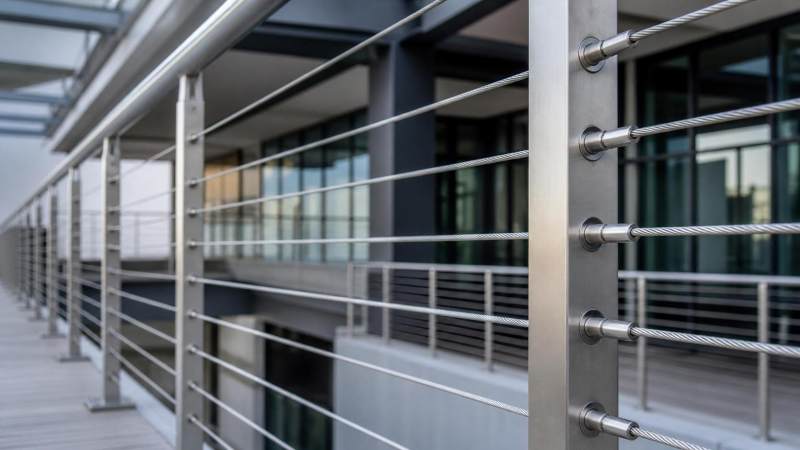
Material selection is where the cable either fits the job or creates maintenance issues later. Stainless steel is commonly preferred where moisture, outdoor exposure, or periodic cleaning are expected, because it handles corrosion resistance better than plain carbon steel. In coastal or de-icing salt environments, the exact grade and surface finish deserve more attention than the cable diameter alone. For a railing that faces weather and hand contact, the final finish should be smooth, uniform, and free from handling damage that can become a starting point for staining.
When the railing system is part of a broader steel package, related metal components should be matched with the same level of corrosion control. A galvanized base structure can reduce risk at the framing level, while the cable itself carries the appearance and tensioning load. In some projects, a component such as Steel Coil Galvanized is selected for supporting steel parts because zinc coating offers barrier protection and sacrificial protection to the underlying steel. That does not change the cable specification, but it affects how the full railing assembly behaves over time.
Use this cable type when the posts, terminals, and fittings are designed for tensioned wire railing rather than decorative infill. The anchor points must resist the force created by tightening, and the post spacing should be chosen with cable deflection in mind. Long unsupported spans, soft end posts, or weak fastening points will usually create more trouble than the cable itself. If the structure allows movement, a lower-stretch wire can expose that movement immediately, which is useful for diagnosis but unforgiving if the frame was not designed correctly.
Installation details often decide whether the system performs well. End fittings need to be compatible with 5/32 inch cable, and the termination method should match the project’s maintenance plan. Swage fittings, mechanical terminals, and threaded tensioners all behave differently during setup and retensioning. Over-tightening can distort the cable surface or overload the support posts, while under-tightening can leave visible sag that makes the railing look unfinished and may invite repeated adjustment. The right approach is usually to tension gradually, checking alignment as each cable is set.
For railing systems with bends, corners, or frequent changes in direction, 1x19 stainless steel aircraft cable 5/32 inch can still be used, but the layout should keep bending at the terminals rather than forcing the cable to wrap around tight radii. A 1x19 construction is not the best choice where flexibility is needed during routing. If the design includes compound angles, complex frames, or repeated movement, a more flexible rope construction may be better suited. Here, the point is to match the cable to the mechanical path, not to force one cable type into every railing pattern.
Loading expectations should also be kept realistic. Cable railings are affected by span length, post stiffness, terminal quality, and the local code basis for the project. The cable diameter alone does not define performance. A 5/32 inch cable may be acceptable in one configuration and unsuitable in another if the post system is undersized or the spacing is too wide. Before specifying, it is sensible to confirm the total system design rather than focusing only on the wire rope spec.
Processing and procurement should be straightforward but exact. Confirm the stainless grade, strand construction, diameter tolerance, and the finish condition before release. If the cable will be cut on site, the cut ends must be prepared carefully so the strand does not unravel or fray during installation. Coils and reels should be protected during transport so the wire does not pick up contamination from carbon steel dust, which can lead to surface staining later. For site storage, keeping the cable dry and separated from other ferrous materials is a practical step that avoids unnecessary rework.
Maintenance is simple when the system is set up correctly, but it should not be ignored. Cable railing lines can relax slightly after initial loading, so retensioning is often part of the normal commissioning routine. Periodic inspection should focus on terminal movement, hardware wear, visible surface marks, and any sign of galling at threaded fittings. If the railing is exposed to airborne chlorides or industrial contaminants, more frequent cleaning may be needed to preserve appearance and avoid pitting in vulnerable spots.
Common mistakes are usually predictable. One is choosing the cable for appearance without checking whether the support structure can carry the tension. Another is mixing incompatible metals at the terminals, which can create accelerated corrosion in wet service. A third is assuming all stainless cable behaves the same; strand construction changes stiffness, bend behavior, and installation effort. 1x19 stainless steel aircraft cable 5/32 inch is a good fit when the railing design needs a straight, disciplined run with limited stretch and a clean finish, but only when the hardware, posts, and maintenance plan are matched to that choice.
In practice, the best results come from treating the cable as one part of a coordinated assembly. The cable specification, anchoring method, support steel, and exposure conditions should be checked together before fabrication starts. That keeps the railing predictable during installation and more stable in service, which is exactly what a tensioned cable system is supposed to do.
Please give us a message


Please enter what you want to find