Selecting the right ss 304 pipe is not a routine specification decision when designing or maintaining high-pressure hydraulic systems—especially those operating above 250 bar, with pulsating loads, or in critical safety environments like mobile hydraulics, offshore equipment, or industrial test rigs. In these applications, pipe failure can trigger cascading downtime, fluid contamination, fire hazards, or injury. While welded SS 304 pipe meets basic corrosion resistance and dimensional requirements, its structural limitations become decisive under sustained pressure cycling and thermal stress. Seamless SS 304 pipe eliminates weld seams entirely—removing localized stress concentrations, microstructural inconsistencies, and potential initiation points for fatigue cracking. For project managers overseeing system integrity, procurement timelines, and long-term maintenance budgets, choosing seamless over welded is less about preference and more about predictable performance boundaries.
Why Welded SS 304 Pipe Falls Short Under High Pressure
Welded SS 304 pipe is formed by rolling a strip and joining the edges via TIG or laser welding. Even with modern automated processes, the weld zone introduces three inherent constraints:
- Non-uniform metallurgy: The heat-affected zone (HAZ) adjacent to the weld exhibits altered grain structure, reduced ductility, and lower local yield strength compared to the base metal—typically 10–15% lower than the parent material’s specified minimum yield strength (205 MPa).
- Residual stress concentration: Thermal contraction during welding creates tensile residual stresses along the seam line. These stresses combine with internal hydraulic pressure, accelerating crack nucleation—particularly at bends, fittings, or vibration-prone mounting points.
- Wall thickness variation: Rolled-and-welded tubes often show ±12–15% wall thickness deviation across the circumference, especially near the weld seam. This variability directly impacts burst pressure calculations and reduces margin of safety in ASME B31.4 or ISO 4397 compliance reviews.
These factors are rarely visible during visual inspection but manifest operationally: premature leakage at flange joints, inconsistent pressure hold during proof testing, or unexpected fatigue fractures after 5,000–8,000 cycles—not thousands of hours. If your system experiences frequent recalibration, unexplained flow instability, or recurring seal failures upstream of welded sections, the pipe itself may be the root cause—not installation or component selection.
Where Seamless SS 304 Pipe Delivers Measurable Advantage
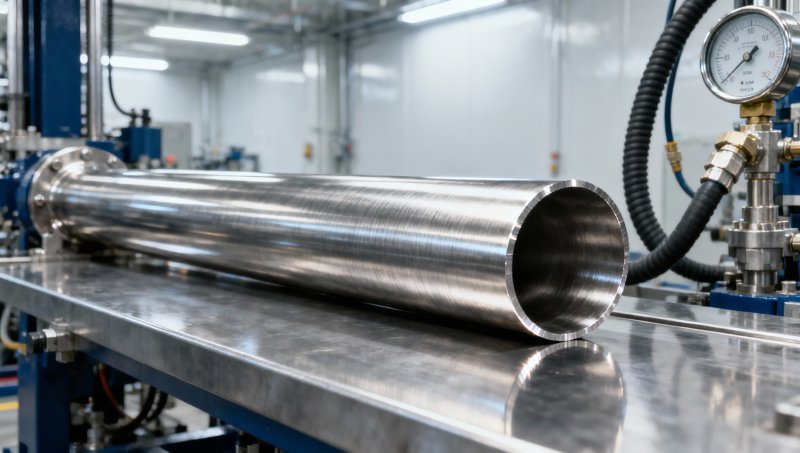
Seamless SS 304 pipe is extruded from solid billets, ensuring homogeneous microstructure, consistent wall thickness (±5% tolerance), and isotropic mechanical properties throughout the cross-section. Its performance edge becomes quantifiable under real-world conditions:
- Burst pressure reliability: At identical nominal diameter and wall thickness, seamless pipe achieves 1.3–1.5× higher actual burst pressure than welded equivalents due to absence of seam weakness. For example, a 25 mm OD × 3.0 mm wall seamless tube consistently withstands >620 bar in hydrostatic validation—where welded counterparts fail between 420–480 bar.
- Fatigue life extension: Under cyclic loading at 75% of rated working pressure, seamless SS 304 demonstrates ≥3× longer fatigue life before crack initiation, per ASTM E466 testing protocols. This translates directly into extended service intervals between inspections and reduced unplanned shutdowns.
- Thermal stability: With no HAZ, seamless pipe maintains uniform coefficient of thermal expansion (17.2 × 10⁻⁶/°C) across its entire circumference—critical for systems exposed to rapid temperature shifts (e.g., cold-start hydraulic circuits or outdoor machinery in desert climates).
Decision Criteria: When Seamless Is Non-Negotiable
Project managers should mandate seamless SS 304 pipe when any of the following apply:
- Working pressure exceeds 200 bar (or 80% of material’s minimum specified yield strength);
- System duty cycle includes >100 pressure cycles per hour;
- Pipe routing involves tight-radius bends (<5× OD) or dynamic flex zones;
- Fluid media contains abrasive particles (e.g., emulsified water-glycol blends) or operates at elevated temperatures (>80°C);
- Regulatory or client specifications require traceable mill test reports (MTRs) showing full-body ultrasonic testing (UT) and hydrostatic certification—standard for seamless but optional for welded grades.
Conversely, welded SS 304 pipe remains viable for low-pressure return lines (<35 bar), static reservoir feeders, or non-critical instrumentation tubing—provided wall thickness is increased by ≥20% to compensate for seam-related derating.
Material Selection Beyond the Seam: Matching Grade to Application Demands
While seamless construction addresses structural integrity, the base alloy must also meet environmental and mechanical demands. SS 304 offers broad corrosion resistance but has limitations in chloride-rich or reducing acid environments. For projects where cost sensitivity intersects with moderate corrosion exposure—such as food processing conveyors, agricultural irrigation manifolds, or transport vehicle hydraulic frames—202 Stainless Steel Coil provides a technically sound alternative. Its manganese-nickel austenitic structure delivers comparable ductility (≥55–60% elongation) and toughness across -40°C to +300°C, with improved oxidation resistance at elevated temperatures. Though not suitable for marine or chemical dosing applications, it performs reliably in high-temperature electrical enclosures, kitchen equipment housings, and conveyor belt components where chloride exposure is controlled and pressure remains below 150 bar.
Procurement Considerations for Global Projects
For project managers sourcing from China-based suppliers, verifying seamless origin is essential—not just mill certification. True seamless pipe carries distinct identifiers: absence of longitudinal seam marks under magnification, uniform surface finish (no weld bead or grinding痕迹), and consistent wall thickness measured at four quadrants using ultrasonic gauging. Hongteng Fengda supplies ASTM A312 and EN 10216-5 compliant seamless SS 304 pipe with full MTR documentation—including tensile test results, intergranular corrosion testing (ASTM A262 Practice E), and dimensional verification reports. Lead times remain stable at 6–8 weeks for standard sizes (OD 12.7–114.3 mm, wall 1.2–6.0 mm), with no premium for seamless grade versus welded equivalents in volume orders.
Maintenance & Inspection Implications
Adopting seamless SS 304 pipe reduces long-term inspection burden. Unlike welded pipe—which requires periodic dye-penetrant or phased-array UT scanning of every seam joint—seamless sections need only external visual checks and periodic wall-thickness monitoring at high-vibration points. This lowers third-party NDT costs and shortens scheduled maintenance windows. However, seamless does not eliminate the need for proper support spacing, bend radius compliance, or correct ferrule-type fitting selection—especially with high-frequency pulsation. Always validate fitting compatibility using manufacturer torque and pull-test data, not generic industry tables.
Please give us a message


Please enter what you want to find