Understanding when steel tube specifications require mill test reports (MTRs) — and when they don’t — is critical for procurement, quality assurance, and project compliance. Whether you’re sourcing steel tube for construction, evaluating H-beam steel price, or selecting a trusted steel tube manufacturer and supplier, MTRs directly impact safety, certification, and cost efficiency. As a leading structural steel manufacturer and exporter from China, Hongteng Fengda ensures full traceability for ASTM/EN/GB-compliant steel tubes, steel rods for construction, and custom profiles — helping engineers, buyers, and project managers make informed, risk-aware decisions without compromising on quality or lead time.
When Do Steel Tube Specifications Mandate Mill Test Reports?
Mill test reports are not universally required — their necessity hinges on application criticality, regulatory jurisdiction, and contractual obligations. For structural applications governed by ASME BPVC Section II, ASTM A53/A106, or EN 10216-2, MTRs are mandatory for pressure-containing or load-bearing components. In contrast, non-structural scaffolding tubes or temporary bracing used in low-risk civil works may only require basic dimensional verification and visual inspection.
Key triggers for MTR requirement include: (1) design temperature below –29°C or above 371°C; (2) maximum allowable working pressure ≥ 10 bar; (3) inclusion in ASME Section I, III, or VIII systems; (4) submission to third-party inspectors (e.g., TÜV, BV, SGS); and (5) compliance with project-specific QA/QC plans requiring full material traceability back to heat number and ladle analysis.
For global buyers, especially those in North America and the EU, MTRs serve as legal evidence of conformity. Under ASTM A106 Gr B specification, each heat lot must be accompanied by a certified MTR listing tensile strength (≥ 415 MPa), yield strength (≥ 240 MPa), elongation (≥ 20% in 2 in), and chemical composition — all verified per ASTM E59 and ASTM E354 testing protocols.
When Can You Skip the MTR — Without Compromising Safety?
MTRs can be waived for non-critical applications where mechanical performance tolerances align with standard grade expectations and no regulatory body mandates traceability. Examples include decorative handrails, non-load-bearing conduit supports, and interior framing in commercial buildings meeting local building code exemptions.
However, “skipping” MTRs does not mean skipping verification. At Hongteng Fengda, even non-MTR orders undergo standardized factory acceptance tests: water pressure test at 1.5× design pressure (held for ≥ 5 seconds), dimensional tolerance checks (±0.5 mm OD, ±0.05 mm wall thickness), and surface finish inspection per ASTM A530. This ensures consistent baseline quality across all deliveries — whether MTR-required or not.
A common misconception is that “no MTR = lower cost.” In reality, eliminating MTRs rarely reduces unit price by more than 1–2%, but it increases downstream risk: rework due to undocumented chemistry mismatches, rejection during site inspection, or delayed commissioning. For projects with tight timelines (e.g., ≤ 8-week delivery windows), pre-certified stock with ready MTRs often accelerates approval by 7–15 days.
MTR Requirements by Application & Standard
This table reflects real-world procurement logic — not just code minimums. For instance, many Middle Eastern infrastructure projects require MTRs for *all* structural steel, even when EN 10219 permits waiver. That’s why Hongteng Fengda maintains dual-track documentation: full ASTM/EN-compliant MTRs for regulated markets, and streamlined factory test reports (FTRs) for cost-sensitive, low-risk applications — both issued within 48 hours of shipment.
How Hongteng Fengda Streamlines MTR Compliance for Global Buyers
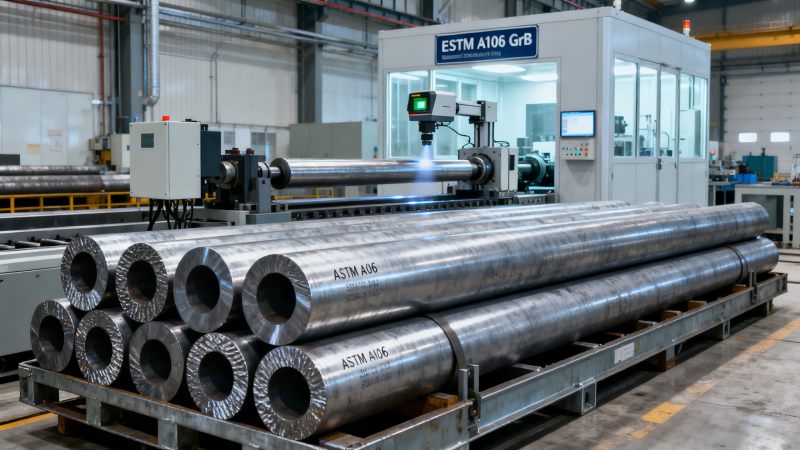
As a structural steel manufacturer and exporter from China, we embed MTR readiness into our production workflow — not as an afterthought. Every heat of a106 gr b Seamless Pipe is tracked from raw material receipt through hot rolling, heat treatment (normalizing at 890–920°C), NDT, and final hydrostatic testing. Our digital QA system logs every parameter: outer diameter (10–3048 mm), wall thickness (0.5–75 mm), length (1–12 m), and tolerance bands (±0.5 mm OD, ±0.05 mm thickness).
We support multi-standard compliance: ASTM A213, EN10216, JIS G3459, and GB13296 — enabling seamless cross-border supply. For buyers sourcing from multiple regions, this eliminates requalification delays. Typical MTR turnaround is 3–5 business days post-inspection, with electronic copies issued in PDF/A format and hard copies shipped with goods.
Our value-add goes beyond documentation: we offer pre-shipment MTR review with your QA team, coordinate third-party witness testing (SGS/BV), and maintain archived records for ≥ 10 years — exceeding ISO 9001:2015 retention requirements. This level of traceability helps procurement teams justify budget allocation to finance stakeholders and accelerates audit readiness for EPC contractors.
Why Partner With Hongteng Fengda for MTR-Ready Steel Tubes?
You need certainty — not paperwork theater. Hongteng Fengda delivers MTRs that hold up under technical scrutiny *and* align with your project timeline. We’ve supported over 120+ international projects across 23 countries since 2018, maintaining 99.4% on-time MTR issuance rate and zero client-reported MTR-related rejections.
Whether you’re evaluating a106 gr b Seamless Pipe for a petrochemical plant in Saudi Arabia, specifying cold-formed steel profiles for a high-rise in Germany, or comparing H-beam steel price versus carbon steel alternatives in Southeast Asia — our engineering team provides free technical consultation on MTR scope, test frequency, and documentation formatting per your local authority requirements.
Contact us today to: (1) confirm MTR content for your next order; (2) request sample MTRs aligned with ASTM/EN/GB standards; (3) discuss accelerated certification for urgent tenders; or (4) schedule a virtual factory audit covering traceability systems and lab accreditation (CNAS ISO/IEC 17025).
Please give us a message


Please enter what you want to find