When seamless carbon steel pipe API 5L Grade B is required
When seamless carbon steel pipe API 5L Grade B is required, the discussion usually starts with pressure service, but it should not end there. In practice, the real issue for inspection and safety teams is whether the pipe will perform consistently once it is installed, welded, tested, and exposed to the operating environment. A pipe that meets the grade on paper but arrives with poor dimensional control, unclear traceability, or incomplete test records can still create avoidable risk.
API 5L Grade B remains one of the most commonly referenced material grades for line pipe because it sits in a useful middle ground: broadly available, familiar to fabricators, and suitable for many oil, gas, water, and general industrial transmission applications. The seamless version is typically specified where service conditions, design philosophy, or client standards place more weight on wall uniformity, pressure integrity, or resistance to seam-related concerns.
That does not mean seamless is always the better choice. It means seamless carbon steel pipe API 5L grade B is required when the project specification, operating pressure, fabrication approach, or risk assessment makes the absence of a weld seam materially relevant.
Where Grade B seamless pipe usually makes sense
The first trigger is specification control. Many EPC documents, owner standards, and piping classes already define API 5L PSL level, end preparation, testing scope, and whether seamless or welded pipe is acceptable. For quality personnel, this seems obvious, yet substitution requests are still a common source of trouble. If the data sheet calls for seamless, the reason may be tied to design assumptions elsewhere in the project, including corrosion allowance, NDT approach, or welding procedure qualification. Changing the manufacturing route is rarely just a purchasing decision.
The second trigger is service severity. In higher-pressure systems, critical utility lines, and some hydrocarbon services, buyers may prefer seamless pipe to reduce concern about longitudinal weld quality. This is not a blanket rule, because modern welded pipe can also perform well when correctly produced and tested, but seamless is often chosen when the margin for uncertainty is small.
The third is downstream fabrication. Some projects involve significant cold bending, repeated fit-up work, or field conditions where installers want predictable wall behavior around the full circumference. In those situations, dimensional consistency matters as much as nominal grade.
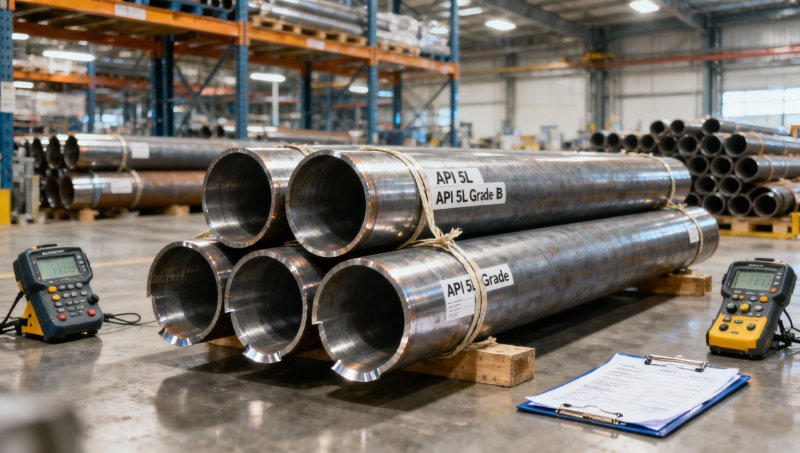
A fourth case appears in markets where approval routines are conservative. Safety managers in regulated sectors often work with internal checklists that favor materials with simpler review paths. If seamless API 5L Grade B has already been accepted by the owner, inspector, or third-party verifier on similar lines, keeping the same route can reduce approval delays.
What API 5L Grade B tells you, and what it does not
One recurring mistake in procurement is treating “API 5L Grade B” as if it were a complete technical description. It is not. The grade identifies a level of mechanical and chemical requirement within the API 5L framework, but it does not by itself settle every question that matters to inspection teams.
You still need to confirm at least four things:
- Whether the order is to PSL1 or PSL2
- Required dimensions, wall thickness, and tolerances
- End condition, length range, and coating or bare supply
- Inspection, testing, and documentation requirements
PSL level matters because it affects chemistry limits, testing scope, and documentation expectations. If a project requires tighter quality assurance, assuming PSL1 is acceptable can create nonconformities later. This point often surfaces only after the material test certificate is reviewed, which is much too late if the pipe is already in transit or on site.
Another gap is dimensional interpretation. Buyers may focus on outside diameter and forget that wall tolerance has direct implications for pressure containment and for minimum remaining thickness after threading, beveling, or corrosion allowance. A clean MTC cannot compensate for a pipe body that falls short in actual wall measurement.
What quality control should verify before release
Before shipment approval, inspection should look beyond grade marking. Heat number traceability is basic, but not enough. The more useful review combines documents, visual examination, dimensional checks, and consistency across the lot.
For seamless carbon steel pipe API 5L grade B, the practical checkpoints usually include outside diameter, wall thickness, straightness, end squareness or bevel condition, surface imperfections, marking clarity, and the match between the physical pipe and the certificate. If supplementary NDT or hydrostatic testing is required by order, that record should be reviewed in the same package, not as an afterthought.
Lot consistency also deserves attention. Even when individual pieces appear acceptable, mixed heats, mixed manufacturing dates, or variable finish quality can indicate weak process control. For safety managers, this is often an early warning sign. Material problems in the field rarely begin as dramatic failures; they begin as small deviations no one wanted to stop the shipment for.
This is one reason many international buyers prefer working with manufacturers or exporters who already operate under multiple standard systems and are used to cross-market documentation. Companies such as Hongteng Fengda, which supply structural steel products to North America, Europe, the Middle East, and Southeast Asia, tend to understand that the technical order is only part of delivery. The other part is making sure ASTM, EN, JIS, or GB references in the wider project package do not conflict with the line item being shipped.
In mixed-material projects, that coordination matters more than many teams expect. A pipe package may sit beside structural members, cold formed sections, and fabricated components sourced from the same export channel. Mid-project, a buyer may also need corrosion-resistant sheet or plate for enclosures, guards, chemical-contact parts, or fabricated accessories. In those cases, materials such as 304L Stainless Steel Plate are selected for very different reasons than API 5L pipe: corrosion resistance, formability, and weldability. The 304L grade is commonly used in chemical, food, medical, transport, and equipment applications, with typical properties such as tensile strength ≥ 520, yield strength ≥ 275, elongation around 55-60, and hardness up to 183HB or 100HRB. The point is not to substitute one for the other, but to keep material selection tied to actual service conditions rather than broad assumptions about “steel.”
Common procurement risks that show up too late
A frequent issue is incomplete ordering language. Purchase orders that simply say “API 5L Gr.B seamless” leave too much open. If no PSL level, length tolerance, testing requirement, or documentation list is stated, the supplier may deliver to a basic interpretation that does not match project expectations.
Another issue is confusing line pipe with other carbon steel pipe standards that may look similar in basic mechanical terms but are intended for different service frameworks. Cross-referencing can be possible in some projects, but it should never be assumed without technical review.
There is also the problem of over-relying on mill certificates without checking physical conformity. Certificates are essential, yet they do not replace incoming inspection. Surface laps, eccentricity, end damage from handling, or poor stenciling can all complicate field installation and traceability.
For imported material, packaging and lead-time discipline are part of quality risk too. Pipe that arrives with damaged end protection, illegible marks, or mixed bundles can cause quarantine on site. Exporters with stable production planning and strict quality control can reduce this risk, especially where the buyer is managing multiple steel categories in one project schedule.
A practical review table before procurement
The decision is rarely just about price
When seamless carbon steel pipe API 5L grade B is required, the cost question should be framed correctly. The cheaper offer is not necessarily lower cost if it introduces uncertainty around acceptance, reinspection, schedule slippage, or field rework. Safety and quality teams usually see this earlier than procurement does, because they are the ones asked to clear exceptions after the order has already moved.
A better approach is to define the technical basis at the start: exact standard level, dimensions, test scope, document package, and any market-specific compliance requirement. Then evaluate whether the supplier can deliver that package consistently, not just whether they can quote the grade name.
For projects sourcing from China or through multi-product steel exporters, that capability often comes down to production control, export documentation discipline, and familiarity with international standards rather than simple manufacturing capacity. If those elements are clear, procurement becomes easier and inspection becomes less defensive.
If your team is reviewing a new order, the useful next step is not to ask only whether API 5L Grade B is available. Ask whether the offered pipe matches the service conditions, the project specification, the required inspection route, and the way the material will actually be handled on site. That is usually where the real decision sits.
Please give us a message


Please enter what you want to find