Choosing between I section steel and H section steel is not only a matter of shape, but also of load direction, span length, weight efficiency, fabrication requirements, and project cost.
For technical evaluation, I section steel can be better where bending in one primary direction, lighter self-weight, and economical material use matter most.
This article explains when I section steel offers advantages, how it compares with H section steel, and what should be checked before specification.
What is I section steel, and why does its shape matter?
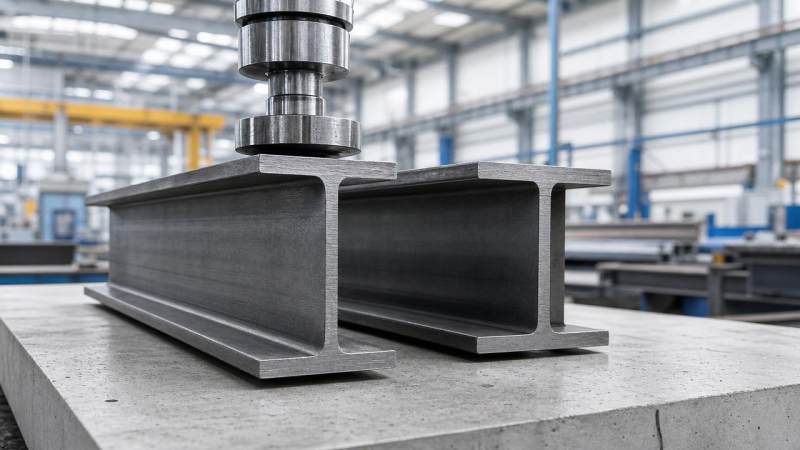
I section steel is a structural steel profile with flanges connected by a central web.
Its cross-section looks like the letter “I”, with material concentrated away from the neutral axis.
This geometry improves bending resistance around the strong axis while keeping the section relatively efficient in weight.
In many beam applications, vertical loads dominate.
When loading is mainly downward, I section steel can provide practical strength without unnecessary steel volume.
H section steel has wider flanges and usually stronger performance in multiple directions.
That advantage is important for columns, heavy frames, and complex load paths.
However, when the design requirement is simpler, I section steel may be more economical and easier to handle.
Key structural meaning
- Strong bending capacity in one main direction.
- Efficient material distribution for beam action.
- Lower self-weight in suitable spans.
- Good suitability for roof beams, floor beams, and secondary structures.
When is I section steel better for load direction?
I section steel is often better when the load acts mainly in one vertical plane.
Typical examples include simply supported beams, purlin-supporting members, mezzanine beams, and crane runway secondary supports.
In these cases, the main design concern is bending around the strong axis.
The web resists shear, while the flanges resist compression and tension from bending.
Compared with H section steel, I section steel may achieve the required bending performance with less steel weight.
This advantage becomes clearer where lateral loads, torsion, and biaxial bending are limited.
If the beam is well restrained against lateral-torsional buckling, I section steel can perform very effectively.
Restraint may come from floor decking, bracing, purlins, or connected secondary members.
Best-fit loading conditions
- Vertical gravity loads are dominant.
- The beam has clear strong-axis bending demand.
- Sideways instability is controlled by bracing.
- Torsional loading is not a primary design factor.
Is I section steel better for reducing weight and cost?
I section steel can be better when a project needs a balance between strength, weight, and purchase cost.
Because its shape is optimized for one-directional bending, it avoids some extra flange mass found in heavier profiles.
Lower weight can reduce transportation cost, lifting demand, and erection difficulty.
It may also reduce load transferred to columns, foundations, or supporting structures.
However, lower cost should not be judged only by price per ton.
The correct comparison includes total installed cost, connection work, coatings, delivery time, and project risk.
Hongteng Fengda supplies structural steel profiles for international projects under ASTM, EN, JIS, and GB requirements.
Stable manufacturing control helps keep I section steel dimensions, mechanical properties, and delivery schedules consistent.
Cost-related advantages
- Lower self-weight in suitable beam designs.
- Efficient use of steel for strong-axis bending.
- Easier handling for some light and medium structures.
- Potential savings in transport and installation.
For related site materials, Galvanized Steel Wire can support construction, packaging, wire mesh, barriers, decoration, and industrial uses.
It uses low carbon steel such as Q195 and Q235, with diameters from 0.25 mm to 5.0 mm.
Its zinc coating, flexibility, ductility, and corrosion resistance make it useful beside structural steel supply programs.
When should H section steel still be preferred?
H section steel is often preferred when loads act in more than one direction.
It is also stronger for many column applications because its wider flanges improve stability.
If a member must resist axial compression, lateral load, and bending together, H section steel may be safer.
This is common in high-rise frames, industrial buildings, portal frames, and seismic structures.
H section steel also performs well where connection plates, stiffeners, and large bolted joints are required.
Its wider flange surface can simplify certain connection layouts.
The decision should follow structural calculation, code requirements, and fabrication feasibility.
Choosing I section steel only because it is lighter may create hidden risks.
Use H section steel when:
- The member works mainly as a column.
- Biaxial bending is significant.
- Lateral load resistance is critical.
- Large moment connections are required.
- Frame stability depends on member stiffness.
How can I section steel and H section steel be compared correctly?
A reliable comparison starts with design function, not appearance.
The same nominal height does not mean the same capacity, stiffness, or buckling behavior.
I section steel should be checked for bending moment, shear force, deflection, and lateral-torsional buckling.
H section steel should be checked for combined loading, axial compression, connection design, and frame action.
Material grade also matters.
Yield strength, tensile strength, elongation, and impact requirements influence the final selection.
Standards such as ASTM, EN, JIS, and GB may define different tolerances and mechanical requirements.
Surface treatment should also be reviewed, especially for outdoor or humid environments.
What mistakes should be avoided when choosing I section steel?
One common mistake is using I section steel without checking lateral restraint.
A beam may have enough bending strength but still fail due to lateral-torsional buckling.
Another mistake is comparing only section height.
Flange width, web thickness, moment of inertia, and section modulus are more important.
Corrosion protection is also sometimes underestimated.
If the environment is aggressive, coating selection can affect service life and maintenance cost.
Fabrication tolerances should be checked before cutting, drilling, welding, or assembling members.
Clear drawings and confirmed standards reduce rework during installation.
Practical risk checklist
- Confirm load combinations before section selection.
- Check deflection limits, not only strength.
- Review bracing spacing and lateral restraint.
- Match the steel grade with project standards.
- Verify coating, packaging, and export documentation.
FAQ: quick answers about I section steel selection
Conclusion: when is I section steel the better choice?
I section steel is better when a structural member works mainly as a beam under vertical loading.
It is especially valuable where weight efficiency, economical material use, and straightforward fabrication are important.
H section steel remains preferable for columns, complex frames, heavy connections, and multi-directional loading.
The best choice should be based on calculations, standards, connection details, and real project conditions.
Hongteng Fengda provides structural steel products and customized solutions for construction, industrial, and manufacturing projects worldwide.
For a reliable selection, prepare drawings, load data, grade requirements, and delivery needs before confirming I section steel specifications.
Please give us a message


Please enter what you want to find