In long-span framing, the real question is rarely whether steel is strong enough. It usually is. The harder question is which section gives the project the best balance of span, stiffness, fabrication efficiency, shipping, erection, and long-term cost. That is where h beams often become the better choice.
For engineers and buyers, the appeal is not just capacity. It is predictability. A well-selected h beam can carry heavy loads across a wide span with less material waste than a makeshift solution built from smaller members and extra reinforcement. In many projects, that translates into cleaner detailing, fewer connection problems, and fewer surprises on site.
Why long-span framing changes the selection logic
Short spans allow more flexibility. Long spans do not. As span length increases, deflection control, torsional stability, and connection behavior start to matter as much as nominal strength. A section that looks economical on paper can become expensive once additional bracing, deeper framing, or heavier end connections are added.
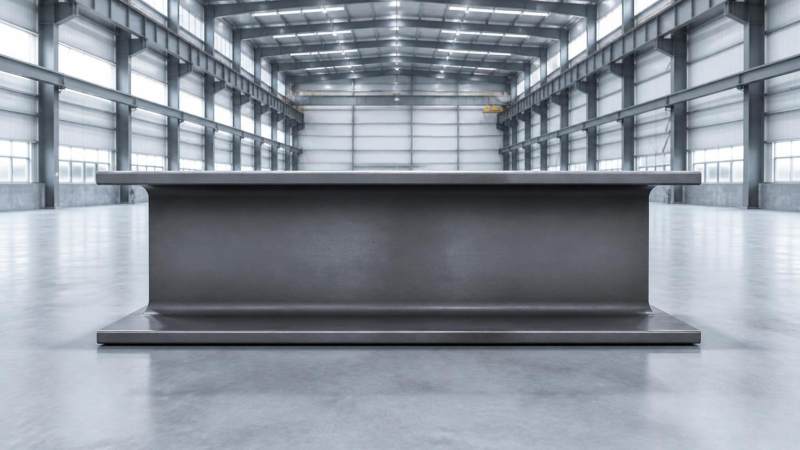
That is one reason h beams are frequently considered early in the design process for warehouses, industrial floors, platform structures, plant buildings, and other frames where open space matters. Their geometry is efficient for resisting bending in the strong axis, which is exactly what long-span members are asked to do most of the time.
Where h beams tend to outperform alternatives
The advantage is not universal. It appears when the project needs a member that is efficient under bending and can be integrated into a straightforward structural layout. In practice, h beams are often the better choice when:
- the span is long enough that deflection becomes a governing issue;
- the structure needs fewer intermediate supports;
- the frame benefits from wide flange geometry for easier connection design;
- fabrication time matters and the project favors standard, repeatable section behavior;
- the buyer wants to reduce steel consumption without undercutting stiffness.
This is especially relevant in industrial and building material projects where the framing has to do more than simply “hold up.” It must also coordinate with roof systems, equipment loads, service routes, and erection tolerances. A member that is efficient in theory but awkward in fabrication often loses its cost advantage quickly.
What buyers should check before choosing
A common mistake is to compare only section weight or only nominal depth. For long-span framing, the better approach is to test the section against the actual project conditions.
The practical takeaway is simple: the right choice is the section that works across the whole chain, not just in the calculation sheet.
The cost story is usually more complex than tonnage
Buyers sometimes focus on the lowest unit price per ton. That can be misleading in long-span framing. A cheaper member may require extra secondary steel, more labor, longer welding time, or more complicated transportation. Once those factors are included, the initial savings can disappear.
h beams can be advantageous because they often reduce the number of separate components needed to reach the same structural performance. That said, the economic result depends on engineering discipline and sourcing quality. Poor dimensional consistency, weak traceability, or inconsistent mill output can wipe out the benefits very quickly.
Quality and sourcing risk are part of the decision
For international buyers, the section itself is only part of the risk. The other part is whether the supplier can deliver consistent material, reliable lead times, and documentation that matches the project specification. This matters more on exported structural steel than on routine local procurement.
At this stage, it is also useful to distinguish long-span framing from reinforcement or general-purpose bar supply. A project may use structural members for the main frame and items such as Rebar in concrete works or related building elements, but the decision logic is different. The point is not to mix product categories; it is to make sure each one is being sourced for the role it actually plays.
For structural members, buyers usually want three things from a supplier: repeatable production, enough technical control to meet the specified grade, and the ability to support custom requirements without turning every order into a special case. That is where a manufacturer with export experience and multiple compliance references can reduce friction, especially on multi-country projects.
When h beams are the better choice
There is no universal rule, but there is a reliable pattern. h beams are a strong option when the project needs long clear spans, stable load distribution, and a framing solution that can be fabricated and erected without unnecessary complexity. They are especially relevant when the cost of extra supports, extra steel, or extra labor would outweigh the benefit of a simpler section.
They are less attractive when the loads are light, the span is modest, or the project is dominated by special connection geometry that does not suit a standard rolled or fabricated section. In those cases, forcing an h beam into the design can create avoidable cost without delivering real value.
For engineers, that means the section should be selected as part of the full structural system. For buyers, it means asking whether the quoted member fits the span, the load path, the compliance target, and the delivery schedule. If the answer is clear, the procurement decision becomes much easier.
That is the practical value of h beams in long-span framing: not that they solve every problem, but that they often solve the right one with fewer compromises.
Please give us a message


Please enter what you want to find