When does A572 structural steel channel need welding preheat?
Does every A572 structural steel channel need preheat before welding? Not necessarily—but skipping required preheat can increase the risk of hydrogen cracking, especially in thick or highly restrained joints. For welders and fabrication crews, the decision depends on the steel grade, material thickness, joint restraint, hydrogen control, and the applicable welding procedure specification (WPS). Start with the approved WPS and material certificates rather than assuming one preheat temperature fits every channel.
The practical distinction is between no additional heating being necessary and no minimum temperature requirement existing. A channel already warm enough for the approved procedure may not need a torch or electric heater. The same joint on a cold morning may need heating before the first tack weld.
The grade designation is only the starting point
ASTM A572/A572M covers high-strength, low-alloy structural steel in several grades. “A572” alone therefore does not identify everything needed to select welding conditions. Confirm the actual grade, product form, heat number, and chemical composition against the mill test report. A drawing calling for Grade 50 should not be treated as permission to weld any channel marked simply “A572.”
For projects governed by AWS D1.1/D1.1M, the applicable edition provides requirements for prequalified procedures, including base-metal eligibility and minimum preheat and interpass temperatures. Those requirements depend on the material classification, welding process, and thickness category. A qualified WPS may establish conditions through procedure qualification instead. Contract specifications can add requirements beyond the code minimum.
Do not borrow a temperature from an online chart without confirming its edition, material grouping, thickness definition, and notes. If the channel grade or process is outside the procedure’s permitted scope, the answer is not to choose a higher temperature by guesswork. Stop and obtain welding-engineering review.
What makes a channel weld vulnerable to cracking?
Hydrogen-assisted cold cracking develops when diffusible hydrogen, a susceptible microstructure, and tensile stress occur together. Rapid cooling can create a harder heat-affected zone, while weld shrinkage supplies stress. Moisture in consumables, contaminated surfaces, or unsuitable handling can introduce hydrogen. Cracking may appear after the weld has cooled rather than while the arc is running.
Preheat slows cooling and gives hydrogen more opportunity to diffuse away from the weld region. It does not compensate for wet electrodes, poor joint preparation, or an unsuitable welding procedure. A hot but contaminated joint is still a poor starting point.
Channel geometry adds a practical complication. The web and flanges may have different thicknesses, and a flange-to-end-plate connection can lose heat differently from a small web attachment. The section designation or overall channel depth is not the welding thickness. Check the actual material at the joint and apply the thickness rule specified by the governing procedure or code.
Conditions that deserve closer review
- Thick connected parts: a substantial end plate or support member can draw heat away even when the channel web is relatively thin.
- High restraint: welded frames, closure joints, and tightly constrained repairs limit movement during weld contraction.
- Cold steel: outdoor storage and cold supports can keep the joint below the WPS minimum despite comfortable air temperatures.
- Uncertain chemistry: missing heat traceability prevents a reliable assessment of material weldability.
- Hydrogen-control problems: questionable electrode exposure, damp flux, or surface moisture require correction, not simply more heat.
These conditions do not each prescribe a universal temperature. They identify situations where the existing WPS must be checked carefully and, if necessary, reviewed by the responsible welding engineer.
Make the decision before fit-up becomes permanent
A useful shop-floor decision begins with four documents: the fabrication drawing, material certificate, approved WPS, and project welding specification. Together, they should identify the joint, both base metals, process, filler metal, minimum preheat, interpass limits, and any special restrictions. Missing information should be resolved before production welding starts.
Where chemical composition needs further evaluation, a welding engineer may use a carbon-equivalent method to assess hardenability. Different methods serve different materials and procedures; a carbon-equivalent result is not, by itself, a shop-floor preheat instruction. Weld heat input, hydrogen level, thickness, and restraint still matter.
Consider a channel welded to a heavy end plate. Looking only at the channel web can underestimate the thermal demands of the connection. Likewise, a short weld is not automatically low risk: a small deposit can cool quickly, and a restrained tack may experience substantial shrinkage stress. Check the applicable requirements for tack welding as well as final welding.
If the WPS specifies a minimum temperature and the entire required measurement region already meets it, additional heating may be unnecessary. If the steel is below that minimum, preheat is required. Higher-restraint or otherwise unusual work may need a revised procedure, but operators should not independently change its temperature limits or welding parameters.
Heat the joint region—not just the thermometer spot
An approved temperature on one small surface patch does not prove that the joint is ready. Preheat must cover the region required by the WPS and governing code, with enough time for heat to distribute through the relevant thickness. The channel’s internal corners and flange-to-web transitions can make access and uniform heating difficult.
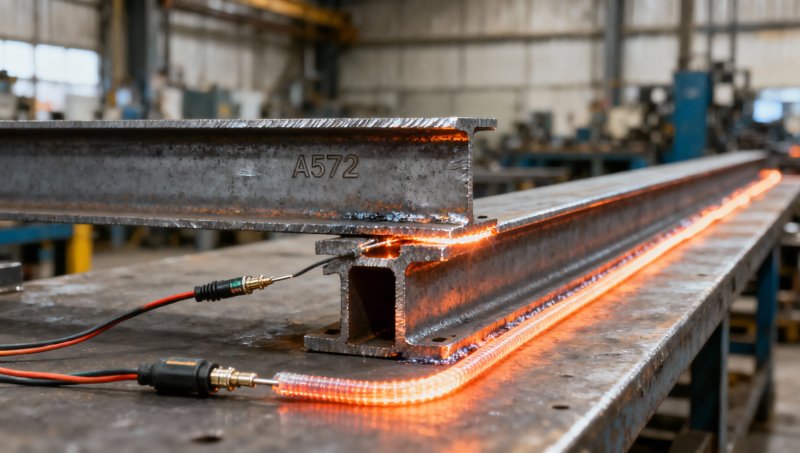
Use a heating method suited to the connection. Controlled flame heating can be practical for accessible work; electric resistance or induction heating may suit joints needing more consistent control. Whatever the method, avoid concentrated overheating and account for thin attachments that heat faster than the main member.
Temperature-indicating crayons, suitable contact thermometers, or thermocouples can verify conditions. Follow the procedure’s requirements for measurement location and timing. Where accessible and required, checking the opposite surface helps establish that heat has penetrated rather than merely warmed the torch side.
Infrared thermometers require care on shiny steel because surface emissivity affects the reading. Do not rely on an unverified infrared setting as the sole acceptance check. Remove the heat source as required for measurement and allow the reading to stabilize according to the approved inspection method.
Keep temperature control going between passes
Preheat is not a one-time box to tick. A channel can cool during fit-up adjustments, grinding, a consumable change, or a shift break. Recheck before restarting whenever the required region may have dropped below the minimum. Do not assume that warmth elsewhere on the assembly proves the weld location is ready.
Interpass control also includes any maximum specified by the WPS. More heat is not automatically safer: excessive accumulation can affect weld properties and increase distortion. Keep current, voltage, travel speed, and bead placement within the approved limits rather than using a hotter weld to substitute for preheat.
Maintain low-hydrogen consumables according to the manufacturer’s instructions and project requirements. Electrode storage and exposure limits still apply during a long preheat operation. Clean moisture, oil, and unsuitable coatings from the joint; plan coating removal with appropriate controls for fumes and residues.
After welding, avoid forced cooling unless expressly permitted. Any specified postheat or controlled cooling must follow the approved procedure. Postheat for hydrogen control and post-weld heat treatment are different operations; neither should be improvised as a remedy for inadequate preheat.
Mixed-material assemblies need a separate check
Equipment platforms often combine A572 channels with patterned floor plate. For example, A36 Patterned steel plate is offered in a 2–8 mm thickness range for applications including equipment-area flooring and construction. That thinner plate does not determine the welding requirements for the entire connection. Confirm the actual plate grade and channel grade, then use a WPS covering that combination.
Thin flooring also changes the fabrication problem: heating and welding must control distortion without leaving the channel-side joint below its required temperature. Patterned surfaces can complicate fit-up and temperature-probe contact. Similar commercial grade names or comparable strength levels do not establish automatic interchangeability between ASTM, EN, JIS, and GB materials.
Material traceability makes the welding decision easier
For internationally sourced structural steel, preserve heat identification through cutting and fabrication. A certificate disconnected from the physical channel cannot reliably support a material-specific WPS decision. Purchasing documents should state the exact grade, applicable standard, required certificates, and any project-specific welding restrictions rather than simply requesting “structural channel.”
Hongteng Fengda manufactures and exports channels, angles, beams, cold-formed profiles, and customized structural components from China. For a welding-sensitive order, the useful coordination is between the supplied material specification and the fabricator’s approved procedure. Confirming certificate requirements, identification arrangements, and connected-part details before shipment helps avoid unanswered questions at the welding station.
Before striking an arc on an A572 structural steel channel, be able to identify the WPS, both materials, the governing thickness, and the required temperature limits. Verify the temperature where the procedure requires it, not wherever measurement is easiest. If any of those points is unresolved, hold the weld and obtain clarification. That is a more reliable decision than applying a familiar preheat temperature to an unfamiliar joint.
Please give us a message


Please enter what you want to find