For technical evaluators comparing material options, a36 steel pipe makes sense when moderate load support, weldability, and cost control matter more than high-strength alloy performance.
In many structural and industrial applications, it offers a practical balance of availability, fabrication ease, and compliance with common standards.
That balance helps projects achieve efficient sourcing, predictable performance, and simpler processing without unnecessary material upgrades.
For steel structures, support frames, and utility assemblies, a36 steel pipe is often selected because the real requirement is stable service, not extreme strength.
When load support conditions favor a36 steel pipe
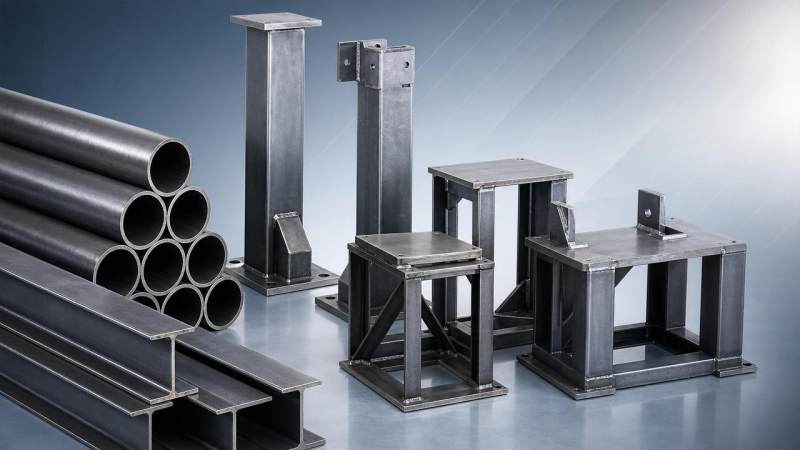
The first question is not whether a36 steel pipe is strong.
The better question is whether the load case matches its practical strength range and fabrication advantages.
This material works well in static or moderately variable loading, especially where sections are sized conservatively and deflection control is manageable.
It is commonly considered for support columns, pipe racks, braces, sleeves, equipment stands, sign structures, and secondary framing members.
In these scenes, easy cutting, drilling, welding, and field adjustment often create more value than premium strength properties.
Why scenario-based selection matters in structural steel work
Not every steel support serves the same purpose.
Some supports carry mostly vertical dead load, while others face vibration, impact, fatigue, wind cycling, or corrosive exposure.
That difference changes whether a36 steel pipe remains the right answer.
A reliable evaluation usually compares five factors: load level, connection type, fabrication method, exposure environment, and replacement or maintenance access.
When these factors stay within ordinary structural conditions, a36 steel pipe often delivers the lowest complexity path.
This is especially true in projects where lead time, broad market availability, and standard processing matter as much as mechanical performance.
Typical application scenes where a36 steel pipe is a practical fit
Support frames and general building auxiliaries
For general support frames, the loads are often known, repetitive, and not highly dynamic.
In these cases, a36 steel pipe supports economical fabrication and routine inspection.
It is suitable for canopies, simple structural legs, equipment skirts, guard structures, and non-critical transfer supports.
Pipe racks, utility corridors, and industrial platforms
Many utility systems prioritize constructability over maximum strength-to-weight ratio.
Where spans are moderate, support spacing is reasonable, and welding must be straightforward, a36 steel pipe becomes an efficient option.
Its value increases when site modifications are likely during installation.
Temporary works and cost-sensitive infrastructure
Temporary braces, staging supports, and short-cycle installations often do not justify specialty steel grades.
Here, a36 steel pipe can reduce procurement friction and simplify replacement planning.
The main judgment point is whether service demands remain moderate and well-controlled.
In lifting, pulling, or suspended systems, support selection often extends beyond pipe sections.
Where corrosion resistance and tensile rope performance matter, Galvanized Steel Wire Rope may complement structural assemblies.
It is used in mining, cranes, elevators, drilling, marine work, agriculture, and cableway systems.
Available constructions include 6X7+FC, 6X19+IWR, and 8x19S+FC, with diameters from 1.0mm to 22mm.
Options such as electro galvanized and hot dipped galvanized finishes support different corrosion conditions and maintenance strategies.
How different load support scenes change the decision
The same material can perform very differently depending on the service scene.
A quick comparison helps clarify when a36 steel pipe is the sensible choice.
Practical signs that a36 steel pipe is the better material choice
Several field conditions strongly support using a36 steel pipe.
- The design load is moderate, with clear reserve capacity.
- Welding, cutting, and fit-up speed matter on site.
- Material availability affects schedule certainty.
- The structure is not governed by aggressive fatigue cycles.
- Section size can be adjusted without severe weight penalties.
- Protective coating systems can manage the operating environment.
These conditions are common in ordinary steel structures across construction, utilities, and light industrial installations.
Where a36 steel pipe may be misapplied
A36 is versatile, but it is not universal.
Problems usually come from assuming a general-purpose material can solve special-duty demands without checking the service details.
Ignoring buckling and slenderness
Load support is not only about yield strength.
Long, slender members can fail by instability before material strength is fully used.
Underestimating cyclic or impact loads
Repeated movement, shock, and vibration can shift the design basis completely.
If fatigue controls the structure, a36 steel pipe may require different detailing or another grade.
Treating corrosion as a secondary issue
Outdoor exposure, coastal air, chemicals, and moisture change life-cycle performance.
Coating selection, galvanizing, drainage, and inspection access should be part of the first decision, not an afterthought.
A scenario-based checklist for selecting a36 steel pipe
Use this simple checklist before finalizing the material.
- Define whether loads are static, variable, impact, or fatigue-sensitive.
- Check compression, bending, deflection, and buckling limits.
- Review welding needs, field cutting, and connection complexity.
- Compare coating requirements against the service environment.
- Evaluate whether higher-strength steel would actually reduce total project cost.
- Confirm compliance with the relevant ASTM, EN, JIS, or GB project basis.
If most answers favor simplicity, moderate load support, and fabrication efficiency, a36 steel pipe is usually a sound choice.
How to move from evaluation to a dependable supply plan
Material selection only creates value when supply quality stays consistent.
For structural steel projects, stable production, dimensional accuracy, and clear standard compliance reduce downstream risk.
Hongteng Fengda, a structural steel manufacturer and exporter from China, supplies structural steel products and customized solutions for global projects.
Its product range includes angle steel, channel steel, steel beams, cold formed profiles, and custom structural components.
With modern facilities and strict quality control, production supports major international standards and dependable lead times.
When reviewing a36 steel pipe for load support, the next step should be practical.
Prepare the target application, load type, dimensions, exposure level, coating need, and required standard.
That information makes it easier to confirm whether a36 steel pipe is the right fit, or whether another structural steel solution would perform better.
Please give us a message


Please enter what you want to find