Choosing the right steel product can directly affect cost, performance, and processing efficiency.
In many applications, a stainless steel strip is the better option because it offers precise dimensions, corrosion resistance, and forming flexibility.
For steel buyers and project teams, understanding where stainless steel strip performs best helps reduce sourcing risks and improve technical decisions.
Basic overview of stainless steel strip
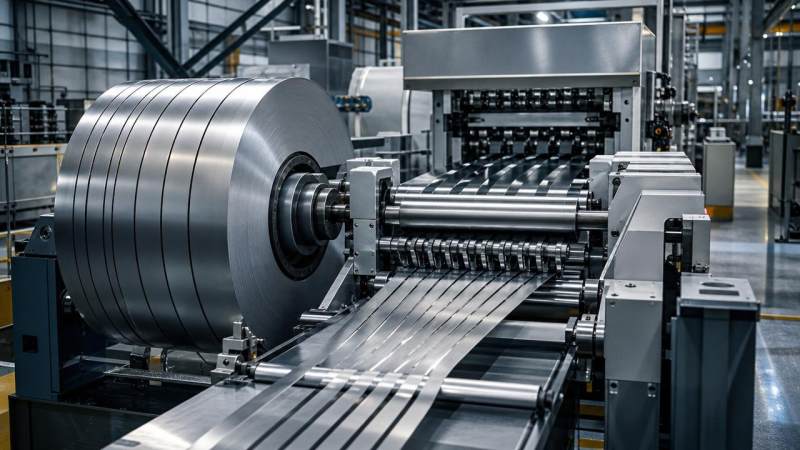
A stainless steel strip is a flat rolled steel product supplied in narrow widths and controlled thickness ranges.
It is usually delivered in coils or cut lengths for stamping, bending, roll forming, welding, and precision fabrication.
Compared with plate or wider sheet, stainless steel strip offers tighter dimensional control and more efficient feeding in automated production lines.
Common grades include 201, 202, 304, 310, and 316, each selected according to corrosion exposure, strength, and forming demands.
Surface condition also matters.
Bright, annealed, pickled, or polished finishes can influence appearance, weld quality, and downstream coating or cleaning needs.
Current industry focus in steel selection
Steel selection today is shaped by several practical concerns across construction, manufacturing, transport, and industrial equipment projects.
- Material waste must be reduced through better dimensional matching.
- Processing speed matters in automated punching, slitting, and forming operations.
- Corrosion resistance is increasingly important in outdoor and humid environments.
- Stable quality helps avoid line stoppage and inconsistent finished parts.
- International standards support smoother global sourcing and project approval.
These trends explain why stainless steel strip receives strong attention in applications requiring repeatability, clean surfaces, and reliable forming behavior.
Why narrower rolled products gain preference
A narrow strip format often lowers secondary cutting work.
It can also improve yield because the incoming material already matches the production width more closely.
That advantage becomes significant in high-volume parts, support brackets, trim sections, cable components, and light structural fabrications.
When a stainless steel strip is the better option
A stainless steel strip is the better option when precision, corrosion resistance, and processing consistency are more important than large-section load capacity.
Its value appears most clearly in the following situations.
1. Precision forming is required
Thin and narrow material feeds more smoothly into stamping and roll-forming equipment.
This reduces handling complexity and supports tighter tolerances in finished parts.
2. Corrosive exposure cannot be ignored
In humid, chemical, marine, or outdoor environments, stainless steel strip can extend service life and reduce maintenance frequency.
That can offset the higher initial material cost.
3. Clean appearance matters
Visible components benefit from uniform finish quality.
A stainless steel strip is often used where decorative and functional performance must coexist.
4. Repetitive production needs stable input
For continuous fabrication, stable thickness and width reduce setup changes and scrap generation.
This improves line efficiency and quality consistency.
Application value across steel projects
Although stainless steel strip is not a replacement for all steel sections, it delivers clear value within the right design range.
In broader steel packages, strip products often work alongside heavier structural sections.
For example, secondary formed components may connect to beams, channels, or larger support members within the same project.
Where primary structural strength is needed, sections such as H Girder remain suitable.
This product is used in mechanical manufacture, steel structures, shipbuilding, bridging, and automobile chassis applications.
Available materials include Q235, Q345B, Q460C, SS400, S275JR, S355JR, A572, A992, galvanized steel, and stainless steel grades.
Typical dimensions include flange thickness from 8-64mm, web thickness from 5-36.5mm, and lengths from 1m to 12m.
With standards such as JIS G3101, EN10025, ASTM A36, ASTM A572, and ASTM A992, it supports strong bending resistance and efficient section design.
Typical scenarios and material matching
The best choice depends on application conditions, not on one material feature alone.
In these cases, stainless steel strip supports better material matching than using oversized sheet or unsuitable carbon steel alternatives.
Practical considerations before ordering
Selecting a stainless steel strip should involve more than grade name alone.
Several details affect production success and total cost.
- Confirm thickness tolerance and width tolerance for the actual forming process.
- Check coil ID, coil weight, and packaging suitability for unloading equipment.
- Match finish condition to welding, polishing, or visible appearance requirements.
- Review standard compliance if the project follows ASTM, EN, JIS, or GB rules.
- Request mill test documentation when traceability or export approval is necessary.
Avoid common selection mistakes
Do not select stainless steel strip only because stainless sounds universally superior.
If the application needs heavy load-bearing performance, a structural section may be more appropriate.
Likewise, choosing 316 for a low-risk indoor part may increase cost without meaningful benefit.
Decision guidance for better sourcing results
A stainless steel strip is the better option when the project requires precise dimensions, repeatable processing, and dependable corrosion performance.
It is especially useful in formed parts, industrial assemblies, exposed components, and applications with continuous fabrication workflows.
The best results come from matching grade, finish, tolerance, and supply format to the real service environment.
For complete steel supply planning, it also helps to compare strip products with structural solutions used in the same project scope.
If a project includes both light fabricated parts and main load-bearing members, reviewing both stainless steel strip and structural profiles can improve overall efficiency.
Hongteng Fengda provides reliable steel products and customized solutions for global construction, industrial, and manufacturing needs, supporting stable quality and dependable lead times.
Please give us a message


Please enter what you want to find