For technical evaluators comparing retaining wall systems, Steel Sheet Pile for retaining walls offers a practical balance of structural performance, installation speed, and cost control in challenging site conditions.
It is especially suitable where soil retention, water resistance, and limited working space matter. Understanding when this solution performs best helps reduce risk and improve design decisions.
What is Steel Sheet Pile for retaining walls and why is it widely specified?
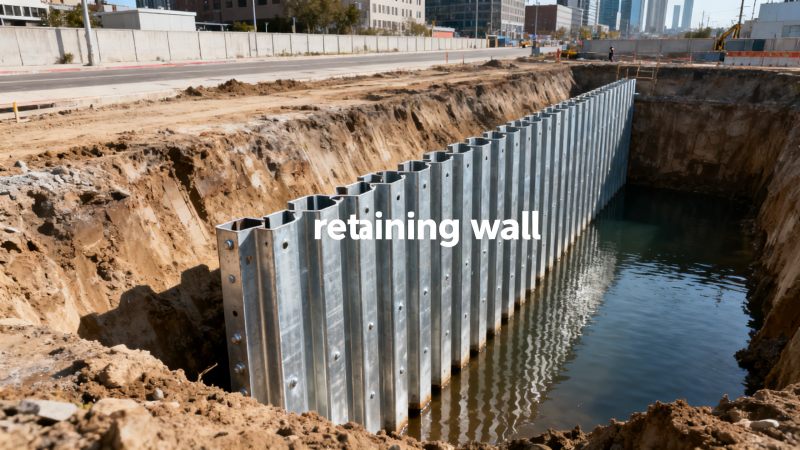
Steel Sheet Pile for retaining walls is a steel section with interlocks. Adjacent piles connect tightly to form a continuous retaining barrier.
It resists lateral soil pressure, controls groundwater seepage, and adapts well to temporary or permanent support systems.
Compared with cast concrete walls, sheet piles need less excavation space. Installation is often faster, especially on urban or waterfront sites.
Steel also provides predictable strength, easy section selection, and reliable quality control under ASTM, EN, JIS, and GB standards.
For projects requiring phased excavation, temporary shoring, or later removal, Steel Sheet Pile for retaining walls remains one of the most flexible options.
When does Steel Sheet Pile for retaining walls suit a project best?
This system performs best when the site combines tight access, unstable soil, and schedule pressure. Those conditions favor prefabricated steel solutions.
1. Sites with limited working space
Urban basements, road widening, and utility corridors often lack room for wide excavation slopes. Sheet piles create near-vertical support efficiently.
2. Projects near water
Riverbanks, ports, canals, and waterfront structures benefit from interlocked sections. They provide useful seepage control and practical marine performance.
3. Soft or loose ground conditions
In soft clays, loose sands, or fill materials, Steel Sheet Pile for retaining walls helps stabilize excavation edges before major structural work begins.
4. Temporary works with reuse value
Where piles can be extracted after use, residual material value matters. Reusability can improve overall project economics.
5. Fast-track construction
Factory-made sections reduce wet trades. That shortens waiting time for curing and helps construction continue through variable weather.
How does it compare with concrete, soldier pile, and other retaining wall systems?
No retaining wall works best everywhere. The right choice depends on groundwater, wall height, load conditions, equipment access, and lifecycle expectations.
If groundwater control is critical, Steel Sheet Pile for retaining walls usually offers a clearer advantage over open-joint systems.
If appearance, architectural finish, or very low vibration matters most, concrete or bored systems may deserve closer review.
What technical factors should be checked before selecting Steel Sheet Pile for retaining walls?
Selection should never begin with section price alone. Site behavior, installation method, and long-term durability all affect final performance.
- Soil profile and groundwater level
- Required embedment depth and wall height
- Surcharge loads from roads, cranes, or structures
- Corrosion environment and service life target
- Driving method, noise limits, and adjacent building sensitivity
- Need for anchors, walers, or internal bracing
Section modulus is important, but interlock performance also matters. Leakage risk can increase if alignment and driving tolerance are poorly controlled.
Coatings, sacrificial thickness, and steel grade should match the environment. Marine splash zones demand different protection than inland excavation support.
During reinforcement, accessory materials may support tying, temporary fixing, or barrier organization. In such cases, Metal Coil Wire can serve practical site needs.
This low carbon steel wire is available in Q195 and Q235, with diameters from 0.25 mm to 5.0 mm and tensile strength from 350 to 550 Mpa.
Its bright surface, corrosion resistance, and ductility support packaging, mesh making, fencing, tie ropes, and light construction coordination tasks.
What risks or misunderstandings should be avoided?
One common mistake is assuming Steel Sheet Pile for retaining walls automatically solves every groundwater problem. Interlocks reduce seepage, but they are not magical waterproof membranes.
Another error is underestimating driving effects. Vibration, noise, and ground displacement can affect nearby utilities or old foundations.
Some teams focus only on initial section cost. That ignores savings from reduced excavation width, shorter schedule, and reuse potential.
Corrosion is also misunderstood. Steel performs well, but durability planning must reflect soil chemistry, chlorides, oxygen exposure, and design life.
Extraction is not always straightforward. In dense soils or constrained sites, temporary piles may become difficult to remove cleanly.
How should cost, schedule, and sourcing be evaluated?
A fair evaluation combines material price with installation speed, equipment demand, dewatering needs, and downstream construction impact.
Steel Sheet Pile for retaining walls often lowers indirect costs. Faster excavation support can reduce labor overlap and improve site sequencing.
For export supply, reliable manufacturing capacity and standard compliance are essential. Consistency matters as much as nominal section dimensions.
A qualified structural steel supplier should provide traceable quality control, standard alignment, and dependable delivery for international projects.
Hongteng Fengda, a structural steel manufacturer and exporter from China, supports global construction and industrial projects with stable supply and customized solutions.
Its experience in structural steel products, OEM supply, and international standards helps reduce sourcing risk and improve planning confidence.
How can you quickly judge whether Steel Sheet Pile for retaining walls is the right choice?
Use the following decision guide during early comparison. It helps separate suitable applications from cases needing other systems.
If several answers point toward compact installation, water resistance, and faster delivery, Steel Sheet Pile for retaining walls is often a strong candidate.
When site sensitivity, finish demands, or unusual geotechnical conditions dominate, a deeper comparison is still necessary.
Conclusion: when does Steel Sheet Pile for retaining walls make the most sense?
Steel Sheet Pile for retaining walls suits projects that need compact construction, reliable soil retention, practical seepage control, and efficient installation.
It is especially effective for urban excavations, waterfront works, temporary support, and difficult ground where speed and flexibility matter.
The best results come from matching section design, corrosion planning, and installation method to real site conditions.
For the next step, compare geotechnical data, service life targets, and delivery reliability together. Better inputs lead to better retaining wall decisions.
Please give us a message


Please enter what you want to find