Choosing the right foundation support can determine the safety, speed, and cost efficiency of a project. Steel Sheet Pile for retaining walls is often the preferred solution when strong earth retention, rapid installation, and dependable performance are required in excavation, waterfront, and basement works. Knowing when this system creates the best value helps reduce delays, control risk, and improve structural reliability.
Why a Checklist Matters Before Choosing Steel Sheet Pile for Retaining Walls
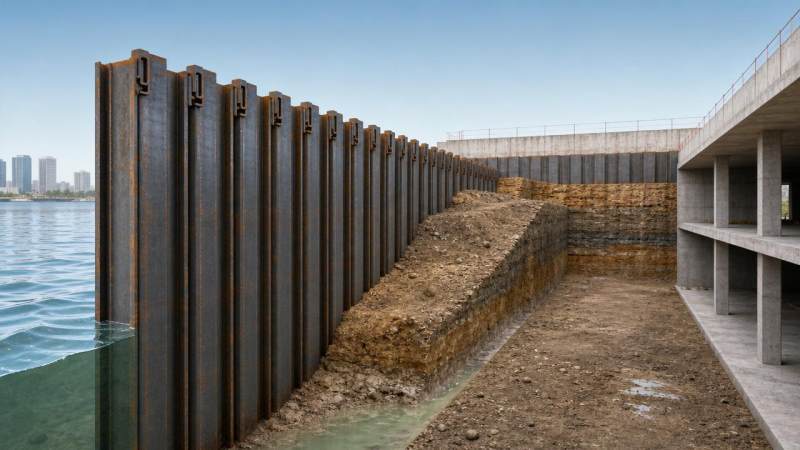
Retaining wall selection is rarely a simple material decision. Soil pressure, groundwater, access limits, vibration tolerance, and schedule constraints all influence performance. A checklist prevents design teams from selecting a familiar option when a more efficient system is available.
Steel Sheet Pile for retaining walls stands out because it combines structural strength with construction speed. Unlike bulkier concrete systems, sheet piles can often be driven quickly, reused in temporary works, and installed in confined locations where excavation support must start immediately.
This checklist-based approach is especially useful for steel-related construction planning. It links engineering conditions with practical execution factors such as corrosion exposure, section selection, equipment needs, and long-term maintenance expectations.
Core Checklist: When Steel Sheet Pile for Retaining Walls Is the Right Choice
- Check soil conditions early. Choose sheet piles when loose soils, saturated ground, or unstable excavation faces require continuous earth support instead of isolated structural members.
- Confirm groundwater pressure. Use this system when water control matters, especially in riverbanks, quay walls, cofferdams, and deep basements where seepage can weaken open excavations.
- Measure installation space. Select sheet piles when access is tight and the project cannot accommodate wide foundations, heavy formwork, or extended curing time.
- Compare construction speed. Prefer steel piling when the schedule is compressed and retaining structures must be installed and loaded quickly after delivery.
- Review temporary or permanent use. Sheet piles are highly attractive when sections may be extracted and reused, improving cost efficiency in temporary support works.
- Assess lateral load demand. Apply steel sheet pile walls where bending resistance, interlock continuity, and anchoring systems can be engineered for expected surcharge and earth pressures.
- Evaluate corrosion exposure. Choose protected steel solutions when marine, industrial, or aggressive soil environments demand coating systems, thicker sections, or service-life planning.
- Verify nearby structure sensitivity. Use caution in vibration-sensitive zones, but keep sheet piles in consideration when press-in or low-vibration methods are available.
Where This Solution Performs Best
Basement Excavation and Urban Retention
Steel Sheet Pile for retaining walls is a strong option in dense urban projects. It works well where property lines are close, excavation depth is significant, and temporary support must be installed before major earth removal begins.
Its narrow wall profile helps preserve usable space. This matters in underground parking, utility corridors, and commercial basements where every meter affects layout and cost.
Waterfront, Riverbank, and Marine Works
Marine and waterfront projects often favor sheet piling because the system can resist both soil and hydraulic forces. Interlocking sections also help form a more continuous barrier than many alternative retaining methods.
In these environments, corrosion planning becomes critical. Material grade, wall thickness, coating, cathodic protection, and inspection intervals should be defined before final procurement.
Temporary Cofferdams and Construction Staging
When a retaining wall is needed only during construction, steel sheet piling often delivers excellent value. Sections can be extracted after use, reducing material loss and making the system economically attractive for staged works.
Temporary works still need full engineering checks. Water level variation, embedment depth, bracing arrangement, and extraction feasibility should be confirmed before mobilization.
Material Planning Beyond the Retaining Wall Itself
Many retaining wall projects also require complementary steel products for roofing, enclosures, staging shelters, site buildings, or utility structures. In integrated construction supply planning, combining foundation steel with building envelope materials can improve logistics and delivery coordination.
For example, Color Coated Galvalume Steel Sheet PPGL can support agricultural, residential, commercial, and public building applications. Made from 55% aluminum, 43.3% zinc, and 1.6% silicon, it offers strong corrosion resistance, heat resistance, light weight, and attractive appearance.
Available in thicknesses from 0.2mm to 1.2mm and widths from 600mm to 1250mm, this product is suitable for wavy and trapezoidal profiles. PE, SMP, HDP, and PVDF finishes also support longer service life and color stability in demanding environments.
A structural steel supplier with broad manufacturing capability can simplify such combined sourcing. Hongteng Fengda provides structural steel products, customized components, and export support aligned with ASTM, EN, JIS, and GB standards for international projects.
Commonly Overlooked Risks
- Ignore driveability at your own risk. A section may work structurally on paper but perform poorly in dense strata, obstructions, or mixed ground conditions.
- Underestimate corrosion loss carefully. Marine splash zones, polluted soils, and stray current exposure can shorten service life if allowance and protection are not specified.
- Overlook wall movement limits cautiously. Even when ultimate strength is adequate, nearby roads, pipes, or buildings may require tighter deflection control.
- Treat water tightness realistically. Interlocks reduce seepage but do not automatically create a fully watertight system without seals or supplementary measures.
- Plan extraction before installation. Temporary sheet piles can become difficult to remove if concrete, tie systems, or adjacent works restrict access later.
Practical Execution Advice
Start with a ground investigation that includes soil layering, groundwater data, and obstruction mapping. This information drives section modulus selection, embedment design, and installation method choice.
Match the piling method to site sensitivity. Vibratory driving may accelerate production, while hydraulic press-in systems can reduce noise and vibration near existing structures.
Coordinate steel supply early. Standardized profiles shorten lead times, but customized lengths, coatings, and fabricated accessories should be aligned with the construction sequence.
Request documentation that supports international compliance. Mill certificates, coating data, dimensional tolerances, and load-related design information improve traceability and project approval speed.
Review the full life cycle cost, not only the purchase price. Reusability, installation speed, reduced excavation risk, and lower site disruption often make steel sheet piling more competitive than it first appears.
Conclusion and Next Step
Steel Sheet Pile for retaining walls is the right choice when a project needs rapid installation, reliable earth retention, limited site footprint, and strong performance under groundwater or marine exposure. It is especially effective in basements, cofferdams, riverfront works, and temporary excavation support.
Use the checklist above to evaluate soil, water, access, loading, corrosion, and movement criteria before final selection. When these factors align, sheet piling can reduce risk, improve scheduling, and create a more efficient steel-based construction solution.
For projects that also require structural steel products or coordinated export supply, working with an experienced Chinese structural steel manufacturer can improve consistency, cost control, and delivery reliability across the entire build.
Please give us a message


Please enter what you want to find