Choosing between ASTM A312 and A790 for 2 stainless pipe applications is a critical decision that impacts corrosion resistance, mechanical performance, and project compliance—especially in demanding industrial or structural environments. As a leading structural steel manufacturer and exporter from China, Hongteng Fengda supports global project managers with precision-specification stainless piping solutions aligned with ASTM standards. This article clarifies when to specify ASTM A312 (for seamless/welded austenitic stainless pipe) versus ASTM A790 (for duplex stainless seamless/welded pipe), helping technical evaluators, procurement teams, and engineering decision-makers optimize material selection, cost, safety, and long-term reliability.
Understanding the Core Differences: Chemistry, Microstructure & Performance
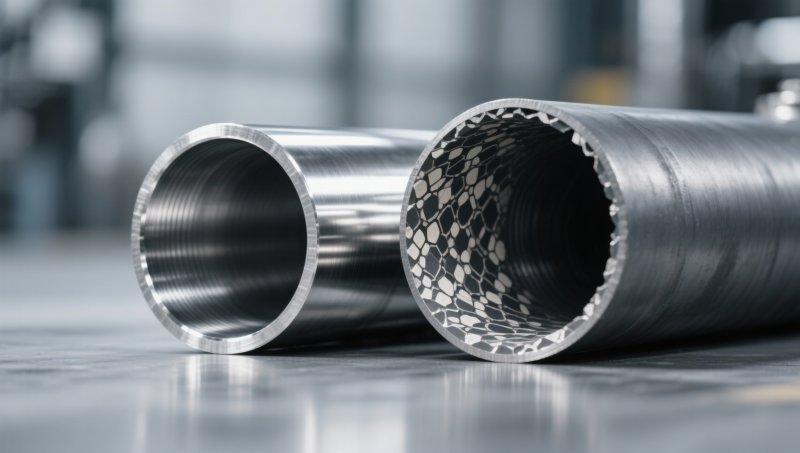
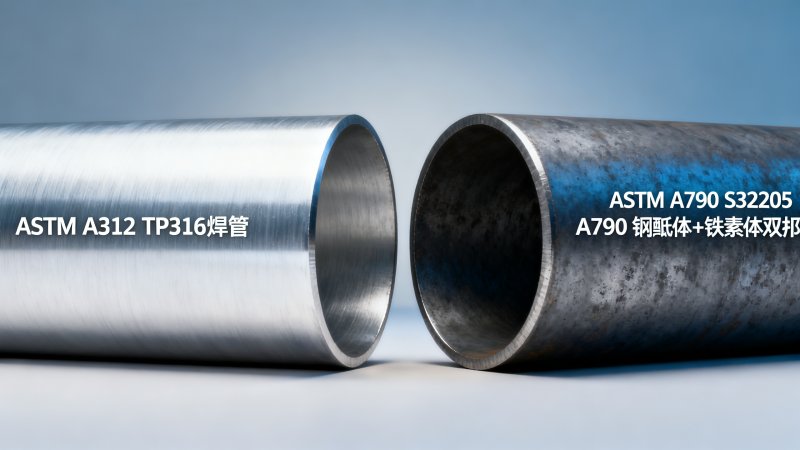
ASTM A312 and A790 are both widely accepted specifications for stainless steel pipe—but they govern fundamentally different alloy families. A312 covers austenitic stainless steels such as TP304, TP316, and TP321, characterized by high nickel (8–12%) and chromium (16–20%) content, face-centered cubic (FCC) crystal structure, and excellent formability and weldability. In contrast, ASTM A790 specifies duplex stainless steels—including UNS S32205/S32202 and S32750—featuring a near-equal mix of austenite and ferrite phases, with chromium levels of 22–25%, molybdenum up to 4%, and nitrogen additions of 0.14–0.30%.
This microstructural divergence drives measurable differences in mechanical strength and environmental resistance. Duplex grades per A790 typically deliver yield strengths of 450–550 MPa—nearly double that of standard A312 austenitics (205–310 MPa)—while maintaining superior resistance to chloride-induced stress corrosion cracking (SCC). For example, in seawater-cooled heat exchangers or offshore platform piping, A790’s critical pitting temperature (CPT) often exceeds 35°C, whereas A312 TP316 typically ranges between 22–26°C.
Thermal expansion behavior also differs significantly: A312 austenitic pipes exhibit ~17.3 µm/m·°C expansion, while A790 duplex grades average ~13.7 µm/m·°C—a 21% reduction. This has direct implications for thermal cycling design, anchor spacing, and flange bolt torque calculations in large-diameter process lines.
The table above highlights how A790 delivers higher strength with only a modest trade-off in ductility—making it ideal for weight-sensitive structural supports or high-pressure feedwater lines where wall thickness reduction directly lowers fabrication and transportation costs by up to 30%.
When ASTM A312 Is the Optimal Choice: Applications & Rationale
ASTM A312 remains the specification of choice for general-purpose stainless piping where aggressive corrosion or extreme pressure is not the primary concern. Its broad applicability spans food-grade process lines (e.g., dairy and beverage plants), pharmaceutical clean steam systems, architectural handrails, and HVAC condensate drainage—environments where TP304 or TP316 provides ample corrosion resistance at lower material and fabrication cost.
From a manufacturing standpoint, A312-compliant pipe benefits from mature global production capacity, shorter lead times (typically 4–8 weeks for standard sizes), and wider availability in thin-wall (<2.0 mm) and small-bore (≤25 mm) configurations. Seamless A312 tubing is routinely produced down to 6.35 mm OD with ±0.1 mm dimensional tolerance—critical for instrumentation and control valve manifolds.
For projects prioritizing weld integrity in field conditions, A312 offers superior hot-crack resistance due to its stable austenitic matrix and lower ferrite number (FN < 5). This reduces post-weld heat treatment (PWHT) requirements and simplifies NDE acceptance criteria—cutting QA/QC labor hours by an estimated 22% on mid-size refinery packages.
When ASTM A790 Becomes Mandatory: Critical Use Cases & Compliance Drivers
ASTM A790 enters the specification requirement list when service conditions exceed the safe operating envelope of austenitic stainless steels. Key triggers include chloride concentrations >200 ppm in cooling water, H₂S partial pressures >0.05 psi in oil & gas gathering lines, or continuous exposure to pH < 4.5 acidic condensates in flue gas desulfurization (FGD) scrubbers.
In marine infrastructure—such as desalination plant intake/outfall headers—A790 S32205 is specified per ISO 21457:2019 for its proven resistance to microbiologically influenced corrosion (MIC), with failure rates below 0.8% over 15-year service life versus 4.3% for A312 TP316 in identical coastal installations.
Structural applications also increasingly adopt A790. Offshore jacket leg bracing, subsea support frames, and coastal bridge cable ducts leverage its 25% higher fatigue strength under cyclic loading. Hongteng Fengda routinely supplies A790-compliant pipe in diameters up to 610 mm OD with wall thicknesses of 12–32 mm—fully certified to EN 10216-5 and ASTM A790 Grade S32205, with full traceability to heat number and mill test reports (MTRs).
Note: PREN (Pitting Resistance Equivalent Number) = %Cr + 3.3×%Mo + 16×%N. A312 TP316 averages PREN ≈ 25; A790 S32205 ≈ 34; A790 S32750 ≈ 40+—a quantifiable metric used by EPC contractors during bid evaluation.
Procurement & Supply Chain Considerations for Global Buyers
Procurement teams must weigh not only technical suitability but also supply chain realities. While A312 pipe is available from dozens of Chinese mills—including those certified to ASME BPVC Section II Part A—A790 production is more concentrated. Only 7 mills in China hold current ASTM A790 certification with third-party surveillance (SGS/BV), and lead times for non-stock sizes range from 12–20 weeks versus 6–10 weeks for A312.
Hongteng Fengda maintains dual-certified inventory (A312 and A790) across key grades, with 92% on-time delivery performance over the past 18 months. Our quality system includes 100% ultrasonic testing (UT) for A790 pipe ≥150 mm OD and solution annealing verification via ferritoscope (±1% FN accuracy) per ASTM E562.
For budget-conscious projects, integrating Wire rod into reinforcing elements—such as anchorage bars for pipe supports or embedded plates—offers synergistic cost control. Our HRB400 and Q345 wire rod, available in 6–40 mm diameters and compliant with GB1499.2 and ASTM A615, enables seamless structural integration without multi-supplier coordination delays.
Conclusion: Aligning Specification with Project Lifecycle Value
Specifying ASTM A312 over A790—or vice versa—is never about “better” or “worse,” but about precise alignment with operational risk, lifecycle cost, and regulatory obligation. A312 delivers unmatched versatility and cost efficiency for benign-service piping; A790 provides mission-critical resilience where failure consequences include safety incidents, environmental liability, or multi-million-dollar downtime.
As a structural steel manufacturer and exporter from China with deep expertise in ASTM-compliant stainless solutions, Hongteng Fengda supports your decision with technical data sheets, MTR validation, and application-specific engineering consultation—free of charge. Whether you’re evaluating alternatives for a new LNG terminal or optimizing spares strategy for aging petrochemical assets, our team delivers clarity before commitment.
Contact Hongteng Fengda today to request a customized ASTM A312/A790 comparative assessment—including material cost modeling, fabrication impact analysis, and lead time optimization—for your next project.
Please give us a message


Please enter what you want to find