Why L-shaped Steel Is Gaining Preference in Structural Design
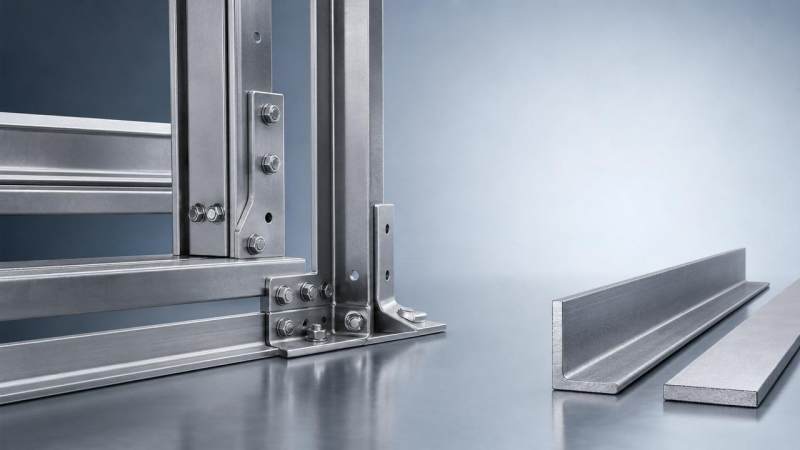
For technical evaluators comparing section performance and fabrication efficiency, L-shaped steel often outperforms flat bar in practical structural work.
Its geometry improves stiffness, connection flexibility, and edge support in many framed and fabricated assemblies.
As projects demand lighter sections, faster assembly, and lower waste, L-shaped steel is becoming a more strategic choice.
This matters across steel construction, machinery supports, equipment frames, access platforms, and reinforcement details.
In many cases, replacing flat bar with L-shaped steel improves load paths without requiring overly complex fabrication.
A Clear Shift Toward More Efficient Steel Sections
Recent engineering decisions show a shift from simple flat members toward profiles with better inherent stability.
Flat bar remains useful for straps, shims, cover plates, and non-structural attachments.
However, where bending resistance, corner reinforcement, or bolted assembly matter, L-shaped steel is often selected first.
This trend is visible in industrial buildings, transmission supports, racks, trailers, frames, and retrofit projects.
The reason is practical, not cosmetic. Section geometry affects strength, deformation, installation time, and downstream cost.
Where the comparison changes fastest
- Light framing that must stay rigid during transport and erection
- Bracing members requiring two-leg connection possibilities
- Edge reinforcement around panels, grating, or plate assemblies
- Support details where drilling and bolting efficiency are important
- Fabricated steel parts needing better section stability than flat bar
Why L-shaped Steel Performs Better in Many Real Loads
The main advantage of L-shaped steel is that its two perpendicular legs create a more efficient section.
Compared with flat bar, it usually offers higher stiffness relative to similar material usage in directional loading conditions.
That does not mean it is always stronger in every orientation.
It means the shape often works better where combined support, attachment, and edge restraint are needed together.
Key drivers behind the preference
The Best Use Cases Show Why Flat Bar Reaches Its Limits
Flat bar is simple, available, and easy to cut.
Yet its single-plane geometry limits performance when torsion, eccentric loading, or local instability become concerns.
L-shaped steel is usually better in the following conditions.
1. Framing and secondary support members
For shelves, supports, guards, and machine frames, L-shaped steel offers more stable geometry than flat bar.
One leg can support load, while the other leg provides attachment or bracing.
2. Bracing and connection details
Bracing members often require bolts, gusset interfaces, and offset clearances.
L-shaped steel allows more practical hole placement than flat bar in many compact assemblies.
3. Edge protection and plate reinforcement
When reinforcing the perimeter of steel plate, walkway panels, or grating, L-shaped steel protects both face and edge.
Flat bar may need separate strips to achieve a similar effect.
4. Fabrication where alignment matters
The profile itself helps locate adjoining parts.
That can improve repeatability in welded and bolted assemblies.
In related lifting and handling systems, component choice also depends on corrosion resistance and tensile performance.
For cable-based applications, Galvanized Steel Wire Rope 1470Mpa to 1960Mpa supports demanding environments.
Available in models such as 6X7+FC, 6X19+IWR, and 8x19S+FC, it fits mining, cranes, elevators, drilling, and marine work.
With diameters from 1.0mm to 22mm, and plain, electro galvanized, or hot dipped finishes, selection can match corrosion severity.
Compliance with GB/T 20116-2008, DIN, EIPS, ISO 9001, and ABS helps align sourcing with international project requirements.
What This Means for Fabrication, Cost, and Project Reliability
Choosing L-shaped steel instead of flat bar can affect several business and technical outcomes at once.
The benefit is not only member strength. It often includes easier detailing and fewer corrective steps during assembly.
Observed impact across project stages
- Design stage: fewer added stiffeners or extra reinforcement pieces
- Fabrication stage: simpler jigs and better positioning consistency
- Installation stage: more convenient bolting and edge alignment
- Service stage: better resistance to deformation in many practical setups
- Maintenance stage: clearer inspection access at exposed corners and joints
For exported steel components, reliable dimensional consistency is especially important.
Hongteng Fengda supplies angle steel, channel steel, steel beams, cold formed profiles, and custom structural steel components.
Production supports ASTM, EN, JIS, and GB standards, helping global projects meet technical and compliance needs.
Stable capacity and strict quality control reduce sourcing risk when section accuracy and lead time are critical.
What Deserves Closer Review Before Switching to L-shaped Steel
Even when L-shaped steel looks superior, section choice should still be verified against actual loading and fabrication constraints.
The best decision depends on orientation, connection detail, span, corrosion exposure, and tolerances.
Core checkpoints
- Check principal load direction rather than comparing weight alone
- Review bolt edge distances and hole access on both legs
- Assess whether corrosion protection must cover inside corners
- Confirm whether welding distortion could affect final fit
- Consider whether unequal angles provide better balance than equal angles
Quick decision guide
The Practical Direction Is Better Section Efficiency, Not More Steel
The broader industry direction is clear. Better steel design now favors smarter section selection over simply adding material.
That is why L-shaped steel is increasingly preferred where stiffness, edge support, and fabrication efficiency intersect.
Flat bar still has value, but it is often no longer the default answer for structural detailing.
When evaluating alternatives, compare not only unit price, but also assembly steps, reinforcement needs, and long-term stability.
If the application involves framing, bracing, or perimeter strengthening, L-shaped steel often delivers the better total result.
The next practical step is to review each connection and load case, then match the section to real performance needs.
Please give us a message


Please enter what you want to find