When a specification sheet lists both black pipe and coated pipe as acceptable options, the real work begins for the technical evaluator. The choice is rarely about one product being universally “better.” It is about fit: service environment, fabrication sequence, lifecycle expectations, and cost pressure all interact. In that context, ERW black steel pipe is often the smarter selection when corrosion exposure is limited, downstream processing matters, and the project team wants to avoid paying for protection that the application does not truly require.
The appeal of coated pipe is easy to understand. A galvanized, painted, or otherwise protected surface can extend service life in aggressive conditions and simplify some asset management concerns. But coating also changes the economics and the workflow. It adds material and processing cost, may complicate welding or cutting, and can introduce repair steps after fabrication. For many indoor, dry, embedded-in-system, or further-processed applications, that extra layer does not always produce proportional value.
That is where ERW black pipe enters the discussion as a practical engineering choice rather than a budget-only compromise.
What technical evaluators are really comparing
In procurement meetings, the conversation often sounds like a surface-finish question. In practice, the decision goes much deeper. Evaluators are usually weighing five things at once:
- Whether corrosion resistance is needed from day one or will be handled later in the process
- How the pipe will be cut, welded, bent, drilled, or assembled
- What dimensional consistency is required for fit-up and repeatability
- How much cost sensitivity the project has at tonnage scale
- Whether the final application is structural, mechanical, utility-related, or part of a larger fabricated system
Because electric resistance welded pipe is produced from steel strip with controlled forming and seam welding, it is widely chosen for applications where consistency, availability, and manufacturing efficiency matter. If the service environment is not highly corrosive, black ERW pipe frequently provides the right balance between performance and total project cost.
When coated pipe adds protection—but not always value
Coatings solve a real problem. In outdoor exposure, humid climates, marine settings, or infrastructure that cannot be easily maintained, a protective layer can be essential. No serious evaluator should ignore that. But coated pipe is sometimes specified by habit rather than necessity.
For example, if pipe will be enclosed inside a building system, used in dry interior structural supports, incorporated into machinery frames, or sent through later finishing processes, the original coating may not be the deciding factor. In some cases, that coating gets partially removed during cutting, coping, threading, or welding, which means the project still needs touch-up work or secondary treatment.
That is the point where a simpler substrate can become the more rational choice. ERW black steel pipe gives the fabrication team a clean starting point when the final finish is still undecided or when the installed environment is relatively controlled.
Situations where ERW black steel pipe is often the better fit
Technical evaluators usually favor ERW black pipe under conditions like these:
1. The installation environment is low-corrosion
Interior construction, dry plant environments, protected utility routing, and enclosed equipment assemblies do not always justify pre-coating. If exposure to moisture, salts, chemicals, or weathering is limited, black pipe can perform well when matched to the actual service conditions.
2. The pipe will undergo substantial fabrication
Cutting, welding, slotting, drilling, and end-forming are easier to manage when there is no coating to burn off, crack, or repair. This is especially relevant for fabricators trying to control labor hours and maintain process flow. Black pipe can reduce interruptions between raw material receipt and finished assembly.
3. Surface treatment will happen later
Some projects apply paint systems, powder coating, or other finishing only after full fabrication. In that workflow, buying pre-coated pipe may create redundant cost. Starting with black pipe keeps the process aligned with the actual finishing sequence.
4. Budget discipline is a key project driver
On large-volume structural or industrial purchases, unit cost differences matter. If coating is not technically required, removing it from the initial specification can generate meaningful savings without sacrificing essential structural integrity or dimensional needs.
5. Consistency and sourcing flexibility matter
ERW pipe is commonly available across a wide range of sizes and standards, making it easier to integrate into global procurement plans. For buyers managing multi-market supply, consistency in dimensions and production control is often more important than paying for a surface treatment that may not be critical.
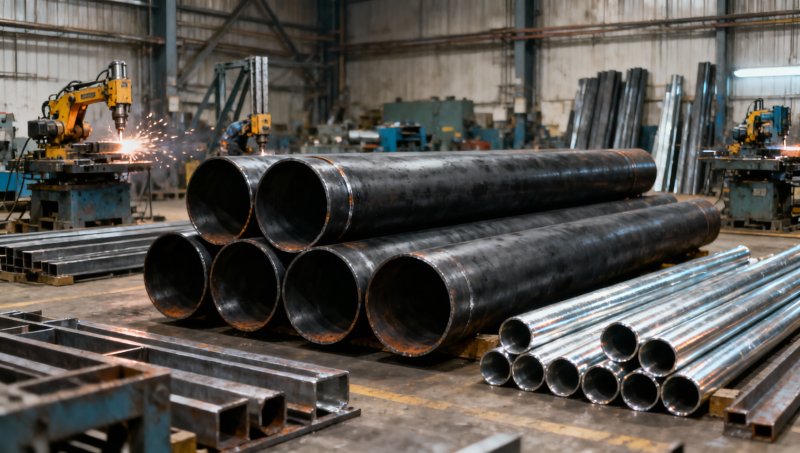
Fabrication efficiency is often the hidden advantage
Many selection discussions focus too heavily on corrosion and not enough on production reality. Yet for technical teams, the time spent in the workshop or fabrication yard can shape total cost as much as the raw pipe price.
Black ERW pipe is frequently preferred because it supports straightforward handling in operations such as:
- Welded frame and support fabrication
- Custom brackets and structural subassemblies
- Machine bases and equipment housings
- General-purpose industrial skids and racks
- Project-specific OEM steel components
Coated surfaces can demand more caution. Welding may require local coating removal. Heat-affected zones may need repair. Cosmetic damage during transport or processing may trigger rework. None of these issues make coated pipe a bad choice, but they do mean that coated pipe is not automatically the most efficient one.
For engineering teams working backward from fabrication drawings, ERW black pipe often fits better because it keeps the process simpler.
How to evaluate service life honestly
One common mistake is treating “uncoated” as equivalent to “short life.” That assumption is too broad. Service life depends on exposure, drainage, maintenance access, cleaning regime, operating temperature, and whether the pipe serves a structural or conveying function. A dry indoor support member and an exposed coastal handrail do not belong in the same decision model.
Technical evaluators should ask a more useful question: What level of corrosion resistance is necessary for this exact application, and at what stage should it be added?
If the answer points to harsh outdoor exposure, washdown conditions, or salt-laden air, coated pipe may be clearly justified. If the answer points to a protected environment or a later-stage finishing process, black ERW pipe may be the more disciplined specification.
Selection is not only about pipe—adjacent steel choices matter too
In many projects, pipe is only one part of a broader steel package. Support systems, tower members, ancillary structural parts, and machined steel accessories may follow different exposure requirements. That is why experienced buyers often source through suppliers that understand both standard structural sections and customized downstream steel components.
For instance, some projects pair black pipe for indoor fabricated assemblies with corrosion-protected solid steel elements in exposed zones. A related option used in power, transport, and fabricated component applications is DC01 Galvanized Round Steel. Its galvanized surface, tensile strength range of 570–820 MPa, and customizable diameter options make it better suited to applications where long anti-corrosion life is part of the design requirement. In other words, a smart material strategy does not force one finish across every component. It assigns each steel product to the environment and process it actually faces.
What to check before approving ERW black pipe
Choosing black pipe should still be a controlled engineering decision, not a casual downgrade. A sound review usually includes the following checkpoints:
Material standard compliance
Confirm the required standard, dimensional tolerance, and mechanical property expectations for the intended use. For international projects, alignment with ASTM, EN, JIS, or GB requirements may be necessary depending on design documents and destination market expectations.
Weld seam quality
Because ERW pipe depends on seam integrity, manufacturing control matters. Technical teams should verify that the supplier maintains stable production processes and quality inspection routines appropriate for the application.
Dimensional accuracy
Roundness, wall thickness consistency, and straightness affect fit-up, especially in repetitive fabrication or load-bearing assemblies. Reliable dimensional control can reduce field correction and assembly delays.
End-use exposure
Check not just the nominal location, but the real environment. Indoor does not always mean dry. Condensation, intermittent washdown, trapped moisture, and contact with reactive substances can change the selection outcome.
Post-fabrication finish plan
If painting, powder coating, or system-level protection will be added after fabrication, black pipe may align naturally with that route. If no later protection is planned, recheck whether the environment truly permits that choice.
Common specification mistakes
One of the most expensive habits in steel procurement is defaulting to the most protected option without mapping the full manufacturing path. Another is the opposite: selecting black pipe purely for initial savings without considering service conditions. Both approaches create avoidable risk.
Technical evaluators should be cautious of these errors:
- Specifying coated pipe for components that will be extensively welded and then fully repainted anyway
- Assuming all indoor areas are low-corrosion environments
- Overlooking touch-up and rework costs associated with damaged coatings
- Comparing pipe prices without including fabrication and finishing impact
- Ignoring supply reliability and lead-time stability in favor of surface treatment alone
The better approach is to assess total suitability, not just catalog appearance.
Why sourcing capability matters in this decision
For global buyers and engineering teams, product selection is tied closely to supplier capability. A dependable structural steel manufacturer should be able to support not only the pipe specification itself, but also the surrounding needs: standard sections, cold formed profiles, customized structural components, and OEM-based fabrication requirements.
Hongteng Fengda, as a structural steel manufacturer and exporter from China, serves this broader sourcing logic. With experience in angle steel, channel steel, steel beams, cold formed steel profiles, and customized structural steel components, the company supports projects that require practical material matching rather than one-size-fits-all recommendations. For technical evaluators, that matters because the best answer is sometimes black pipe in one part of the system and corrosion-protected steel in another.
A practical way to make the final call
If you are deciding between ERW black steel pipe and coated pipe, reduce the choice to three questions:
- Will the pipe face an environment that truly requires built-in corrosion protection?
- Will fabrication steps remove, damage, or complicate the coating before installation?
- Is the project better served by lower upfront cost and smoother processing, or by immediate surface protection?
When the environment is controlled, the fabrication path is active, and cost efficiency matters, ERW black pipe is often the better fit. Not because coating lacks value, but because engineering discipline means paying for the performance you need—and not for the performance you will never use.
That is usually what technical evaluators are looking for: a choice that is defensible on paper, practical in production, and appropriate in service.
Please give us a message


Please enter what you want to find