Choosing the right steel section can improve strength, reduce weight, and lower project costs. In many applications, C-shaped steel offers a practical advantage over traditional sections thanks to its efficiency, versatility, and ease of fabrication. For buyers comparing options from a China Steel Supplier, understanding how C-shaped steel performs alongside products like hrc coil, ASTM stainless steel, and API 5L Steel Pipe is essential for better sourcing and engineering decisions.
For engineers, procurement teams, fabricators, and project managers, the decision is rarely about section shape alone. It involves load paths, welding time, corrosion exposure, logistics cost, compliance with ASTM, EN, JIS, or GB standards, and how quickly material can move from purchase order to installation. In that context, C-shaped steel often becomes the better fit not because it replaces every traditional section, but because it solves specific structural and commercial problems more efficiently.
This article explains where C-shaped steel performs best, how it compares with conventional sections such as angle, I-beam, and standard channel products, what technical and sourcing factors should be checked before ordering, and how global buyers can reduce risk when working with a structural steel manufacturer and exporter from China.
Where C-Shaped Steel Delivers a Practical Edge
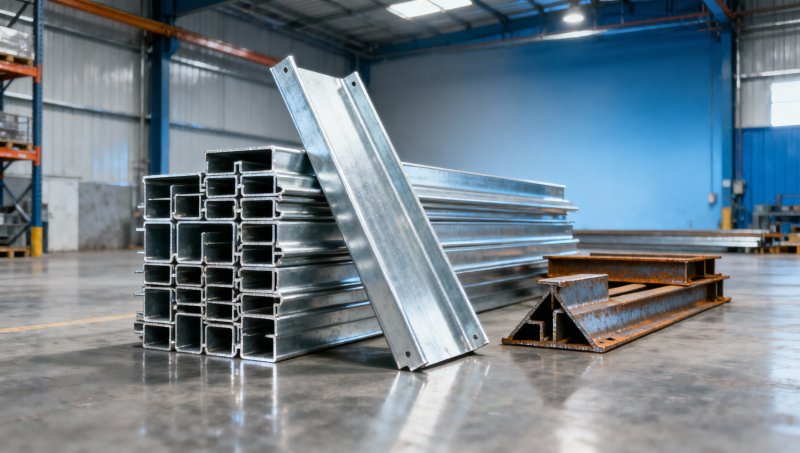
C-shaped steel, often produced as a cold formed profile, is widely selected when a project needs a balance of section strength, lower self-weight, and efficient downstream fabrication. Compared with heavier hot rolled sections, it can help reduce steel consumption in secondary framing, support rails, equipment frames, wall girts, roof purlins, cable tray supports, and light industrial structures. In many real projects, a weight reduction of 10% to 30% at the secondary structure level can directly influence transport, handling, and installation cost.
Its geometry matters. The open section provides good bending performance in one principal direction while remaining easy to punch, slot, cut, galvanize, and assemble. This is especially useful for modular fabrication, where hundreds or even thousands of repeated members are processed with tight hole spacing tolerance and predictable connection details. When production speed and consistency are critical, C-shaped steel often fits automated or semi-automated fabrication better than bulkier traditional sections.
Another advantage appears in logistics. Because many C-shaped steel members are lighter and easier to stack, loading efficiency can improve over long export routes. For buyers in North America, Europe, the Middle East, and Southeast Asia, even a modest reduction in dead weight can affect freight planning, container optimization, and site unloading arrangements. This becomes significant in projects with delivery windows of 2 to 6 weeks, where coordination pressure is already high.
That said, the section is not universally superior. For major primary load-bearing members with large spans, heavy torsion, or high moment demand, I-beams, H-beams, or closed structural sections may remain the better engineering option. The real value of C-shaped steel comes from choosing it where its shape, manufacturability, and cost structure align with the project’s actual demands.
Typical applications where it outperforms traditional sections
- Roof purlins and wall girts in industrial workshops, where repeated spans and lighter roof systems benefit from fast installation.
- Solar mounting frames, machine bases, and equipment support systems, where pre-punched holes and dimensional consistency save fabrication time.
- Warehouse racks, mezzanine framing, and utility supports, where lower section weight can ease handling and reduce installation labor.
- Temporary structures and modular units, where transport efficiency and quick bolted assembly are often more important than maximum section mass.
The comparison below helps clarify when a buyer should favor C-shaped steel over a traditional alternative.
The key conclusion is straightforward: C-shaped steel is often the stronger business case in secondary structural systems, repeatable fabricated components, and export projects where fabrication efficiency and installed cost matter as much as nominal section strength.
Engineering Criteria: How to Judge Fit Beyond Section Shape
A common mistake in steel selection is comparing sections by size alone. A better approach is to review at least 4 engineering filters: load direction, span length, connection method, and service environment. C-shaped steel performs well when loads are predictable, bracing is properly designed, and the member mainly works in bending or as a linear support. If the structure faces heavy eccentric loading, repeated torsional stress, or unrestrained compression, a traditional section may be more stable.
Thickness and forming method also matter. Cold formed C-sections can provide good dimensional accuracy and repeatability, but the engineer should confirm yield strength, coating type, edge condition, and section tolerances before approving a large order. In exported structural projects, practical tolerances such as hole position deviation, straightness, and cut length are often more important than catalog dimensions alone, especially when on-site correction time is limited to 1 or 2 installation shifts.
Corrosion protection is another major decision point. For indoor dry applications, standard finishes may be sufficient. For outdoor industrial zones, marine air, transport infrastructure, or utility structures, galvanized or otherwise protected steel usually offers better lifecycle value. The right answer depends on the design life target, maintenance access, and local climate severity rather than on a generic material preference.
Procurement and technical teams should also coordinate early. In many projects, a section that is 5% cheaper per ton can still be more expensive overall if it requires more welding hours, slower drilling, or frequent site modification. The more repetitive the assembly, the more likely C-shaped steel can deliver savings through processing efficiency rather than raw material price alone.
Four technical checkpoints before specification approval
- Confirm whether the member is primary or secondary framing, and define its governing load case.
- Check span, bracing spacing, hole layout, and connection type against the fabrication drawing.
- Match the section finish to the service environment, such as indoor, coastal, humid, or chemically exposed conditions.
- Review compliance needs under ASTM, EN, JIS, or GB, including mechanical properties and dimensional tolerances.
Why standards and tolerances affect installation cost
In structural steel supply, dimensional accuracy can reduce hidden costs. A tolerance issue of only a few millimeters on repeated hole patterns can cause assembly delays across 50, 100, or 500 members. This is why experienced buyers ask not only for section data but also for inspection methods, traceability, marking, and packing logic. Reliable manufacturers support this with controlled production and documented quality checks before shipment.
For projects requiring supporting accessories or related steel components, buyers may also source complementary items such as Galvanized Round Steel. In utility structures, transport infrastructure, or fabricated assemblies, round steel can be used for fasteners, brackets, tower-related components, stamped parts, and machined items. Typical supply can include DC01 material, galvanized finish, diameter ranges from 16 mm to 250 mm, tensile strength of 570 to 820 MPa, and compliance options aligned with AiSi, ASTM, BS, GB, JIS, EN, or AS requirements.
When integrated into a broader steel package, such products are often selected for anti-corrosion life, cold drawn tolerance control, straightening quality, and inspection support such as ultrasonic checks or spectrotest-based anti-mixing control. That matters when a buyer wants a single supplier to coordinate both section steel and supporting fabricated materials under one quality management process.
Cost, Fabrication, and Supply Chain Advantages in Real Projects
In B2B purchasing, section selection should be evaluated across the full cost chain: raw steel cost, fabrication hours, coating, packing, freight, customs documentation, and installation efficiency. C-shaped steel can be attractive because it often lowers at least 3 of those cost points at the same time. The biggest savings usually come from reduced processing complexity and faster site assembly, not from headline price per ton.
For example, if a factory building uses 800 repeated purlin members, the ability to pre-punch, label, bundle, and install standardized C-sections can shorten fabrication and erection schedules. Even a reduction of 10 to 15 minutes per member in handling or alignment can produce meaningful labor savings over the project duration. On export jobs, fewer field adjustments also reduce claims risk and schedule uncertainty.
Lead time is equally important. A capable structural steel manufacturer in China can support both standard specifications and OEM fabrication, which helps buyers consolidate sourcing. Instead of splitting angle steel, channel steel, cold formed profiles, and custom components among multiple vendors, procurement teams can reduce communication loops and inspection complexity through one coordinated supplier. This is especially useful when project schedules allow only 20 to 45 days from drawing confirmation to shipment.
However, not all low-price offers are equal. Buyers should compare coating thickness, mechanical property consistency, packaging method, bundle identification, and document completeness. A cheaper offer can become more expensive if it increases rework, fails inspection, or causes installation delays at destination. That is why technical and commercial evaluation should run together, not separately.
Decision factors procurement teams should score
The table below provides a practical framework for comparing suppliers and section choices during purchasing review.
This matrix shows why section choice should never be reduced to a single price line. For many buyers, the right C-shaped steel package is the one that minimizes total installed cost, shortens coordination cycles, and arrives with fewer quality surprises.
Common Selection Mistakes and How to Avoid Them
One frequent mistake is assuming that lighter means weaker in every case. In reality, a well-designed C-shaped steel member can meet project needs more efficiently than an oversized traditional section. The problem is not low weight itself; the problem is using the wrong section without checking the actual load path, support spacing, or bracing condition. Overspecification adds cost, while underspecification adds risk.
A second mistake is ignoring the environment. Steel for an indoor equipment frame and steel for a coastal support structure should not be evaluated the same way. If corrosion risk is high, the finish system can be as important as the base section. Buyers should confirm whether hot-dip galvanizing, pre-galvanized stock, or another protective route is appropriate for the expected exposure and maintenance plan over 5, 10, or 20 years.
A third issue is poor communication between engineering and procurement. Engineers may specify a section that is technically acceptable but difficult to source in the required quantity or lead time. Procurement teams may find a low-cost substitute that appears similar but does not match tolerances or fabrication assumptions. Early alignment on drawings, standards, and inspection criteria usually prevents these conflicts.
The fourth mistake is overlooking supporting material compatibility. A framing system may use C-shaped steel effectively, but related parts such as connection plates, round bars, pipe sections, or stainless components must also suit the mechanical and environmental demands of the full assembly. Smart sourcing evaluates the whole package, not only the headline profile.
Risk checklist before placing an order
- Verify whether drawings require pre-punched holes, chamfering, labeling, or bundled sequence delivery.
- Check that section tolerances and coating expectations are written into the purchase specification, not left as assumptions.
- Confirm inspection scope, including appearance, dimension checks, and whether additional testing is needed for critical parts.
- Review packaging method for long-distance export to reduce damage, mixing, or missing-piece risk.
- Align on incoterms, shipping schedule, and document issue timing before final production release.
A practical sourcing approach for global buyers
For global construction and industrial buyers, the most reliable process is usually a 5-step workflow: inquiry, technical confirmation, drawing or sample review, production and inspection, then shipment and after-sales follow-up. When a manufacturer can support standard sections and customized components under one system, the buyer gains better schedule visibility and fewer coordination gaps. This is especially relevant for distributors, contractors, and project teams handling multiple steel categories in one order cycle.
Hongteng Fengda operates in this type of supply environment, focusing on structural steel products such as angle steel, channel steel, steel beams, cold formed steel profiles, and customized structural steel components. With compliance aligned to major international standards and support for global export markets, the company is positioned to help buyers balance technical suitability, delivery reliability, and cost control without overcomplicating the sourcing process.
FAQ for Buyers, Engineers, and Project Teams
Because C-shaped steel is used across light industrial, commercial, utility, and manufacturing applications, many purchase decisions come down to a few recurring questions. The answers below focus on practical selection, delivery, and inspection points that affect real projects.
How do I know whether C-shaped steel is suitable for my project?
Start by checking whether the member is part of a secondary framing system, repeated support structure, or modular assembly. If the project values lighter weight, faster punching or drilling, and easier handling, C-shaped steel is often a strong option. If the member carries major primary loads over long spans or faces high torsional demand, another section may be more appropriate. A basic review of span, load direction, connection type, and environment usually identifies the right path.
What documents should procurement teams request from a steel supplier?
At minimum, request material specification details, mechanical property confirmation, dimensional information, inspection records, marking method, and packing details. For export projects, buyers should also confirm standard compliance, shipment schedule, and whether the supplier can provide consistent traceability from production to loading. These checks reduce the risk of site delays and acceptance disputes.
Is galvanized material always necessary?
Not always. In dry indoor environments with controlled exposure, standard finishes may be acceptable. In outdoor, humid, coastal, infrastructure, or utility-related conditions, galvanized protection is often the more economical lifecycle choice. The decision should be based on service environment, expected maintenance interval, and target design life rather than a one-size-fits-all rule.
What lead time should buyers expect for structural steel export orders?
Lead time depends on section type, tonnage, fabrication depth, coating, and shipping route. For many standard and semi-custom structural steel orders, production may fall within roughly 20 to 45 days after technical confirmation, with additional transit time based on destination. Orders involving customized hole patterns, bundled project sequencing, or multiple product categories usually require earlier planning.
When C-shaped steel is matched to the right application, it can improve fabrication efficiency, reduce structural dead weight, simplify installation, and support better total project economics than traditional sections. The best results come from combining sound engineering judgment with disciplined sourcing: verify load requirements, confirm standards, assess corrosion exposure, and compare suppliers on quality control and delivery reliability rather than on price alone.
For buyers seeking a dependable structural steel manufacturer and exporter from China, Hongteng Fengda provides standard and customized structural steel solutions for global construction, industrial, and manufacturing projects. If you are evaluating C-shaped steel, related profiles, or supporting steel components, contact us to get product details, discuss drawings, or request a tailored solution for your next project.
Please give us a message


Please enter what you want to find