What tensile strength range do construction-grade galvanized steel wire ropes actually need?
Let’s start with what you’re really thinking—not what the spec sheet says, but what happens when a crane lifts its first 80-ton load on a coastal site in Dubai, or when temporary suspension cables hold up a bridge deck over monsoon-season rivers in Southeast Asia. Tensile strength isn’t just a number stamped on a coil. It’s the margin between “this works” and “we pause the schedule for an engineering review.”
For project managers, the question isn’t theoretical. It’s operational: Which strength grade delivers real-world safety *and* avoids over-engineering? Where does corrosion resistance intersect with mechanical performance? And how do you verify that the rope you ordered—especially from overseas—isn’t just labeled to meet ASTM A586 or EN 12385, but actually performs to it under site conditions?
It’s not one number. It’s a calibrated range—and context decides where you land.
Construction-grade galvanized steel wire ropes used in structural lifting, permanent suspension, or temporary works typically fall within 1470 MPa to 1960 MPa. That’s not arbitrary. This range reflects decades of field validation across standards bodies: ASTM A586 (US), EN 12385-4 (Europe), GB/T 20067 (China), and JIS G3525 (Japan). Below 1470 MPa, ductility and fatigue life often suffer under cyclic loading—especially critical for crane hoist ropes. Above 1960 MPa, brittleness increases, and zinc coating adhesion becomes harder to maintain during stranding and bending.
But here’s what spec sheets rarely clarify: 1470–1960 MPa is the tensile strength of the individual wires—not the finished rope. The rope’s minimum breaking force (MBF) depends on construction (6×19, 6×36, 8×36), lay direction, core type (fiber vs. steel), and compaction. A 6×36 IWRC rope with 1770 MPa wires will have higher MBF than a 6×19 FC rope using the same wire—but also lower flexibility and higher susceptibility to kinking on tight sheaves.
So your selection starts upstream—with wire quality. That’s why we pay close attention to consistency at the wire stage: uniform zinc coating thickness (8–25 g/m²), minimal surface defects, and strict control over carbon content in base steel (Q195/Q235). Poorly galvanized wire—even if tensile-tested at 1860 MPa—can show premature white rust or flaking after two months on a humid jobsite, compromising both grip and fatigue life.
Where low-tensile wire still earns its place
Not every application needs high-strength rope. For non-load-bearing roles—like perimeter fencing, mesh reinforcement in precast formwork, or temporary site demarcation—lower tensile grades make practical sense. Our Hot Dipped Galvanized Steel Wire, for example, operates reliably in the 350–550 MPa range. Its strength isn’t meant for lifting—but its ductility, smooth surface, and consistent coating let it be cold-formed, bent, or woven without cracking the zinc layer. That matters when fabricating custom wire mesh for erosion control on embankments, or assembling reusable barrier isolation systems on urban sites.
We see this misalignment often: teams specifying 1770 MPa rope for scaffolding tie-backs simply because “it’s stronger,” then struggling with stiffness during installation—or paying premium cost for performance they don’t use. Conversely, using 400 MPa wire for guy lines on a 60-m tower risks creep under sustained tension. Context isn’t optional. It’s the first filter.
The hidden variable: galvanizing quality—not just thickness
A 1960 MPa rope with uneven or porous galvanizing fails faster than a 1570 MPa rope with dense, adherent coating—even in mild inland environments. Zinc must survive stranding, bending, and repeated abrasion against sheaves and shackles. That’s why hot-dip galvanizing remains the benchmark: immersion in molten zinc forms a metallurgical bond, not just a surface layer. Electro-galvanized wire may look shinier, but its coating is thinner and less durable under mechanical stress.
At Hongteng Fengda, our wire production includes controlled cooling post-galvanizing to minimize spangle size and maximize coating uniformity—critical for ropes that undergo pre-stressing or compacting. We test coating weight per square meter (not just average thickness), and verify adhesion via bend-and-quench tests per ASTM A90. Because corrosion doesn’t wait for the final inspection.
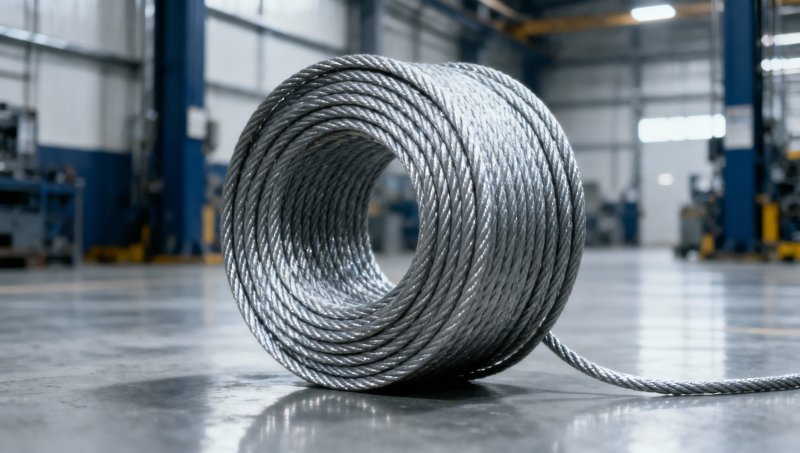
Real-world verification—not just paperwork
Certificates of Conformance are necessary. But they’re not sufficient. We recommend three verification steps before accepting a batch:
- Batch traceability: Confirm each coil carries heat number, galvanizing bath log, and tensile test report—not just a generic mill certificate.
- On-site bend testing: Take a 1-meter sample, wrap it around a mandrel matching your smallest sheave diameter, and inspect for zinc flaking or micro-cracking.
- Visual coating check: Under angled light, the surface should show uniform dull-silvery gray—not streaky, blotchy, or overly yellow-tinged (a sign of excessive iron-zinc alloy layer).
This isn’t about distrust. It’s about recognizing that tensile strength degrades predictably—but only if coating integrity holds. Once zinc fails, corrosion attacks the steel substrate at grain boundaries, accelerating fatigue failure far beyond what tensile charts suggest.
What this means for your next order
If your project involves long-term exposure (bridges, marine terminals, power transmission), lean toward 1770–1960 MPa wire ropes with heavy-duty galvanizing (≥20 g/m²) and independent wire rope core (IWRC). If it’s short-duration rigging or temporary works with frequent re-use, 1570–1770 MPa offers the best balance of strength, flexibility, and handling safety.
And if your scope includes auxiliary wire applications—mesh fabrication, formwork ties, or site barriers—don’t default to high-tensile. Consider whether Hot Dipped Galvanized Steel Wire fits better: cost-efficient, highly formable, and corrosion-resistant enough for its role.
At Hongteng Fengda, we treat wire rope as part of the structural system—not just a component. That means aligning tensile grade, galvanizing process, and application intent from day one. We support global projects with documentation that traces back to raw material heats, third-party lab reports aligned to your required standard (ASTM/EN/GB), and lead times built for construction sequencing—not factory convenience.
The right tensile strength isn’t the highest number on the page. It’s the one that stays intact—through installation, service, and seasonal exposure—without requiring extra safety factors, rework, or unplanned downtime.
Please give us a message


Please enter what you want to find