Soil pH and Steel Sheet Pile Integrity: Where Corrosion Acceleration Begins
When reviewing Steel Sheet Pile technical specifications, one question keeps reappearing—not in procurement checklists, but in corrosion reports, post-installation inspections, and long-term asset reviews: at what soil pH does electrochemical degradation shift from gradual to aggressive? It’s not a theoretical threshold. It’s a field-validated inflection point that directly impacts design life, inspection frequency, and coating selection.
For quality control and safety professionals overseeing infrastructure—coastal retaining walls, inland flood barriers, or industrial containment systems—this isn’t about academic precision. It’s about knowing when standard carbon steel sheet piles cross into a regime where uniform corrosion rates double, pitting initiates more readily, and cathodic protection becomes less predictable without intervention.
The 4.5 pH Threshold: Not Arbitrary, But Electrochemically Grounded
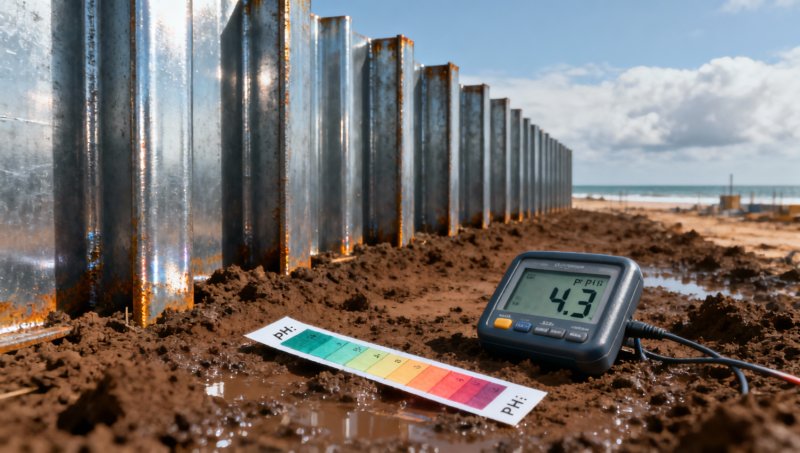
The widely cited value of pH 4.5 as the trigger for accelerated corrosion in uncoated or conventionally coated structural steel isn’t an industry rule-of-thumb. It reflects the onset of hydrogen ion dominance in the soil electrolyte—where the protective oxide layer on carbon steel begins to dissolve faster than it reforms. Below pH 4.5, the corrosion current density increases measurably, especially in the presence of chloride or sulfate ions, which are common in marine sediments or acid-sulfate soils.
This is confirmed across ASTM G193 (Standard Guide for Corrosion Terms), ISO 15686-2 (Service life planning), and EN 1993-5 (Design of steel structures — Part 5: Plated structural elements). None prescribe a universal “safe” pH—but all treat pH < 4.5 as a red flag requiring explicit corrosion mitigation strategies within the Steel Sheet Pile technical specifications.
That doesn’t mean pH 4.6 is safe and 4.4 is catastrophic. Corrosion is cumulative, synergistic, and site-specific. But from a specification review standpoint, pH 4.5 serves as the first technical gate: if site investigation indicates sustained pH ≤ 4.5 in the active corrosion zone (typically the upper 2–3 meters below ground level), the spec must address it—not with vague language like “corrosion-resistant materials,” but with defined material grades, coating systems, and verification methods.
What Happens If You Overlook This in Specification Review?
We’ve seen cases where projects passed geotechnical review with “pH 4.3–4.7” noted in the appendix—but the Steel Sheet Pile technical specifications referenced only ASTM A572 Grade 50, with no mention of coating thickness, adhesion testing, or supplemental cathodic protection. Three years post-installation, ultrasonic thickness surveys showed localized wall loss exceeding 30% in zones matching low-pH strata. No failure occurred—but the inspection cycle had to be halved, and contingency budgets revised.
That’s the real risk: not immediate collapse, but unpredictability. When pH drops below 4.5, corrosion shifts from relatively linear to more stochastic—especially under cyclic wet-dry conditions or fluctuating groundwater tables. That undermines the reliability of service-life projections baked into tender documents and maintenance plans.
How Material Selection and Coating Strategy Respond
At Hongteng Fengda, our approach starts with clarity: we don’t assume pH thresholds. We build flexibility into our manufacturing and documentation so that corrosion response is traceable—not just compliant. For example, our ASTM- and EN-compliant sheet piles can be supplied with hot-dip galvanizing per ASTM A123 (minimum 610 g/m²) or polymer-coated systems meeting ISO 12944 C4–C5 requirements—both validated for extended performance in acidic soils when applied over proper blast cleaning (Sa 2.5).
But coating alone isn’t enough if base steel lacks resilience. That’s why, for projects where pH ≤ 4.5 is confirmed, we often recommend upgrading from standard Q235-based piles to Q355B or even weathering steel variants—provided environmental chloride levels remain moderate. These steels offer higher inherent passivation stability in low-pH environments, buying time before coating degradation accelerates.
It’s worth noting that this same principle applies across related structural components. For instance, when specifying anchor rods, wales, or bracing systems in the same soil profile, consistency matters. A mismatch—say, using high-strength low-alloy steel for sheet piles but carbon steel for tie rods—creates galvanic couples that further accelerate localized attack. That’s why our engineering support includes cross-component material alignment checks—not just for compliance, but for electrochemical coherence.
Where Seamless Pipe Fits In—Not as a Replacement, But as a Reference Point
While sheet piles dominate vertical earth retention, many supporting systems—like dewatering casings, grout conduits, or internal bracing sleeves—rely on seamless pipe. Our a106 gr b Seamless Pipe, manufactured to ASTM A106 Grade B with Q355B carbon steel base, demonstrates how controlled chemistry and tight dimensional tolerances (+/− 0.05 mm on wall thickness) contribute to predictable behavior in corrosive environments. Its consistent microstructure supports reliable pickling and coating adhesion—traits equally relevant when evaluating sheet pile surface preparation standards.
We mention it not to pivot the discussion, but because spec reviewers often overlook how material consistency across *all* embedded steel elements affects long-term integrity. If your sheet pile spec demands SSPC-SP10/NACE No. 2 surface prep, but your anchor pipe supplier only guarantees SP6, you’re introducing variability at the interface—where corrosion most often initiates.
Practical Steps During Specification Review
Here’s what we advise QC and safety teams to verify—not once, but systematically:
- Soil pH reporting depth: Is it measured at multiple elevations—or just surface level? The active corrosion zone may sit below topsoil.
- Coating specification linkage: Does the spec cite ASTM D4417 for dry-film thickness measurement? Or just “apply two coats”?
- Test method alignment: If salt-spray testing is required, does it follow ASTM B117—or a custom cycle that better simulates local wet/dry cycling?
- Weld procedure qualification: For welded interlocks or connections, does the WPS include post-weld treatment for heat-affected zone corrosion resistance?
None of these require proprietary solutions. They require attention to how standards interact—not just which ones are listed.
Final Thought: Specifications Are Living Documents
A Steel Sheet Pile technical specifications document isn’t a static stamp of approval. It’s a shared understanding—between geotechnical engineer, structural designer, fabricator, and installer—of where the material will live, how it will behave, and what evidence confirms it’s performing as intended. The pH 4.5 threshold matters because it forces that conversation early. It prevents assumptions from becoming liabilities.
If your next project involves acidic soils—or if past projects revealed unexpected corrosion patterns—we recommend revisiting both the geotech report *and* the spec side-by-side. Not to find fault, but to identify where tighter coupling between pH data, material selection, and verification methods adds tangible, measurable resilience.
Hongteng Fengda supports this process with full traceability—from mill test reports aligned to ASTM A6/A6M and EN 10025, to batch-level coating adhesion logs and third-party salt-spray validation records. Because durability isn’t delivered in a datasheet. It’s verified in the details.
Please give us a message


Please enter what you want to find