When planning structural steel fabrication for curved members—especially for complex architectural or industrial projects—understanding typical yield loss is critical for accurate costing and material procurement. As a trusted structural steel fabrication partner from China, Hongteng Fengda helps global buyers anticipate and minimize waste through precision engineering, advanced bending technology, and decades of experience with ASTM/EN-compliant curved beams, channels, and custom profiles. In this article, we break down realistic yield loss ranges, key influencing factors, and how proactive collaboration with your manufacturer can significantly improve material efficiency and project ROI.
A Shift Toward Precision-Driven Yield Optimization
The structural steel fabrication landscape is undergoing a measurable shift—not in raw material costs alone, but in how yield loss is perceived, measured, and mitigated. Five years ago, procurement teams often accepted 8–12% yield loss for curved structural members as standard practice. Today, leading fabricators—including ISO-certified manufacturers like Hongteng Fengda—are consistently delivering yield losses between 3.5% and 6.2% for ASTM A572 Grade 50 or EN S355JR curved beams, provided design inputs are finalized early and bending parameters align with material formability limits.
This improvement isn’t accidental. It reflects broader industry trends: tighter project budgets, rising scrap disposal costs (up to $180/ton in EU ports), stricter sustainability reporting requirements (e.g., LEED MRc2, BREEAM MAT 03), and growing buyer demand for traceable material utilization metrics. Procurement professionals now routinely request yield-loss forecasts alongside quotations—making it a non-negotiable data point in sourcing decisions.
What’s driving this change? Three interlocking developments: (1) digital twin integration in bending simulation software (e.g., AutoForm-Bending, BendSim), reducing trial-and-error iterations by up to 70%; (2) real-time thickness monitoring during cold roll forming, enabling dynamic compensation for mill tolerance variations; and (3) standardized pre-bend nesting protocols that optimize cut patterns across multiple curved radii on the same plate batch.
Typical Yield Loss Ranges by Member Type & Process
Note that these ranges reflect production at facilities operating under ISO 9001:2015 with calibrated CNC bending machines and certified weld procedure specifications (WPS). Facilities without integrated nesting software or lacking metallurgical process validation often report yield losses exceeding 9.5%—a gap that directly impacts landed cost per tonne and carbon intensity per linear meter.
Why Curved Members Are Now a Key Yield Benchmark
Curved structural members have evolved from niche architectural elements into high-volume components for wind turbine towers, modular data center frames, and logistics hub roof systems. Global demand for curved purlins and wall beams grew at a CAGR of 6.8% from 2020–2023, according to industry shipment data aggregated by SteelMint Analytics. This volume growth has intensified scrutiny on yield performance—not just as a cost factor, but as a proxy for technical capability, digital maturity, and supply chain resilience.
Procurement teams now assess yield loss data alongside bend radius repeatability (±1.2mm tolerance over 12m length), surface finish consistency (Ra ≤ 6.3μm post-bending), and certification traceability (mill test reports linked to individual bent segments). These criteria signal whether a supplier operates reactive fabrication—or predictive, specification-aligned manufacturing.
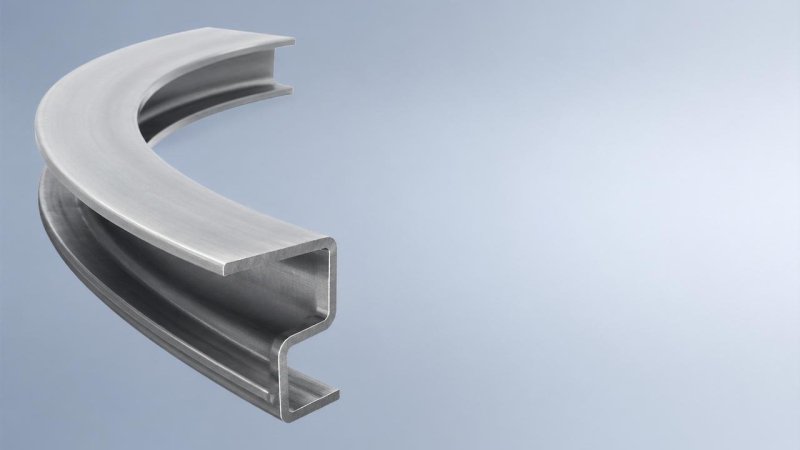
For example, when fabricating curved Z-beam profiles for lightweight roof structures, precise control over web buckling during cold forming directly affects usable length yield. At Hongteng Fengda, our roll-forming lines integrate real-time strain gauging and adaptive roller pressure modulation—reducing end-of-run scrap by an average of 2.1 meters per 12-meter coil compared to conventional setups.
Four Critical Procurement Signals Hidden in Yield Data
- Design-for-manufacturability alignment: Yield loss >7% on simple radius bends often indicates misalignment between CAD geometry and achievable cold-forming limits—flagging potential rework risk.
- Material grade discipline: Consistent yield variance across Q345B and Q420C batches suggests inconsistent mill certificate verification or uncalibrated tensile testing.
- Process transparency: Suppliers who provide yield breakdowns (cutting loss, bending trim, end scrap) demonstrate granular process control—not just aggregate numbers.
- Scalability readiness: Yield stability across lot sizes ≥50 tons signals robust nesting algorithms and stable tooling—critical for multi-phase infrastructure projects.
How Early Collaboration Reduces Yield Variability
Yield loss isn’t fixed—it’s negotiated through technical dialogue. At Hongteng Fengda, our structural steel fabrication team engages procurement partners during the RFQ stage—not after PO issuance—to jointly review bending feasibility, nesting options, and alternative section substitutions. This co-engineering approach reduces yield volatility by up to 40% versus traditional “quote-and-build” workflows.
We recommend initiating this collaboration with three concrete inputs: (1) full 3D model with neutral axis definition, (2) minimum acceptable radius per member type (not just overall curve), and (3) preferred material grade with certified elongation values. With these, our engineers generate a yield forecast within 48 business hours—including annotated nesting diagrams and trim-loss projections per batch.
This level of upfront engagement also surfaces opportunities: switching from hot-bent channels to cold-formed Z-beam with integrated curvature can reduce total delivered weight by 11–14% while improving connection stiffness—factors that compound yield efficiency across the entire structural steel fabrication sequence.
Your Next Step: From Yield Forecast to Project Confidence
Yield loss is no longer a passive cost—it’s an actionable metric that reveals operational rigor, digital capability, and partnership depth. For procurement professionals managing structural steel fabrication across global supply chains, verifying yield assumptions before contract finalization prevents budget overruns, schedule delays, and compliance exposure.
Hongteng Fengda invites you to submit your next curved-member project for a free yield-loss forecast and nesting optimization review. We’ll provide: (1) a detailed yield breakdown aligned to your specified ASTM/EN/GB grade and thickness; (2) recommended bending method with tolerance validation; (3) lead time impact analysis for early-design-stage input; and (4) optional comparison against standard-section alternatives.
Contact our technical procurement team today to discuss your upcoming structural steel fabrication requirements—including curved beams, channels, custom profiles, and Z-beam applications. Let’s ensure your material budget reflects reality—not legacy assumptions.
Please give us a message


Please enter what you want to find