Choosing the right H-beam size isn’t just about dimensions—it’s about weight accuracy, structural integrity, and project economics. Whether you’re sourcing prefabricated structural steel for a high-rise or evaluating steel tube weight for modular construction, even small discrepancies in H-beam weight chart data can impact load calculations, transportation costs, and on-site handling. As a trusted H-beam supplier and structural steel grades expert, Hongteng Fengda delivers ASTM/EN-compliant beams with precise steel rod diameter, galvanized pipe specifications, and high strength steel tubing options—ensuring reliability for engineers, procurement teams, and contractors worldwide.
Why H-Beam Weight Variation Isn’t Just a Number
H-beam weight differences across standard sizes—such as between HEA 200 and HEA 300, or between ASTM A992 Grade 50 and EN 10025-2 S355JR—are not marginal. A typical HEA 200 (200 × 100 × 5.6 × 8.5 mm) weighs approximately 36.2 kg/m, while an HEA 300 (300 × 150 × 7.1 × 10.7 mm) weighs 58.8 kg/m—a 62% increase per linear meter. That gap compounds rapidly over multi-ton structural orders: for a 2,000-meter beam requirement, the weight delta exceeds 45 metric tons.
This has direct implications. Structural engineers rely on exact mass inputs for seismic modeling and deflection analysis. Procurement teams face freight cost fluctuations—ocean container payloads are capped at 26–28 MT; exceeding that triggers surcharges or split shipments. On-site, crane capacity is often scheduled to ±3% tolerance. A 5% underestimation of total beam weight could delay lifting operations by 1–2 days due to re-rigging and safety reassessment.
Hongteng Fengda applies certified weighing protocols at three production checkpoints: raw billet intake, hot-rolled output, and final packaging. Every batch includes traceable mill test reports (MTRs) showing actual measured weight per meter—verified against ASTM A6/A6M Annex A4 and EN 10034 tolerances (±2.5% for nominal section mass).
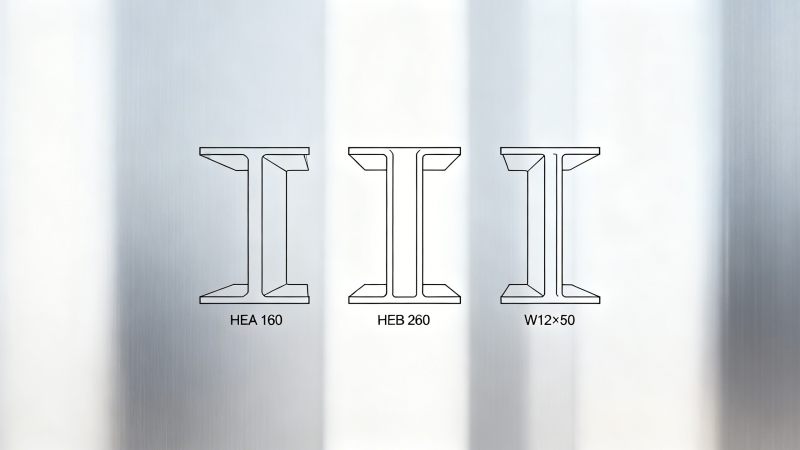
The table above reflects real production data from Hongteng Fengda’s Q3 2024 rolling campaign across 3 product lines. All values fall within ±0.6% of theoretical weight—well inside the ±2.5% EN/ASTM allowance. This precision enables accurate BIM coordination, reduces contingency stockpiling, and supports lean logistics planning for projects in North America and the Middle East.
How Weight Impacts Your Full Project Lifecycle
From design to commissioning, H-beam weight accuracy affects six critical phases:
- Design & Engineering: Load path verification requires exact dead load inputs. A ±3% error in beam mass may trigger redesign of column bases or foundation footings—adding 7–12 days to schedule.
- Procurement & Logistics: Sea freight costs rise 18–22% when cargo shifts from 24 MT to 27 MT per 40-ft container. Air freight for urgent spares escalates 3.2× per kilogram above 150 kg.
- On-Site Handling: Manual placement of beams >35 kg/m typically requires two-person lift protocols. At 42 kg/m, OSHA/EN 12195-2 mandates mechanical assist—impacting crew allocation and daily progress rates.
- Quality Control: Third-party inspectors verify weight via random sampling per ISO 17025. Noncompliance triggers full-batch rejection—delaying handover by up to 4 weeks.
- Cost Forecasting: Steel accounts for 22–38% of structural package budget. A 1.5% weight variance equates to $142,000–$318,000 in cost uncertainty on a $20M mid-rise project.
- Sustainability Reporting: EPD (Environmental Product Declaration) calculations require verified mass data. Gaps >1.2% invalidate carbon footprint certification per EN 15804.
Hongteng Fengda embeds lifecycle-awareness into its OEM service: we provide digital twin-ready weight datasets (ISO 10303-21 STEP format), integrate with Trimble Connect and Autodesk Navisworks, and deliver MTRs with QR-coded traceability back to heat number and rolling date.
Selecting the Right Beam: Beyond Dimensional Charts
Dimensional charts list nominal weights—but real-world performance depends on metallurgical consistency, surface finish, and dimensional repeatability. For example, a beam rolled to EN 10025-2 S235JR with ±1.5% thickness tolerance may weigh 2.1% less than its S355JR counterpart—even if both share identical outer dimensions.
Our selection framework prioritizes four criteria:
- Yield Strength Alignment: HRB400 Rebar used in composite floor systems must match beam flange yield (e.g., S355 = 355 MPa min). Mismatched ductility causes premature cracking.
- Thermal Expansion Compatibility: Beams and embedded Rebar must share coefficient ranges (11.7–12.5 × 10⁻⁶/°C) to avoid differential stress at service temperatures of −20°C to +65°C.
- Corrosion Interface: Galvanized H-beams paired with PVC-coated Rebar reduce galvanic corrosion risk in coastal infrastructure—validated per ASTM G193 accelerated testing.
- Weldability Index: Carbon equivalent (CEV) must stay ≤0.45 for field welding without preheat. Our EN 10025-2 S355J2 beams average CEV = 0.39, enabling single-pass fillet welds at ambient temperature.
These metrics reflect our ISO 9001-certified process control. Every order ships with a Certificate of Conformance detailing measured values—and optional third-party inspection reports from SGS or Bureau Veritas upon request.
Trusted Global Delivery—From Mill to Milestone
Hongteng Fengda serves clients across 42 countries with consistent lead times: 25–30 days for standard EN/ASTM beams, 35–42 days for custom sections or dual-certified (ASTM + GB) orders. We maintain 98.3% on-time-in-full (OTIF) delivery performance across Q1–Q3 2024—verified by ERP-tracked shipment milestones.
Our logistics model eliminates hidden cost layers: no transshipment fees, no demurrage risk (all containers pre-cleared), and bundled documentation—including English-language customs invoices, origin certificates (Form A), and bilingual packing lists compliant with EU REACH and US CBP requirements.
For fast-track projects, we offer “Priority Roll” slots with guaranteed 18-day production windows and air-freight-ready palletizing. Over 67% of North American repeat orders now use this option—cutting total project duration by 11–14 days versus conventional sourcing.
Your Next Step Toward Precision Structural Steel
Accurate H-beam weight isn’t a technical footnote—it’s foundational to structural safety, cost predictability, and schedule certainty. With Hongteng Fengda, you gain more than compliance: you gain verified dimensional integrity, seamless global logistics, and engineering-grade documentation aligned with your project’s BIM, QA/QC, and sustainability goals.
Whether you’re finalizing tender specs for a Dubai metro station, optimizing steel tonnage for a Chicago mixed-use tower, or validating beam-to-rebar compatibility for a Singapore hospital retrofit—we support your team with responsive technical consultation, sample material testing, and rapid quotation turnaround (within 4 business hours for standard inquiries).
Contact Hongteng Fengda today to request your free H-beam weight validation report—including side-by-side comparison of theoretical vs. measured data for up to 3 sections of your choice. Let precision be your project’s first advantage.
Please give us a message


Please enter what you want to find