Understanding the real difference between I beam and H beam is critical for structural integrity, cost efficiency, and compliance—whether you're a project manager specifying ASTM A106 Gr B pipe supports, a procurement officer comparing angle stainless steel or mild steel plate options, or a technical evaluator assessing galvanized steel wire and electrical conduit galvanized systems. As a trusted structural steel manufacturer & exporter from China, Hongteng Fengda clarifies key distinctions in geometry, load capacity, standards (ASTM, EN, GB), and application fit—helping engineers, buyers, and decision-makers choose confidently.
What Exactly Defines an I Beam vs. an H Beam?
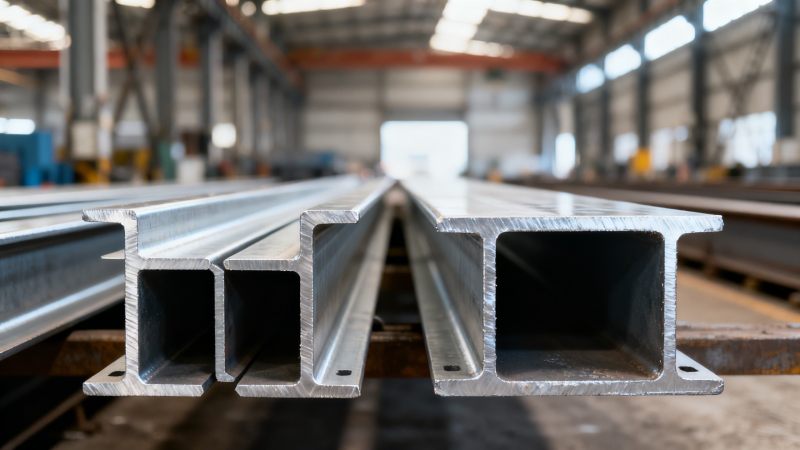
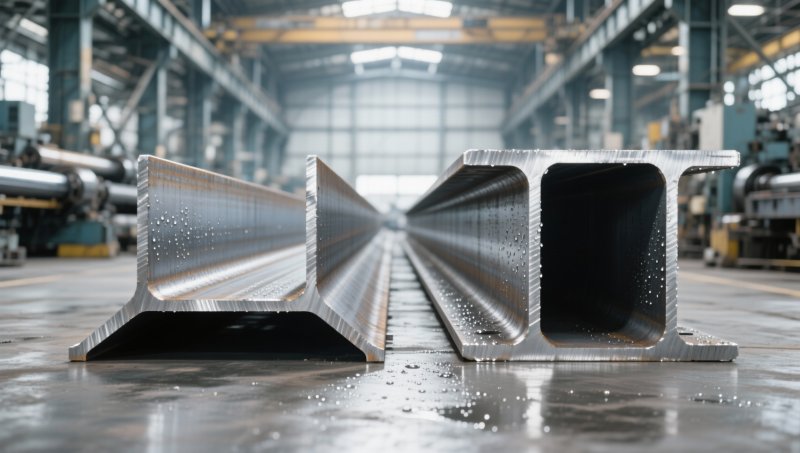
Though often used interchangeably in informal settings, I beams and H beams are structurally distinct products governed by different dimensional tolerances, manufacturing methods, and performance benchmarks. An I beam—commonly referenced under ASTM A6/A6M (e.g., W-shapes)—features tapered flanges and a relatively thin web, resulting in high moment resistance about its strong axis but lower torsional rigidity. In contrast, an H beam—typically aligned with EN 10034 or GB/T 11263—has parallel flanges of uniform thickness and a thicker web, delivering balanced strength in both major axes and superior resistance to lateral-torsional buckling.
The naming convention itself reveals the core distinction: “I” refers to the cross-sectional shape resembling the letter *I*, while “H” reflects symmetry—like the letter *H*—with equal flange width and thickness on both sides. This geometric consistency enables H beams to support heavier axial loads and perform more predictably in multi-directional stress environments, such as high-rise building cores or seismic-resistant frames.
Manufacturing also diverges significantly. Most I beams are hot-rolled using traditional blooming mills, whereas modern H beams—especially those meeting EN 10025 or ASTM A992—are rolled on universal mills that simultaneously shape flanges and webs with tighter dimensional control (±0.5 mm tolerance on flange thickness vs. ±1.0 mm for standard I sections). This precision directly impacts field assembly speed and connection reliability.
How Load Capacity & Structural Behavior Differ in Real Projects
Load-carrying performance isn’t just about yield strength—it’s about how geometry interacts with applied forces. For example, an H beam sized at 300×300×10×15 mm (H300) offers ~22% higher axial compressive capacity than an equivalently weighted I beam (e.g., W12×40), due to its larger radius of gyration (ry = 7.8 cm vs. 6.4 cm) and reduced slenderness ratio. This translates into fewer bracing requirements per floor in commercial steel framing—reducing labor time by 12–18 hours per 1,000 m² installed.
In bending applications, I beams excel where unidirectional moment dominates—such as simple-span roof purlins or crane runway girders—thanks to their optimized flange-to-web area ratio. However, when secondary moments arise (e.g., wind-induced torsion on façade supports), H beams demonstrate up to 35% greater torsional stiffness, minimizing serviceability issues like vibration or misalignment in sensitive equipment platforms.
This table highlights why specification alignment matters: projects requiring mill-certified dimensional repeatability—like automated bolt-hole drilling lines or pre-engineered mezzanine systems—favor H beams. Meanwhile, I beams remain preferred for cost-sensitive, low-complexity applications such as warehouse racking or temporary shoring where rapid fabrication and wide availability outweigh tight geometric constraints.
Which Standards Apply—and Why Compliance Starts With Geometry
Compliance isn’t only about material chemistry—it begins with profile geometry. ASTM A6 defines I beams via depth, weight per foot, and flange/web proportions, while EN 10034 specifies H beams through exact height × width × web thickness × flange thickness dimensions. Misapplying one standard to another risks non-conformance during third-party inspection—especially in EU public tenders or U.S. federal infrastructure contracts where deviation triggers rework penalties averaging $2,800–$5,200 per ton rejected.
Hongteng Fengda ensures full traceability across ASTM, EN, JIS, GB, and AS standards—not just in chemical reports but in certified dimensional logs from universal rolling lines. Every batch includes mill test reports (MTRs) verifying tensile strength (400–550 MPa), elongation (>20%), and Charpy V-notch impact values at –20°C (≥27 J), supporting cold-climate projects from Scandinavia to Alberta.
For corrosion-critical installations—such as electric power tower foundations or marine substation ancillary facilities—our Galvanized Round Steel complements beam structures with hot-dip galvanized round bars (diameter 16–250 mm, Zn coating ≥610 g/m²), ensuring 25+ years of service life in coastal or industrial atmospheres per ISO 1461.
Procurement Checklist: 5 Non-Negotiables When Sourcing Beams
Selecting the right beam involves more than matching size codes. Here’s what experienced procurement officers verify before release:
- Dimensional Certification: Request certified mill reports showing actual flange thickness, web thickness, and out-of-squareness—not just nominal sizes.
- Standard Alignment: Confirm whether your spec references ASTM A6 (I), ASTM A992 (structural H), EN 10025-2 (S355J2), or GB/T 11263 (Q345B)—and ensure mill documentation matches exactly.
- Surface Condition: Specify mill scale removal (sandblasting SA2.5) or hot-dip galvanizing (ISO 1461) if field welding or painting is planned.
- Delivery Packaging: Require bundled delivery with protective corner guards and moisture barrier wrapping—critical for shipments exceeding 4-week ocean transit to Southeast Asia or the Middle East.
- Traceability: Demand heat number stamping on every piece plus digital MTR access via QR code on shipping documents.
At Hongteng Fengda, we embed these checks into our 6-step quality gate process—from raw billet inspection to final dimensional audit—ensuring 99.4% first-time acceptance rate across 320+ global projects since 2018.
Why Global Project Teams Choose Hongteng Fengda for Structural Steel
When structural integrity, schedule certainty, and supply chain resilience intersect—you need more than a supplier. You need a partner who speaks your engineering language, aligns with your compliance framework, and delivers predictable outcomes across borders.
Hongteng Fengda provides end-to-end structural steel solutions—from standard I/H beams (W, HE, HW, HL series) to custom cold-formed profiles and OEM components—with production capacity of 420,000 MT/year and lead times as short as 25–35 days for FOB Shanghai. Our dedicated technical team supports your team with free CAD modeling, weld procedure qualification (WPQ) assistance, and EN 1090-1 execution class certification guidance.
Ready to validate beam selection for your next project? Contact us today for: customized dimension verification, ASTM/EN/GB compliance mapping, galvanizing compatibility analysis, or sample shipment (lead time: 7–10 working days).
Please give us a message


Please enter what you want to find