For technical evaluators, understanding what makes stainless sheet metal easier to fabricate is essential when comparing material options for structural and industrial applications. Factors such as grade selection, thickness consistency, surface condition, and formability directly affect cutting, bending, welding, and overall production efficiency. Choosing the right stainless sheet metal can help reduce processing risks, improve quality control, and support more reliable project outcomes.
Why fabrication difficulty changes across real steel application scenarios
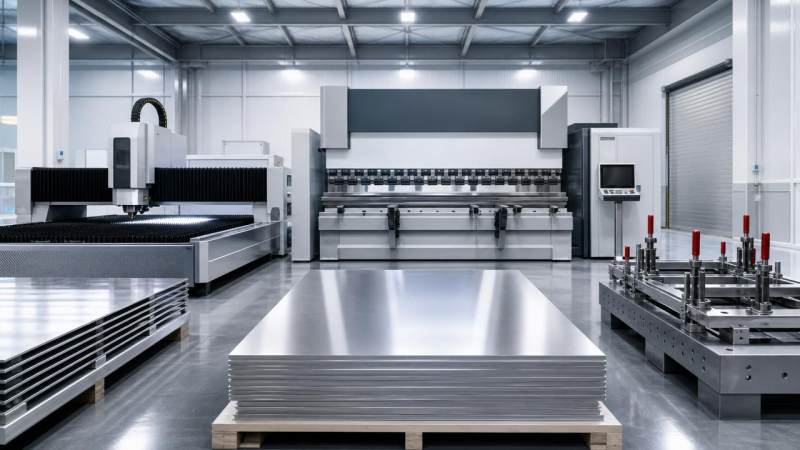
Not all stainless sheet metal behaves the same in production.
Ease of fabrication depends on the project environment, process route, and dimensional tolerance requirements.
In structural steel related work, the same sheet may cut well but bend poorly.
Another grade may weld cleanly but require slower punching or tighter heat control.
That is why stainless sheet metal selection should always be tied to application context.
A panel for industrial enclosures faces different demands than a formed bracket or welded support housing.
Material that supports stable fabrication usually lowers scrap, rework, and production interruptions.
It also improves consistency when downstream assembly depends on repeatable holes, bends, and weld seams.
Which stainless sheet metal works better in cutting-heavy scenarios
Laser cutting, shearing, and punching place immediate demands on flatness, surface condition, and chemistry control.
In cutting-heavy production, stainless sheet metal becomes easier to fabricate when thickness remains highly consistent.
Stable thickness supports cleaner kerf quality and better nesting efficiency.
It also helps avoid local overheating, burr formation, and variation in cut edge appearance.
For fine-feature parts, smooth surface finish matters because contamination can interfere with cut quality.
Grades with balanced strength and moderate hardness often process more predictably than overly hard alternatives.
Key indicators for cutting efficiency
- Uniform thickness across coils or sheets
- Low surface scale and limited contamination
- Controlled hardness for cleaner punching
- Good flatness for automated feeding systems
When bending and forming determine whether stainless sheet metal is easier to fabricate
Forming-intensive parts reveal another side of stainless sheet metal performance.
Brackets, covers, channels, cabinets, and supports need predictable elongation and bend behavior.
If the material hardens too quickly, cracks may appear at bend lines.
If springback is too high, repeatability drops and tooling correction takes longer.
Easier-to-fabricate stainless sheet metal usually combines adequate ductility with stable grain structure.
This improves bend radius control and reduces trial runs.
Surface quality also matters because scratches become more visible after forming.
For visible or exposed components, that affects both appearance and rejection rates.
In broader steel processing lines, supporting products may also require strong formability.
For example, Wire Rod is widely used in structural steel bar, shipbuilding, auto manufacturing, and building material applications.
Available in grades such as GB1499.2 HRB400, HRB500, ASTM A615 Grade 60, and BS4449 500C, it offers excellent formability and weldability.
That makes it a useful reference when comparing steel products for processing efficiency across different fabrication routes.
How welding scenarios change the best stainless sheet metal choice
Welded assemblies require a different evaluation logic.
Here, stainless sheet metal is easier to fabricate when it supports stable arc behavior and controlled heat input.
Grades with suitable carbon levels and balanced alloy content often reduce sensitivity to distortion.
This is important for thin sections, long seams, and appearance-sensitive components.
A clean surface helps produce better weld quality because oil, oxide, and residue may cause defects.
Good edge preparation also affects weld penetration and post-weld finishing time.
If the application involves corrosion exposure, the selected stainless sheet metal must keep both weldability and service performance in balance.
Typical welding judgment points
- Distortion risk in thin-gauge assemblies
- Surface cleanliness before welding
- Heat-affected zone appearance
- Post-weld pickling or polishing requirements
Different applications need different stainless sheet metal priorities
The easiest stainless sheet metal to fabricate depends on where the part will be used.
Structural and industrial applications often demand different tradeoffs.
Practical ways to choose stainless sheet metal for easier fabrication
A practical selection process should begin with the dominant operation.
If cutting drives cycle time, prioritize thickness consistency and flatness first.
If bending drives quality risk, review elongation, hardness, and forming history.
If welding drives rework, focus on surface condition, chemistry control, and distortion tendency.
Recommended evaluation steps
- Define whether cutting, bending, or welding is the primary constraint.
- Match grade selection to corrosion needs and process demands.
- Check dimensional consistency across supply batches.
- Review surface finish against visible and welded applications.
- Run sample fabrication trials before final approval.
Reliable suppliers also matter in this process.
Strong process control helps maintain stable mechanical properties and dependable delivery performance.
That is especially important in global structural steel projects with tight schedules.
Common mistakes when judging stainless sheet metal fabrication performance
One common mistake is selecting stainless sheet metal only by corrosion resistance.
A highly corrosion-resistant grade may still create forming or welding challenges.
Another mistake is focusing only on nominal thickness instead of thickness consistency.
Small variation can create large differences in bending angle and laser settings.
Surface condition is also underestimated.
Protective film residue, scratches, or contamination may increase fabrication defects.
Finally, many teams skip realistic processing trials.
Testing only material certificates does not fully predict production behavior.
What to do next when comparing stainless sheet metal options
The best stainless sheet metal choice is the one that fits the actual fabrication scenario.
Look beyond basic grade labels and evaluate cutting, forming, and welding performance together.
For structural and industrial projects, this approach improves efficiency and reduces hidden processing costs.
Hongteng Fengda, a structural steel manufacturer and exporter from China, supports global projects with reliable steel products, strict quality control, and customized solutions.
When reviewing stainless sheet metal for easier fabrication, prepare drawings, target standards, thickness ranges, and process priorities first.
That makes technical comparison faster and helps identify the most suitable material path for stable project execution.
Please give us a message


Please enter what you want to find