On the shop floor, the difference between a smooth run and a frustrating one often comes down to the material in the chuck. A bar that produces stable chips, holds shape during turning, and does not punish tools at every pass saves more than time; it reduces rework, operator stress, and uncertainty in production. That is why low carbon steel round bar for machining remains a practical choice in many workshops. It is not the hardest steel, not the most exotic, and not the strongest option on paper. What makes it valuable is that it behaves in a predictable, forgiving way under common machining conditions.
For operators, maintenance teams, and buyers supporting daily production, the real question is simple: what exactly makes low carbon steel round bar easier to machine than many alternatives? The answer is not one single property. It comes from a combination of chemistry, microstructure, ductility, and consistency that supports cutting, drilling, threading, and forming without excessive trouble.
It starts with lower hardness and a softer structure
Low carbon steel usually contains a relatively small percentage of carbon compared with medium or high carbon grades. That lower carbon content creates a softer and more ductile material structure, typically with a higher proportion of ferrite and less hard pearlitic content. In practical machining terms, this matters immediately.
A softer structure means the cutting edge does not face the same resistance that it would in harder steels. The tool can enter the material with less force, and the machine does not need to fight as much torque during turning or drilling. For operators, that often translates into easier setup, more stable cutting, and less aggressive wear on inserts, drills, and taps.
This does not mean low carbon steel is “soft” in a negative sense. It still has enough strength for many structural parts, general components, brackets, shafts, bushings, and welded assemblies. The advantage is that it gives a useful balance: strong enough to serve in real applications, but not so hard that machining becomes unnecessarily demanding.
Chip formation is usually more manageable
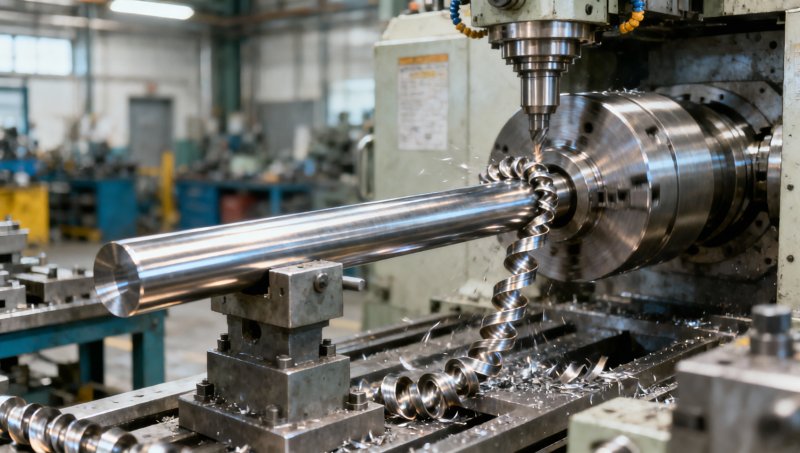
Anyone who has spent time near a lathe knows that chip control affects everything. Long, stringy chips can wrap around the tool, mark the surface, interrupt feed, and create safety concerns. While chip behavior always depends on cutting speed, feed rate, depth of cut, tool geometry, and coolant use, low carbon steel often produces chips that are more manageable than those from tougher, work-hardening, or higher-strength alloys.
Because the material deforms more readily under the cutting edge, it tends to shear in a more predictable way. That helps operators maintain a cleaner process window. You still need proper parameters, of course, but the material itself is generally less punishing when conditions are not perfect.
In many job shops, this matters more than theory. Materials that “forgive” small variations in setup are often preferred for routine machining, especially where multiple operators or mixed batches are involved.
Tool wear is lower than with many harder alloys
One of the biggest reasons machinists like low carbon steel round bar is simple economics. When the workpiece is easier on the tool, the shop spends less on inserts, downtime, and edge changes. Tool life is influenced by many variables, but the work material remains one of the most important.
Compared with higher carbon steels, alloy steels, or difficult stainless grades, low carbon steel generally causes less abrasive wear and lower cutting stress. Heat generation is also easier to manage because the tool is not forced to work as hard to remove material. Less heat at the edge often means less softening, less chipping, and a more consistent finish over longer runs.
For smaller workshops or operators running conventional machines, this can be especially important. A material that machines cleanly without requiring premium tooling or extremely narrow process control is often the one that keeps production practical.
Good ductility helps prevent sudden machining problems
Low carbon steel is known for good ductility and formability. Those same characteristics support machining stability. Brittle materials can chip unexpectedly. Very hard materials may generate vibration or accelerate tool damage. Work-hardening materials can become more difficult the longer you cut them. Low carbon steel generally avoids the worst of these behaviors.
That gives operators more room to maintain dimensional control. During drilling, for example, the material is less likely to behave erratically under a standard cutting setup. During threading or tapping, the lower hardness can reduce the risk of broken tools, provided lubrication and alignment are correct. During turning, it often responds well to common carbide or HSS tooling, making it suitable for both volume work and general-purpose fabrication.
It is easier to weld and machine in the same production chain
In real manufacturing, components are not always just machined. They may be cut, drilled, milled, bent, welded, and finished in sequence. This is another reason low carbon steel remains popular. Its machinability is not isolated from the rest of its usefulness. A workshop can machine features into a part and still benefit from good weldability and general fabrication performance afterward.
That matters in structural steel, industrial supports, equipment frames, anchor assemblies, base plates, and custom fabricated parts. Suppliers like Hongteng Fengda, as a structural steel manufacturer and exporter from China, often support buyers who need stable steel quality not only for machining but also for downstream fabrication. When steel must move through several processes without creating bottlenecks, balanced material properties become more valuable than extreme strength.
Consistency of raw material quality makes a visible difference
Even a machinable grade can become difficult if chemistry control, dimensional tolerance, or surface condition is inconsistent. Operators often blame tooling first, but variation in the incoming round bar can be the hidden source of chatter, poor finish, size drift, or unstable chip behavior.
With low carbon steel round bar for machining, consistency matters just as much as composition. Straightness, roundness, decarburization control, and surface defects all influence cutting performance. A bar with scale, seams, or inconsistent diameter can turn an easy material into a difficult job.
This is where supplier capability matters. Manufacturers serving international projects under ASTM, EN, JIS, or GB standards are generally expected to maintain tighter process discipline. For buyers, that does not just reduce inspection headaches. It also improves confidence that the same cutting program will behave similarly from batch to batch.
“Easy to machine” does not mean “no setup required”
There is a common misunderstanding in workshops: if a material is described as easy to machine, operators may assume almost any setup will work. That is rarely true. Low carbon steel is more forgiving, but machining results still depend on practical details.
Blunt tooling can smear the material instead of cutting it cleanly. Speeds that are too low may worsen built-up edge. Feeds that are too light can produce rubbing rather than shearing. In drilling operations, poor chip evacuation can still cause heat and damage. And if clamping is weak, a ductile workpiece may shift enough to affect tolerance.
So the material gives you a better starting point, not a free pass. Good coolant use, suitable insert geometry, and stable fixturing still matter.
Surface finish is often easier to achieve
When a material cuts with predictable resistance and reduced tool stress, surface finish usually improves as a result. Low carbon steel often allows operators to achieve acceptable finishes without pushing the machine to extremes. That makes it useful for parts that need a functional smooth surface before coating, welding, or assembly.
Still, finish quality depends on the exact grade and condition of the bar. Some low carbon steels can form a built-up edge on the tool, especially at unsuitable speeds. If surface tearing or roughness appears, the answer is not always to blame the steel itself. Often a small adjustment in speed, rake angle, or cutting fluid solves the issue.
In practice, many machinists prefer this kind of material precisely because it responds to sensible correction. With more difficult metals, parameter changes may produce only marginal improvement. With low carbon steel, the process window is usually wider.
Where operators see the biggest advantage
The benefits become most visible in routine, repeatable operations. Turning simple shafts, drilling connection holes, facing bar ends, cutting threads, and producing weld-ready parts are common examples. In these jobs, operators value a material that runs predictably over long shifts and across different machines.
That is one reason low carbon steel remains common in construction support components, general machinery parts, industrial hardware, and fabricated assemblies. It fits environments where cost, process speed, and workable mechanical properties must all stay in balance.
Interestingly, many facilities that work with structural steel or fabricated metal products also handle corrosion-resistant materials for separate applications. For example, filtration, architecture, and chemical processing may call for stainless mesh products such as 316 Stainless Steel Welded Mesh. That type of material serves a very different purpose, emphasizing resistance to rust, corrosion, acid, alkali, heat, and chemical exposure. Available in grades such as 201, 304, 304L, 316, 316L, and 430, with mesh ranges from 2 to 635 mesh and wire diameters from 0.0008″ to 0.12″, it shows how material selection always depends on the application. In machining-focused steel bar work, however, low carbon round bar wins because process friendliness often matters more than corrosion resistance.
How to judge whether a low carbon round bar will machine well
If you are selecting stock for regular machining, it helps to look beyond the grade name alone. Ask practical questions:
- Is the chemical composition controlled consistently across batches?
- Does the supplier provide standard-compliant material with reliable traceability?
- Is the bar straight, clean, and free of surface defects that may disturb cutting?
- Are dimensional tolerances suitable for your turning allowance or finished size?
- Will the material also need welding, bending, or coating after machining?
These points may sound basic, but they often decide whether machining stays efficient or becomes a series of small production losses.
Why buyers and operators often come back to the same material
There is a reason low carbon steel remains a familiar answer in machine shops. It reduces uncertainty. It gives operators a material that usually cuts without drama, responds well to standard tooling, and supports multiple fabrication steps after machining. Buyers appreciate it because it is widely available, economically practical, and suitable for many general-purpose applications.
For teams managing structural and industrial supply chains, this reliability matters as much as any technical property. A material that behaves consistently can simplify purchasing, planning, and production scheduling. That is especially true for exporters and project suppliers serving different markets and standards, where repeatability and reduced sourcing risk are central concerns.
The practical takeaway
What makes low carbon steel round bar for machining easier to machine is not a single magic feature. It is the combination of lower hardness, good ductility, manageable chip behavior, reduced tool wear, and broad process tolerance. Add stable raw material quality, and the result is a steel bar that supports efficient cutting and dependable output.
For operators, this means fewer surprises at the machine. For buyers, it means a material that can serve real production needs without making every job more complicated than it needs to be. In a workshop, that kind of simplicity is not basic at all. It is often the reason work gets done on time, within tolerance, and without unnecessary waste.
Please give us a message


Please enter what you want to find