JIS steel refers to steel products manufactured and tested according to Japanese Industrial Standards, a widely recognized system used in construction, machinery, infrastructure, and manufacturing.
For global buyers and project engineers, understanding how JIS steel differs from ASTM, EN, and GB standards is essential for material selection, compliance, and cost control.
This article explains the key differences in specifications, mechanical properties, dimensional tolerances, and quality expectations, helping you evaluate whether JIS-compliant structural steel suits your project.
The main difference: JIS steel is a complete specification system, not just a grade name
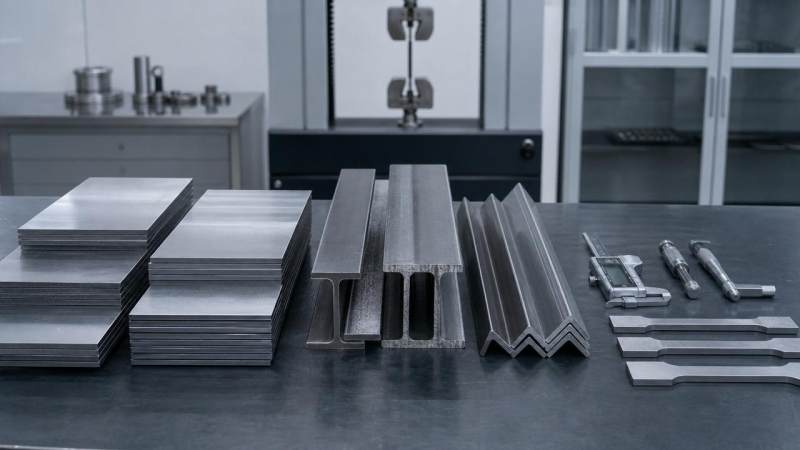
The most important point is that JIS steel is not defined only by chemical composition or strength level. It belongs to a broader standard system.
Japanese Industrial Standards specify material grades, dimensions, testing methods, tolerances, marking rules, and sometimes application-related requirements for steel products.
That means a JIS grade such as SS400, SM490, or S45C should be understood together with its product standard and intended use.
For buyers comparing JIS with ASTM, EN, or GB, the question is not which standard is universally better. The practical question is compatibility.
A project may require JIS steel because drawings, engineering calculations, procurement documents, or local approvals are based on Japanese standards.
What buyers usually want to know when comparing JIS with other standards
Most information researchers are not looking for a textbook definition. They want to know whether a JIS material can replace another specified grade.
They also need to understand whether the steel will pass inspection, match drawings, meet performance expectations, and avoid approval delays.
In international sourcing, standard differences can affect quotation accuracy, production scheduling, freight planning, and final acceptance at the destination site.
A small misunderstanding in grade equivalence, tolerance, or testing documents may lead to rejected cargo or additional third-party verification costs.
Therefore, the useful way to understand JIS steel is to examine performance requirements, dimensional rules, documentation, and practical substitution risks.
How JIS steel grades are named and why that matters
JIS grade names often indicate product type, application, or mechanical performance. For example, SS400 is common structural rolled steel.
In SS400, the number generally reflects a tensile strength class, while the letters relate to the steel category under the relevant JIS standard.
SM490 is often used for welded structures and has requirements more suitable for fabrication where weldability and structural performance are important.
By comparison, ASTM names such as A36 or A572 are organized differently, while EN grades often use yield strength-based designations.
This naming difference is not cosmetic. It changes how engineers search for equivalents and how procurement teams verify compliance.
When a drawing states JIS steel, buyers should confirm the exact grade, product form, standard number, thickness range, and inspection condition.
Mechanical properties: similar numbers may not mean identical performance
Mechanical properties are one of the first comparison points. Buyers usually examine yield strength, tensile strength, elongation, and impact performance.
However, equivalent-looking values do not always mean two grades are interchangeable. Testing direction, specimen type, thickness range, and delivery condition matter.
For example, a JIS structural grade may be close to an ASTM or EN grade in strength, but differ in elongation requirements.
Some standards emphasize yield strength in grade naming, while others classify materials by tensile range or intended application.
Impact testing is another key issue. Low-temperature applications, bridges, pressure-related structures, and offshore projects may require stricter toughness verification.
Before replacing a specified JIS steel, engineers should compare the full mechanical table, not only the headline strength value.
Chemical composition: JIS controls weldability and processing behavior differently
Chemical composition determines more than laboratory compliance. It affects weldability, formability, cutting behavior, heat treatment response, and long-term durability.
JIS standards specify limits for carbon, manganese, phosphorus, sulfur, silicon, and other elements depending on the product category.
For welded structural steel, carbon equivalent may become important because it helps estimate cracking risk and welding procedure requirements.
ASTM, EN, and GB standards may use different chemical limits, even when the mechanical strength range appears similar.
This is why material substitution should be reviewed by technical staff instead of relying only on online equivalence charts.
Equivalence charts are useful for early screening, but final approval should consider composition, mechanical properties, dimensions, and project specifications together.
Dimensional tolerances: a major difference in real procurement
Dimensional tolerances are often underestimated by buyers until assembly problems occur. JIS steel standards include detailed tolerances for many product forms.
For structural steel, these tolerances may cover thickness, width, length, flange width, web thickness, straightness, and out-of-square limits.
Different standards may allow slightly different tolerance ranges, which can affect fabrication accuracy, welding fit-up, and installation efficiency.
For example, channel steel, angle steel, beams, and plates must match design requirements and connected components during construction.
If a project was designed around JIS dimensions, switching to an EN, ASTM, or GB product can require dimensional confirmation.
For buyers, tolerance review is not just a quality concern. It is also a way to reduce rework, delays, and site adjustments.
Testing and inspection: JIS compliance depends on documented verification
JIS steel should be supported by proper inspection documents, not only a product label or a verbal grade statement.
Common verification materials include mill test certificates, chemical analysis results, mechanical test reports, dimensional inspection records, and heat number traceability.
For international buyers, the inspection document should clearly connect the delivered goods with the relevant JIS standard and purchase order.
If third-party inspection is required, the supplier should prepare sampling, testing, marking, and packing according to agreed procedures.
Some projects may also require ultrasonic testing, impact testing, bending tests, or additional surface quality checks before shipment.
The key is to define these requirements before production begins, because late-stage testing changes can affect cost and delivery time.
How JIS compares with ASTM, EN, and GB in practical use
ASTM standards are widely used in North America and many international industrial projects. They are familiar to global consultants and contractors.
EN standards are common in Europe and are strongly connected with Eurocode design practices, CE-related requirements, and harmonized material specifications.
GB standards are Chinese national standards and are highly relevant for projects sourcing from China or following Chinese engineering practices.
JIS standards are deeply used in Japan and many Asian markets, especially where Japanese design, equipment, or engineering influence exists.
The difference is not only regional. Each system has its own classification logic, testing philosophy, tolerance tables, and documentation expectations.
For sourcing decisions, the safest method is to match the standard required by the drawing, then evaluate alternatives only with engineering approval.
When JIS steel is the right choice for a project
JIS steel is a strong choice when the project specification, design drawing, equipment manual, or customer approval system explicitly requires Japanese standards.
It is also useful for projects involving Japanese machinery, prefabricated components, industrial platforms, or structural systems designed under JIS assumptions.
Buyers may prefer JIS-compliant material when they need predictable dimensions, recognized documentation, and compatibility with existing Japanese-standard components.
However, choosing JIS only because it sounds higher quality is not enough. The grade must still match the actual service conditions.
Load requirements, corrosion environment, welding method, temperature exposure, fabrication process, and local code acceptance should all be reviewed.
In many cases, the best solution is not a single standard preference, but a qualified material that satisfies both design and procurement needs.
Where product form affects the standard comparison
JIS steel differences become more specific when you move from general grades to actual product forms such as plates, beams, angles, or channels.
A structural beam and a steel sheet may share similar strength expectations, but their dimensional rules and production methods differ significantly.
For plate and sheet procurement, buyers must pay close attention to thickness range, flatness, surface condition, and cutting tolerance.
For example, Hongteng Fengda supplies Carbon Sheet Steel for construction, shipbuilding, petroleum, chemical, boiler, machinery, and hardware applications.
Available options include carbon sheet steel, hot rolled steel sheets, and corten steel plates, with thickness from 1mm to 100mm.
Typical widths include 1010, 1219, 1250, 1500, 1800, and 2500mm, while lengths can be customized according to project requirements.
When comparing JIS, ASTM, EN, or GB material, these practical size parameters are just as important as the grade designation.
Common risks when replacing JIS steel with another standard
The first risk is assuming that similar strength values equal full equivalence. This can overlook chemical limits, toughness requirements, or testing methods.
The second risk is ignoring thickness restrictions. Some grades only maintain certain property guarantees within defined thickness ranges.
The third risk is dimensional mismatch. Even small differences can affect bolted connections, fabricated frames, and modular assembly systems.
The fourth risk is documentation inconsistency. A buyer may receive acceptable steel physically, but fail project approval due to incomplete certificates.
The fifth risk is local code acceptance. Authorities, consultants, or end users may reject substitutions not formally approved before procurement.
To reduce these risks, buyers should request a technical comparison sheet before confirming orders involving non-original standards.
How to evaluate a JIS steel supplier before placing an order
A reliable supplier should understand not only the grade name, but also the applicable JIS standard and product category.
They should confirm chemical composition, mechanical properties, dimensional tolerances, delivery condition, inspection documents, and packing requirements before production.
For export orders, experience with international standards is especially valuable because many projects compare JIS with ASTM, EN, or GB.
Suppliers should also provide realistic lead times, stable production capacity, and clear communication when customized dimensions or OEM components are required.
Hongteng Fengda manufactures and exports structural steel products including angle steel, channel steel, steel beams, cold formed profiles, and custom components.
With quality control across multiple standards, the company supports buyers who need reliable steel sourcing for construction, industrial, and manufacturing projects.
Practical checklist for comparing JIS steel with other standards
Start with the project drawing and identify the exact grade, standard number, product form, dimensions, and any additional testing requirements.
Next, compare chemical composition limits, not only the common grade name or a simplified equivalent listed online.
Then review mechanical properties including yield strength, tensile strength, elongation, impact requirements, and thickness-related limitations.
After that, check dimensional tolerances for the exact product form, especially for beams, channels, angles, plates, and formed profiles.
Finally, confirm inspection documents, marking, packing, shipping requirements, and whether third-party inspection is needed before shipment.
This checklist helps buyers move from general research to a decision that can survive engineering review and project acceptance.
Conclusion: JIS steel is different because the whole system defines performance
JIS steel differs from other standards through its grade structure, testing rules, dimensional tolerances, documentation practices, and application focus.
It is not automatically better or worse than ASTM, EN, or GB steel. Its value depends on project compatibility.
For buyers and engineers, the right approach is to compare complete specifications instead of relying on simple grade equivalence.
If your project requires Japanese-standard materials, JIS-compliant steel can provide clear technical alignment and predictable acceptance.
If substitution is being considered, confirm mechanical properties, chemistry, tolerances, documentation, and local approval before issuing the purchase order.
With a qualified structural steel supplier, global buyers can reduce sourcing risk, control cost, and obtain materials that match real project requirements.


