When sourcing materials for heavy construction, bridge building, or industrial manufacturing, procurement teams and engineers frequently encounter Hot Rolled Coil (HRC). But what exactly is HRC steel, and how do steel mills produce it to meet rigorous global standards? HRC is a semi-finished steel product created by rolling steel slabs at extremely high temperatures, typically above the recrystallization temperature of the metal. Unlike cold-processed alternatives, hot rolling allows the steel to be easily shaped and formed, resulting in a material that offers excellent structural strength, formability, and cost-efficiency. Understanding the fundamental characteristics and the step-by-step manufacturing process of HRC is crucial for making informed procurement decisions, specifying the correct material grades, and ensuring the structural integrity of your final project.
For information researchers and technical buyers, knowing how HRC is manufactured provides direct insight into its mechanical behavior, surface condition, and dimensional tolerances. The high-temperature processing fundamentally alters the metallurgical structure of the steel, which dictates how the material will perform during subsequent fabrication processes like welding, bending, and cutting. This guide breaks down the core profile of HRC and details the precise operations inside a modern steel mill.
Defining the Physical and Mechanical Profile of HRC
Before examining the manufacturing process, it is necessary to understand the physical state of HRC as it leaves the mill. The most immediate visual characteristic of hot rolled steel is its surface. Because the steel is rolled at high temperatures and cooled in ambient air, it develops a blue-grey oxide layer known as mill scale. This iron oxide layer provides a degree of atmospheric corrosion resistance but must be removed through pickling, sandblasting, or grinding if the steel is to be painted, galvanized, or subjected to precision forming.
Dimensional tolerances are another critical factor. Due to the thermal expansion and contraction that occurs during the heating and cooling phases of production, HRC generally has wider tolerances for thickness and width compared to cold-rolled products. The edges of the coil are typically rounded or slightly irregular, a direct result of the material spreading laterally during the rolling passes. If a project requires sharp, precise edges or extremely tight thickness control, the hot rolled coil may need to undergo further cold reduction processing.
Mechanically, the hot rolling process normalizes the steel to a significant extent. The high temperatures allow the grain structure of the metal to recrystallize, which relieves internal stresses that might have been present in the original continuous cast slab. This results in a material with excellent ductility and impact resistance, making it highly suitable for structural applications where the steel must absorb energy without fracturing. The combination of good weldability and formability makes HRC the default choice for beams, channels, angle steel, and heavy structural components.
The Step-by-Step Manufacturing Process in Modern Steel Mills
The transformation of a solid steel slab into a continuous coil of HRC involves a highly coordinated sequence of thermal and mechanical operations. Modern steel mills utilize continuous hot strip mills to achieve high production volumes while maintaining strict control over the material's final properties.
Slab Reheating and Primary Descaling
The process begins with continuous cast steel slabs, which are stored at ambient temperature. These slabs are charged into a walking-beam or pusher-type reheating furnace. The primary objective is to heat the slab uniformly to approximately 1200°C to 1250°C. At this temperature, the steel becomes fully austenitic and highly plastic, allowing it to undergo massive thickness reduction without cracking. Uniform heating is critical; cold spots can cause rolling defects, while overheating can lead to grain coarsening or surface burning.
Once the slab reaches the target temperature, it exits the furnace and enters the primary descaling phase. As the slab sits in the furnace, a thick layer of primary scale forms on its surface. High-pressure water jets (operating at pressures exceeding 150 bar) blast the slab to remove this oxide layer. If this scale is not completely removed, it will be pressed into the surface of the steel during rolling, causing severe surface defects and compromising the final product's quality.
Roughing and Finish Rolling
The descaled slab then enters the roughing mill. In a typical continuous hot strip mill, the slab passes through a series of reversing stands or a continuous roughing train. Here, the thickness is progressively reduced from around 250 mm to a transfer bar thickness of 30 to 50 mm. The roughing process breaks down the cast structure of the slab, refines the grain size, and elongates the material. The edges of the transfer bar are often trimmed or scaled during this stage to ensure uniform width and prevent edge cracking in subsequent steps.
Following roughing, the transfer bar is conveyed to the finishing train. This section consists of multiple stands (usually 5 to 7) arranged in a continuous tandem configuration. The finishing mills reduce the steel to its final specified thickness, which can range from a few millimeters to around 20 mm, depending on the mill's capabilities. The rolling temperature in the finishing stands is strictly controlled, typically finishing above 900°C. This ensures that the steel remains in the austenite phase and prevents the formation of undesirable microstructures that could negatively impact toughness.
Laminar Cooling and Coiling
Immediately after exiting the final finishing stand, the red-hot steel strip enters the run-out table. This is where the most critical metallurgical control occurs. The strip passes through a laminar cooling system, which consists of multiple banks of water nozzles. By precisely controlling the flow, pressure, and distribution of the cooling water, the mill operators dictate the cooling rate of the steel. This controlled cooling rate determines the final microstructure—such as the proportion of ferrite, pearlite, or bainite—which directly defines the yield strength, tensile strength, and toughness of the final HRC.
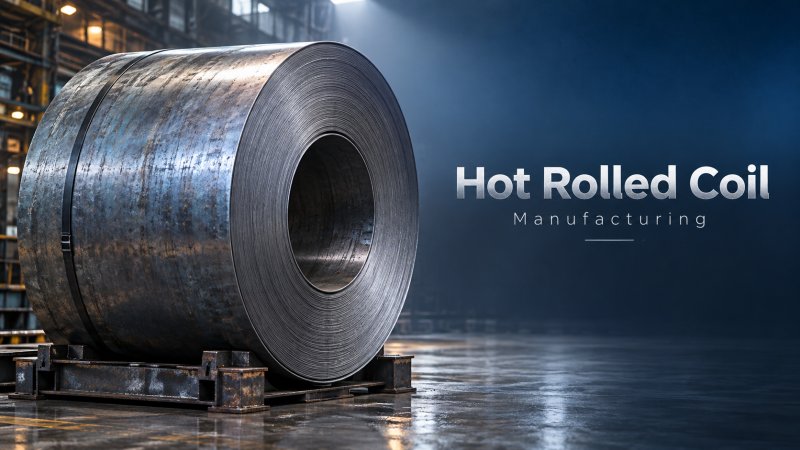
Once the strip reaches the target coiling temperature, usually between 550°C and 650°C, it is directed into the downcoiler. The coiler winds the long, continuous strip into a tight, heavy coil. The coiling temperature is just as important as the cooling rate; if the steel is coiled too hot, it may become too soft and difficult to handle, while coiling it too cold can result in excessive hardness and residual stresses. The finished HRC is then strapped, weighed, and moved to the finishing area for inspection and dispatch.
Differentiating HRC from Cold Rolled Alternatives
While HRC is the backbone of heavy structural engineering, its physical limitations mean it is not suitable for every application. When project specifications demand tighter dimensional tolerances, smoother surface finishes, or specific high-strength-to-weight ratios, engineers must look beyond standard hot-rolled products. In these scenarios, the manufacturing process shifts to cold reduction, or buyers specify cold-processed materials directly.
For applications requiring enhanced toughness, precise thickness control, and superior surface quality, buyers often transition to cold-rolled products. A prime example is the Steel Cold Rolled Coil manufactured from high-strength low-alloy grades like Q355 carbon steel. This specific material is engineered for demanding applications such as construction machinery, building structures, and pressure vessels. Through the cold reduction process, it enhances strength and toughness through the addition of trace alloying elements while maintaining good workability and weldability.
Available in thicknesses from 0.12-12mm and widths of 600-2000mm, this cold-rolled product meets the modern engineering requirement for high strength and lightweight construction. Furthermore, it can undergo various core functions like bending, cutting, punching, and surface treatments (such as galvanizing, oiling, or painting) to suit specific fabrication needs. Backed by certifications including ASTM, JIS, EN, and GB, it provides a reliable alternative when the as-rolled condition of HRC cannot meet the precise aesthetic or dimensional requirements of the final component.
Quality Assurance and Standard Compliance
The production of HRC is governed by strict quality control protocols to ensure the material meets international standards. Steel mills conduct rigorous testing on every heat of steel produced. Standard mechanical tests include tensile testing to determine yield strength, tensile strength, and elongation. For applications in cold environments or dynamic loading conditions, Charpy V-notch impact testing is performed to verify the material's toughness at specific sub-zero temperatures.
Chemical composition is verified using spectrometers to ensure the carbon, manganese, silicon, and trace elements fall within the specified ranges for the requested grade. Dimensional checks are performed continuously using laser gauges and ultrasonic thickness monitors to ensure the coil meets the required width and thickness tolerances. Surface quality is inspected both visually and through automated surface scanning systems.
Global procurement relies on standardized specifications to guarantee material performance. HRC is produced to meet major international standards, including ASTM (such as A36 for general structural use and A572 for high-strength low-alloy), EN 10025 (covering grades like S235, S275, and S355 in Europe), JIS G3101 (such as SS400 in Japan), and GB/T 700 in China. Every coil is accompanied by a Mill Test Certificate (MTC) that provides full traceability back to the original heat number, detailing the chemical and mechanical properties verified during production.
Strategic Sourcing and Specification Considerations
Understanding the manufacturing process of HRC allows procurement professionals and engineers to write more accurate specifications and avoid costly fabrication issues. If the end product requires extensive cold forming or deep drawing, specifying a hot-rolled grade with a coarse grain structure may lead to cracking. In such cases, requesting a normalized condition or a micro-alloyed grade from the mill can improve formability.
Similarly, if the HRC is intended for exposed architectural applications or requires high-quality painted finishes, the specification must explicitly require pickling and oiling (P&O) to remove the mill scale. Failing to account for the surface condition of as-rolled HRC can result in poor paint adhesion and premature corrosion. By aligning the material specification with the intended fabrication methods and the final operating environment, buyers can ensure that the HRC supplied by the mill delivers the required performance, optimizing both the structural integrity and the overall cost-efficiency of the project.
Please give us a message


Please enter what you want to find