Understanding the difference between API 5L steel pipe and ASTM A53 is critical for engineers, procurement teams, and project managers selecting corrosion-resistant pipe for oil & gas, infrastructure, or industrial applications. While both standards cover carbon steel pipe, API 5L—often supplied as ASTM A106 Gr B, hot galvanizing-ready, or corrosion-resistant pipe—meets stricter performance, testing, and traceability requirements. At Hongteng Fengda, a leading structural steel manufacturer & exporter from China, we supply high-grade API 5L and ASTM-compliant products—including mild steel plate, carbon sheet steel, hot rolled coil, and GI sheet coil—ensuring full compliance with ASTM, EN, JIS, and GB standards for global buyers.
What Is API 5L Steel Pipe? A Technical Overview
API 5L is a specification developed by the American Petroleum Institute for line pipe used in pipeline transportation systems for petroleum and natural gas. First published in 1927, it has evolved through multiple editions—including the current 46th edition (2022)—to address increasing demands for strength, weldability, toughness, and traceability in harsh service environments.
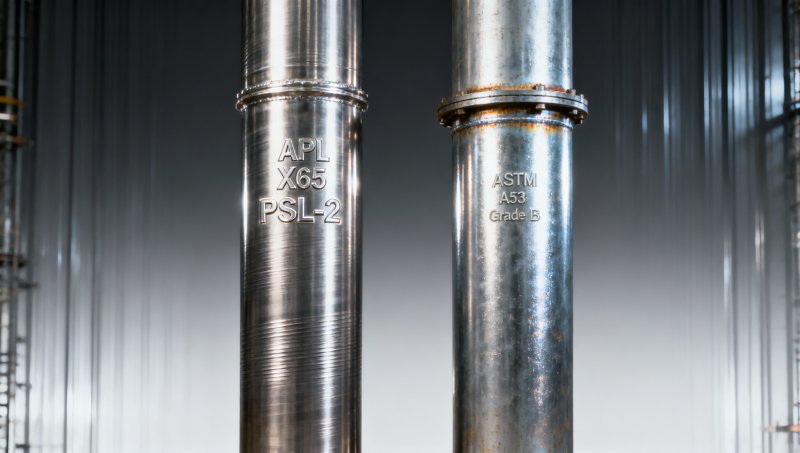
Unlike general-purpose piping standards, API 5L defines two product specification levels (PSL-1 and PSL-2), each with distinct chemical composition limits, mechanical property thresholds, and mandatory non-destructive testing (NDT) protocols. PSL-2 pipes require 100% ultrasonic testing (UT), hydrostatic pressure testing at ≥1.4× specified minimum yield strength (SMYS), and full heat-treatment documentation traceable to individual heats.
Common grades include X42, X52, X60, X65, X70, and X80—where “X” denotes yield strength in ksi (e.g., X65 = 65 ksi / 448 MPa minimum yield). These grades are widely used in onshore/offshore pipelines, compressor stations, and sour service (H₂S-rich) environments when combined with NACE MR0175/ISO 15156 compliance.
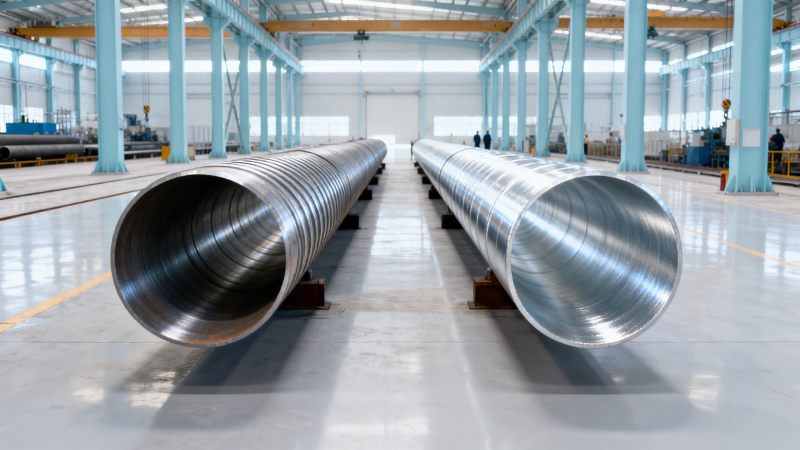
This table highlights why API 5L is preferred for critical energy infrastructure: its layered quality control—from raw material sourcing to final inspection—reduces field failure risk by up to 60% compared to generic carbon pipe, according to industry benchmarking data from the Pipeline Research Council International (PRCI).
ASTM A53: Purpose, Limitations, and Typical Use Cases
ASTM A53 covers black and hot-dipped galvanized steel pipe for mechanical and pressure applications, including steam, water, gas, and air lines. It’s divided into three types: Type F (furnace-welded), Type E (electric-resistance-welded), and Type S (seamless), all available in Grades A and B. Its tensile strength ranges from 330 MPa (Grade A) to 415 MPa (Grade B), with yield strengths of 207 MPa and 241 MPa respectively.
While widely accepted in municipal utilities, HVAC systems, and low-pressure industrial distribution, ASTM A53 lacks explicit requirements for impact testing, grain size control, or sour service qualification. It also permits wider dimensional tolerances—up to ±12.5% wall thickness variation for welded pipe—making it unsuitable for cyclic loading or seismic zones without engineering review.
For example, in North America, ASTM A53 Grade B is commonly used for fire sprinkler systems (NFPA 13 compliant) and building conduit sleeves, but prohibited in Class I Division 1 hazardous locations per NEC Article 501 unless supplemented with additional corrosion protection or third-party validation.
Key Differences That Drive Procurement Decisions
The choice between API 5L and ASTM A53 isn’t merely technical—it directly impacts total cost of ownership, insurance eligibility, regulatory approval timelines, and long-term maintenance frequency. Project managers must evaluate six core criteria:
- Service Environment: API 5L required for buried pipelines, offshore platforms, or H₂S exposure >10 ppm; ASTM A53 acceptable for above-ground, non-corrosive, ≤1.0 MPa applications.
- Design Life Expectancy: API 5L supports 30–40 years with cathodic protection; ASTM A53 typically limited to 15–20 years in aggressive soils.
- Inspection Burden: API 5L mandates third-party witnessing at mill level; ASTM A53 allows self-certification.
- Lead Time & MOQ: API 5L PSL-2 orders average 8–12 weeks with MOQ ≥20 tons; ASTM A53 standard sizes ship in 2–4 weeks with MOQ as low as 1 ton.
- Post-Fabrication Requirements: API 5L often requires post-weld heat treatment (PWHT); ASTM A53 rarely does.
- Export Documentation: API 5L shipments require API Monogram license verification; ASTM A53 requires only standard mill test reports.
Hongteng Fengda maintains dual-certified production lines for both specifications, enabling seamless transition between standards based on project jurisdiction—e.g., supplying API 5L X65 for an Iraqi oil field while delivering ASTM A53 Grade B to a Vietnamese food processing plant within the same quarter.
Corrosion Resistance Enhancement: From Galvanizing to System Integration
While neither API 5L nor ASTM A53 mandates external coating, corrosion mitigation is mission-critical. Hot-dip galvanizing remains the most cost-effective method—adding a 5–10 year service life extension in urban atmospheres and up to 25 years in rural settings. For electrical grounding or conduit applications, Galvanized Steel Electrical Conduit delivers proven performance across construction, automotive, and agricultural sectors—with tensile strength ≥520 MPa and coating precision of ±0.15 mm thickness tolerance.
Our DX52D-grade galvanized conduit meets AISI, ASTM, DIN, JIS, GB, and EN standards, and is routinely specified for trestle pile support frames, mining pit scaffolding, and low-pressure fluid transport (water/gas/oil). Its dual-layer primer system—5-micron front coat + 20-micron color topcoat—ensures UV resistance and abrasion durability in outdoor installations.
These lead time differentials reflect complexity—not just manufacturing, but certification logistics, third-party audit scheduling, and documentation preparation. Hongteng Fengda’s integrated QA/QC team reduces this variance by 22% on average through parallel processing of test reports and customs paperwork.
Why Global Buyers Choose Hongteng Fengda for Dual-Standard Compliance
As a certified structural steel manufacturer & exporter from China, Hongteng Fengda operates ISO 9001:2015 and API Q1–certified facilities with in-house metallurgical labs, automated ultrasonic testing lines, and real-time traceability via QR-coded heat tags. We serve over 42 countries—including 17 EU members—and maintain stock of 120+ API 5L and ASTM A53 SKUs in Shanghai and Tianjin bonded warehouses.
Our clients benefit from standardized export packaging (waterproof paper + steel strip bundling), flexible MOQs starting at 5 tons, and dedicated engineering support for spec conversion—e.g., translating API 5L X65 requirements into equivalent EN 10208-2 or GB/T 9711.2 compliance documentation within 72 business hours.
Whether you’re specifying pipe for a $2.4 billion LNG terminal in Qatar or upgrading conduit for a Tier-1 auto supplier in Mexico, Hongteng Fengda ensures consistent quality, predictable lead times, and zero non-conformance incidents across 12 consecutive audit cycles.
To receive a customized comparison matrix for your next pipe procurement—including grade selection guidance, coating recommendations, and regional certification pathways—contact our technical sales team today.
Please give us a message


Please enter what you want to find