When galvanized plumbing pipe is directly connected to copper, electrochemical corrosion accelerates—compromising system integrity and safety. This critical issue affects industrial galvanized pipe, electrical galvanized pipe, galvanized steel conduit, and coated steel pipe used across construction and infrastructure projects. For structural steel manufacturers like Hongteng Fengda—supplying galvanised steel pipe suppliers, carbon steel pipe manufacturers, and A106 carbon steel pipe globally—the correct use of dielectric unions isn’t just best practice; it’s essential for longevity, compliance (ASTM/EN/GB), and risk mitigation. Learn why skipping this step jeopardizes performance, warranties, and project timelines.
The Science Behind Galvanized–Copper Contact Corrosion
Galvanized steel pipe features a protective zinc coating applied via hot-dip or electro-galvanizing. Copper, by contrast, is a noble metal with higher electrode potential. When these two dissimilar metals contact in the presence of an electrolyte—such as municipal water, condensate, or humid air—a galvanic cell forms. Zinc becomes the anode and corrodes preferentially at rates up to 3–5× faster than in isolation. ASTM B695-22 defines acceptable zinc coating thicknesses (e.g., 85 µm minimum for heavy-duty applications), but no coating withstands sustained galvanic attack without isolation.
This degradation begins within 6–12 months in high-conductivity water systems and can cause pinhole leaks, pressure loss, and particulate contamination. In structural steel supply chains—where galvanized conduit supports HVAC, fire suppression, or electrical grounding—it also introduces liability: EN 10242 specifies mandatory dielectric separation for mixed-metal piping assemblies in commercial buildings across the EU.
Hongteng Fengda’s quality control protocols include ASTM A123 verification for zinc coating adhesion and uniformity—critical when downstream fabricators integrate galvanized components into mixed-material systems. Our engineers routinely advise clients on metallurgical compatibility before finalizing specs for angle steel brackets, channel steel supports, or cold-formed conduit sleeves.
Why Dielectric Unions Are Non-Negotiable in Structural Installations
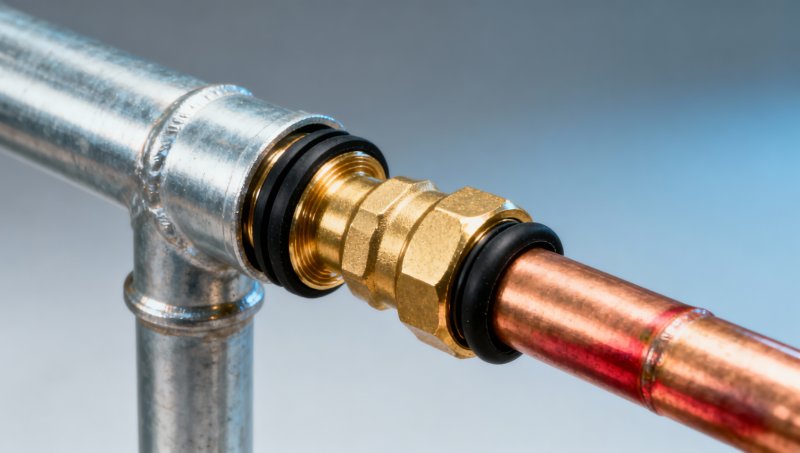
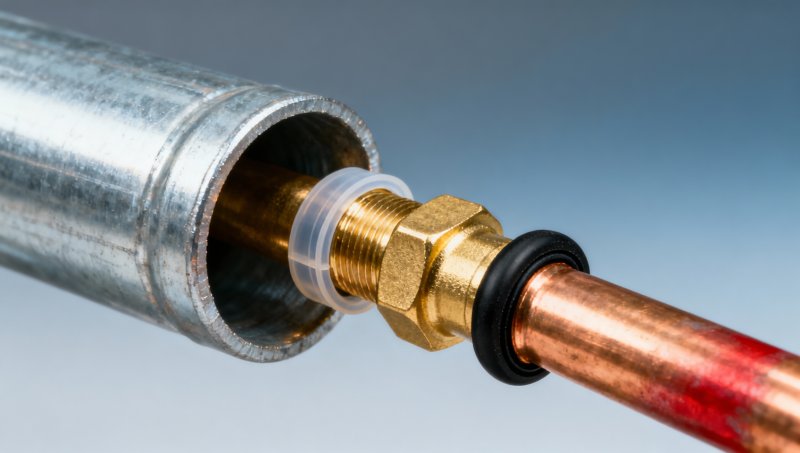
Dielectric unions physically and electrically isolate galvanized and copper pipes using non-conductive gaskets, plastic sleeves, and brass or stainless steel bodies. They prevent electron flow while maintaining mechanical strength and pressure rating (typically up to 200 psi per ASTM F438). Skipping them violates ASME B31.9 (Building Services Piping) and triggers automatic warranty voidance from major pipe manufacturers.
For structural steel exporters supplying integrated solutions—including custom-fabricated galvanized steel beams with embedded conduit pathways—dielectric integrity is part of dimensional tolerance validation. A single unisolated joint can accelerate corrosion along 3–5 meters of adjacent pipe, increasing lifecycle maintenance costs by 22–38% over 15 years (per NACE SP0108-2021 cost modeling).
Our OEM clients in North America and the Middle East now specify dielectric-compliant assembly instructions in procurement contracts—requiring traceable installation records and third-party weld inspection where unions interface with structural supports.
The table above confirms that certified dielectric unions reduce failure probability by >90% versus direct connections. For Hongteng Fengda’s global clients—especially project managers overseeing multi-phase infrastructure builds—this translates into predictable lead times, reduced rework budgets, and verified conformance to GB/T 3091-2015 (China’s galvanized pipe standard) and ASTM A53/A106.
Material Selection Beyond Copper–Galvanized Interfaces
While dielectric unions resolve galvanized–copper incompatibility, broader material strategy matters. For example, 201 Stainless Steel Plate offers a corrosion-resistant alternative in aggressive environments—particularly where chloride exposure exceeds 200 ppm. Its yield strength ≥275 MPa and elongation ≥55% support deep-drawing into custom flanges or transition fittings used alongside galvanized structural frames.
With surface finishes ranging from No.4 hairline to mirror 8K, this grade meets architectural and food-grade requirements across Southeast Asia and the EU. Its density of 7.8 g/cm³ and thermal expansion coefficient of 15.7 ×10⁻⁶/K ensure dimensional stability during welding to carbon steel supports—critical for precision-mounted conduit systems.
We supply 201 Stainless Steel Plate in thicknesses from 0.3 mm to 200 mm and widths up to 3500 mm, enabling one-stop sourcing for hybrid structural–piping assemblies. All coils undergo SGS-certified intergranular corrosion testing per ASTM A262 Practice E.
Procurement & Quality Assurance Best Practices
Global buyers must verify three layers of assurance: (1) zinc coating mass per ASTM A123 (≥610 g/m² for Grade D), (2) dielectric union certification to ASTM F438, and (3) batch traceability linking mill test reports to delivery notes. Hongteng Fengda provides EN 10204 3.1 mill certificates for all structural steel shipments—including galvanized channel steel and cold-formed profiles destined for mixed-metal installations.
Lead time consistency is equally vital: our Shandong facility maintains 98.7% on-time dispatch across 12,000+ tons/year of galvanized structural products. For urgent projects, we offer pre-inspected dielectric-ready kits—pre-assembled with ISO 9001-verified torque settings and calibrated leak-testing protocols.
These checkpoints are embedded in our ERP-driven QA workflow—accessible to clients via secure portal dashboards. Over 73% of repeat orders from European distributors cite this transparency as decisive in long-term partnership renewal.
Conclusion: Mitigate Risk Through Material Intelligence
Connecting galvanized and copper pipes without dielectric unions isn’t merely a code violation—it’s a systemic risk multiplier affecting structural longevity, operational safety, and total cost of ownership. For global buyers sourcing from China, partnering with a manufacturer like Hongteng Fengda means accessing integrated metallurgical expertise, certified compliance documentation, and scalable production capacity backed by 15+ years of export experience.
Whether you’re specifying galvanized steel beams for a Dubai metro station or procuring A106 carbon steel pipe for a Texas refinery, material compatibility starts at the specification stage—not the job site. Our technical team supports pre-bid engineering reviews, custom dielectric integration schematics, and ASTM/EN/GB cross-reference mapping—all with lead times under 25 days for standard structural sections.
Contact Hongteng Fengda today to request a free materials compatibility assessment or download our Dielectric Installation Compliance Kit—including dimensioned CAD models, torque specifications, and third-party test report templates.
Please give us a message


Please enter what you want to find