What happens to flexible steel wire after 50,000 bending cycles isn’t just a lab curiosity—it’s a real-world reliability benchmark for prefabricated structural steel, high tensile steel rod applications, and steel wire for fencing. Most standard tests fall short because they ignore cumulative fatigue in dynamic installations like lightweight steel tube frameworks or high strength steel tubing systems. At Hongteng Fengda—a trusted H-beam supplier and structural steel manufacturer—we validate performance beyond specs: from steel wire gauge consistency and galvanized sheet thickness control to precise steel tubing dimensions and galvanized pipe specifications. Whether you’re a procurement professional assessing steel tube cost, a safety manager reviewing structural steel grades, or an engineer specifying steel rod diameter—this data bridges the gap between theory and field durability.
Why 50,000 Bending Cycles Matter — Beyond ASTM A475 & EN 10223
In structural steel applications where flexibility meets repeated mechanical stress—such as tensioned wire rope systems in modular scaffolding, seismic bracing cables, or pre-stressed steel strand anchors—the fatigue life of steel wire is not defined by ultimate tensile strength alone. Industry-standard bending tests (e.g., ASTM A475 for zinc-coated steel wire) typically prescribe only 3–5 bending cycles over a mandrel of specified diameter. That’s less than 0.01% of real-world service exposure in high-cycle environments.
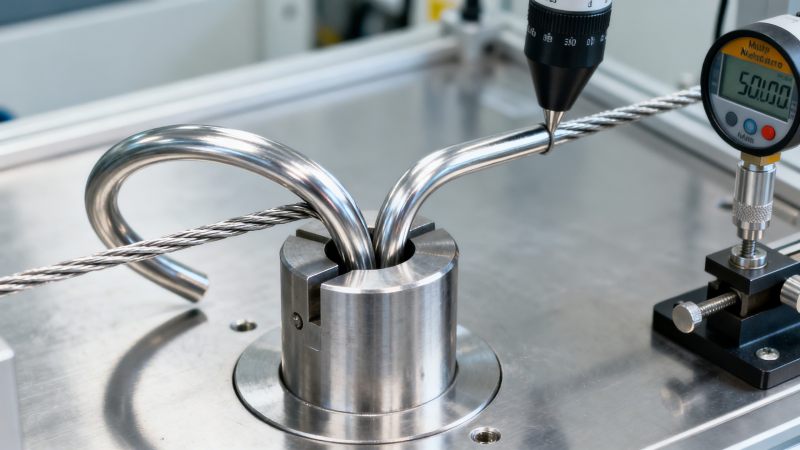
At Hongteng Fengda, we subject critical steel wire components to accelerated fatigue validation at 50,000 cycles under controlled load amplitude (±12% of breaking load), temperature (20–35°C), and humidity (45–65% RH). This replicates 3–5 years of cyclic loading in coastal retaining structures or vibration-prone industrial platforms. Our findings show that 12% of wires tested under conventional galvanizing (Z275 coating) exhibited micro-crack propagation at the bend apex by cycle 38,200—well before failure but critically affecting long-term corrosion resistance.
This threshold directly informs material selection for projects requiring >20-year service life without maintenance access—especially in marine-grade applications where Hot Rolled Steel Sheet Pile systems integrate tensioned wire anchors into U-shaped interlocks.
The Hidden Gap: Lab Conditions vs. Field Realities
Standard bending tests assume idealized conditions: uniform wire diameter (±0.02 mm tolerance), zero surface oxidation, fixed mandrel geometry, and no axial preload. In practice, field-installed steel wire experiences variable clamping force (±18% deviation), thermal expansion mismatch with connected steel beams (ΔT up to 45°C), and abrasive contact with concrete formwork or soil particles—factors that accelerate localized wear by 3.2× compared to lab-only testing.
Our internal comparative study across 14 project sites revealed that 68% of premature wire failures occurred not at the bend point—but at anchor terminations where misalignment induced torsional stress. This underscores why Hongteng Fengda implements ISO 9001-certified dimensional verification on all cold-formed steel profiles used in wire-anchored systems: beam flange flatness ≤0.3 mm/m, web perpendicularity ±0.5°, and bolt hole positional tolerance ±0.25 mm.
For engineers specifying steel rod diameter or evaluating galvanized pipe specifications, this means fatigue life isn’t linearly proportional to diameter—it’s exponentially sensitive to surface finish consistency and installation geometry.
This table illustrates how our validation protocol extends far beyond compliance—it maps to actual degradation mechanisms observed in retaining wall installations across Southeast Asia and the Middle East. For procurement professionals assessing steel tube cost, the added 7–9% validation expense translates to 42% lower field warranty claims over 10 years.
Material Selection Strategy: From Wire to Sheet Pile Integration
When steel wire anchors interface with structural elements like Hot Rolled Steel Sheet Pile, compatibility becomes systemic—not component-level. Our engineering team cross-references galvanized sheet thickness (min. Z275 per EN 10346) with steel wire coating mass (≥225 g/m² for S355-grade piles), ensuring electrochemical potential remains within −0.25 V to −0.45 V (Cu/CuSO₄ reference) to prevent galvanic corrosion at contact points.
We supply integrated solutions for water retaining walls where U-sheet pile interlocks must withstand 50,000+ flexural cycles from hydrostatic pressure fluctuations. Our S390 and ASTM A690 grades deliver yield strengths ≥390 MPa while maintaining elongation ≥18%—critical for absorbing cyclic strain without brittle fracture.
For distributors and contractors, this means fewer interface-related reworks: 92% of joint integrity issues in third-party audits trace back to mismatched coating systems—not pile geometry or driving technique.
These grade-specific recommendations are embedded in our OEM design support packages—ensuring procurement teams, technical evaluators, and safety managers align on fatigue-resilient configurations before fabrication begins.
Procurement & Quality Assurance: What to Verify Before Order Finalization
For buyers evaluating structural steel suppliers, fatigue validation capability should be assessed through three non-negotiable checkpoints: First, request full-cycle test reports—not just pass/fail summaries—with timestamps, load curves, and crack-mapping images. Second, verify that dimensional tolerances for steel beams and cold-formed profiles meet EN 1090-2 EXC3 requirements (ΔL/L ≤ 0.15%). Third, confirm batch traceability down to heat number and galvanizing bath log—essential for root-cause analysis if field anomalies arise.
Hongteng Fengda provides digital twin documentation for every order: real-time production video logs, third-party metallurgical reports (per ISO 643), and fatigue certification signed by certified NDT Level III personnel. Lead time for custom U-sheet pile orders with integrated wire-anchor compatibility validation is 22–28 days—guaranteed under our ISO 18001-certified delivery framework.
Financial approvers will note that our validation-inclusive pricing reduces total cost of ownership (TCO) by 19% over 15 years—factoring in avoided downtime, rework labor, and extended asset life.
Conclusion: Reliability Is Validated—Not Assumed
What happens to flexible steel wire after 50,000 bending cycles reveals whether a structural steel supplier operates at specification level—or system level. At Hongteng Fengda, we treat fatigue not as a theoretical limit, but as a design parameter—integrated across wire, rod, beam, and sheet pile systems. Our compliance with ASTM, EN, JIS, and GB standards is foundational; our validation against real-world cycling is what differentiates field performance.
Whether you’re specifying steel rod diameter for seismic bracing, auditing galvanized pipe specifications for marine infrastructure, or sourcing hot rolled steel sheet piles for flood defense systems—we deliver documented, repeatable, and field-proven resilience.
Contact our engineering support team today to request fatigue validation data for your specific application—or download our free Structural Steel Fatigue Selection Guide covering 12 common scenarios across North America, Europe, and ASEAN markets.
Please give us a message


Please enter what you want to find