A galvanized roof sheet that is too thin can wear out early even when its zinc coating initially looks sound. For many light-duty roof coverings, thickness near the lower end of commercially available sheet gauges is vulnerable to handling damage, fastener distortion, oil-canning, and repeated movement between supports. A thicker sheet is not automatically the correct answer, but premature wear becomes far less likely when the base-metal thickness, coating mass, profile geometry, purlin spacing, and exposure category are specified as one system.
For a roof with ordinary spans and properly spaced secondary steelwork, a nominal base-metal thickness around 0.45 mm is often treated as a practical lower boundary for profiled galvanized roofing. Sheets around 0.50 mm to 0.60 mm provide a more robust starting point where wind pressure, foot traffic during maintenance, larger purlin spacing, or moderate corrosion exposure are expected. Heavier sheets may be justified for long spans, deep profiles, high snow loading, severe wind zones, or roofs where access for repair is difficult. These figures must be read as selection ranges, not as a substitute for structural calculation or the governing project specification.
The important word is base-metal thickness. It refers to the steel substrate before galvanizing or paint layers are included. A quoted “overall thickness” can make a lighter sheet appear equivalent to a heavier substrate because zinc, paint, and protective films add small amounts to the final measurement. Roof performance under bending and fastener loading is governed primarily by the steel core and the formed profile, while corrosion resistance is strongly affected by the coating.
Thickness prevents several different forms of roof wear
Premature roof wear is not one failure mechanism. A sheet can corrode through, crack around a screw, permanently deflect between purlins, or lose its coating at cut edges. Increasing galvanized sheet thickness addresses some of these conditions directly and others only indirectly.
A thicker substrate has greater bending stiffness. This reduces cyclic flexing caused by wind suction and pressure, rainwater ponding, snow accumulation, and occasional access loads. Repeated flexing can enlarge fastener holes, fatigue coatings near bends, and create local low points where water remains after rainfall. The benefit rises sharply when support spacing is generous, because a sheet spanning farther between purlins experiences higher bending demand.
Thickness also improves resistance to dents and creases during lifting, installation, and service access. A thin panel may be permanently marked by a misplaced footstep or a dropped tool. The visible dent is only part of the problem: deformed ribs and laps can alter drainage, pull a fastener off square, or rub through a coating where two metal surfaces move against each other.
Corrosion life, however, cannot be inferred from sheet thickness alone. More steel beneath a damaged coating gives additional time before perforation, but the zinc coating is the first corrosion-control layer. A heavier core paired with inadequate zinc mass can still deteriorate rapidly in wet, chloride-rich, industrial, or poorly ventilated environments. Conversely, a suitable coating on a very thin sheet may resist red rust for a period while still suffering deformation and joint failures.
Begin with the roof system, not a gauge label
Gauge descriptions are useful for ordering only when they are tied to a recognized standard and a confirmed nominal thickness. Gauge tables differ by market, material type, and historical convention. A “26 gauge” description, for example, should never be accepted as the full engineering requirement without stating the actual base-metal thickness, tolerance basis, coating designation, and profile. Metric thickness in millimetres is clearer, provided the purchase documents identify whether the value is before or after coating.
Then review the geometry that determines how the sheet works after forming:
- Profile depth and rib arrangement: Deep trapezoidal ribs, closer rib spacing, and properly formed stiffeners can carry load more effectively than a shallow corrugation made from the same steel thickness. Two panels with equal thickness need not have equal span capacity.
- Purlin spacing: Wider spacing increases bending and uplift demand. A panel that is adequate on closely spaced supports can show visible deflection, fastener movement, or lap opening when installed on a wider grid.
- Roof pitch: Low slopes drain more slowly and are less forgiving of small depressions. Thickness selection should be considered alongside lap design, sealant requirements, profile suitability, and drainage paths.
- Fastener pattern: Screw type, washer quality, edge-zone spacing, and fastening into sound structural members influence whether wind loading remains distributed or concentrates around individual holes.
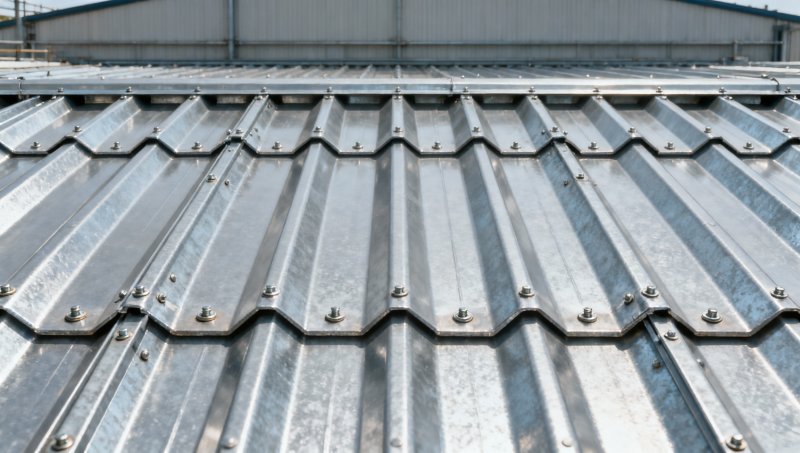
A useful specification therefore identifies the panel profile, support span, steel grade or mechanical properties where required, nominal base-metal thickness, galvanizing designation, finish system if present, and fixing arrangement. A thickness number without these related details leaves room for substitutions that look similar in a stack but behave differently on the roof.
When 0.45 mm is too light
A 0.45 mm galvanized sheet is not inherently unsuitable. It can perform well on short purlin spans, modest building heights, sheltered locations, and profiles designed for that thickness. The limitation appears when the design assumes conditions that are more demanding than the panel and support system allow.
Move above this range when the roof has exposed edges and corners subject to high wind suction, when the panel must bridge wider purlin centres, or when the roof is likely to receive regular maintenance traffic. It is also prudent to select a heavier substrate where equipment installation requires repeated movement across the roof, even if designated walkways are planned. Unplanned access rarely follows the intended route exactly.
Snow is not simply a vertical load issue. Drifting at parapets, roof steps, valleys, and changes in elevation can place concentrated loads on areas that were not represented by a uniform snow assumption. The same applies to standing water caused by blocked drains or construction tolerances. Sheet thickness will not solve a drainage design error, but a more rigid panel can reduce the local deformation that worsens ponding.
Long panel lengths deserve separate attention. Thermal movement becomes greater as length increases. If clips, penetrations, laps, and fasteners restrain that movement, the roof can develop elongated holes, rubbed coatings, or buckled flats. Selecting a substantially thicker sheet may reduce visible waviness, but it does not remove the need for a movement-compatible detailing strategy.
Separate structural thickness from corrosion protection
Galvanizing protects steel through a zinc layer applied to the substrate. Its effectiveness depends on coating mass, coating continuity, exposure conditions, drainage, contact with dissimilar materials, and damage sustained during fabrication and installation. The coating designation should be selected for the anticipated environment under the applicable project standard, whether ASTM, EN, JIS, GB, or another stated system governs the work.
Coating mass is frequently under-specified when attention is focused on gauge. A sheet with the requested 0.50 mm base metal but a coating intended for a milder environment may not meet the expected service life. The reverse mismatch also occurs: a high coating mass cannot compensate for a panel that is structurally too light for its span. Both values belong on the material schedule.
Cut edges, drilled holes, and field-made notches are more exposed than flat factory-coated surfaces. Zinc provides sacrificial protection around small exposed areas, but aggressive cutting, rough burrs, and trapped wet debris reduce that advantage. Where corrosion conditions are demanding, the detailing of penetrations, flashings, gutters, and laps often determines roof life as much as the nominal galvanized sheet thickness.
Measurements that prevent an ordering error
Before release, distinguish the ordered thickness from a quick site measurement. A handheld micrometer placed over a coated sheet measures the total thickness at that point, not necessarily the specified base-metal thickness. Paint systems, zinc layers, local coating variation, and measuring pressure all affect the reading. Coating thickness should be verified by an appropriate coating measurement method, while base-metal thickness should be confirmed from mill documentation or a suitable test procedure agreed in the specification.
Sampling must also avoid misleading locations. Rib crowns, bends, and cut edges are poor places to infer flat-sheet thickness because forming can alter geometry and access. Measurements taken from flat portions of an uncoated sample are more meaningful when verification is necessary. A panel marked with a nominal thickness should still be checked against the governing tolerances rather than treated as exact at every point.
Weight per unit area is another useful cross-check, though it is not conclusive by itself. An unexpectedly low coil or panel weight can reveal a thickness discrepancy, but profile shape, coating mass, length tolerance, and packaging all affect the result. Use it as a signal to investigate, not as the sole acceptance method.
Details that can defeat an otherwise adequate sheet
Fasteners should seat firmly without crushing the sheet or over-compressing the sealing washer. Overdriven screws dish the metal around the hole and create a place for water to collect. Underdriven screws leave a path for wind-driven rain and allow movement. The damage is more severe on thinner sheet, yet poor installation can cause leakage and coating damage even on a heavier panel.
Contact between galvanized roofing and incompatible metals should be controlled, particularly where moisture can bridge the materials. Copper-bearing runoff, certain untreated timber preservatives, and unsuitable flashings may accelerate localized attack. Debris at eaves, valleys, and behind roof-mounted equipment keeps the surface wet and should be removed before it traps contaminants against the coating.
Transport and storage affect the starting condition. Bundles left wet without airflow can develop wet-storage staining before installation. This is not always a structural failure, but heavy staining or corrosion products warrant assessment because the protective zinc surface has already been disturbed. Panels should be lifted without dragging edges across one another, and protective films should not be left in place beyond their intended exposure period where heat or moisture can make removal difficult.
A defensible selection statement
For a durable roof, specify the minimum nominal base-metal thickness after reviewing profile span tables and project loads, then state the galvanizing requirement independently. A 0.45 mm sheet may be appropriate for restrained spans and mild service conditions; 0.50 mm to 0.60 mm is often a stronger basis where loading, access, wind, or support spacing is less forgiving. Beyond that range, select thickness from verified panel capacity rather than from an assumption that heavier steel alone resolves roof durability.
The final selection should match the actual purlin spacing, roof geometry, wind and snow design actions, corrosion exposure, fastener layout, and drainage details. When those inputs are aligned, galvanized sheet thickness becomes a controlled design choice rather than a late purchasing compromise that appears only after premature roof wear has begun.
Please give us a message


Please enter what you want to find