Understanding steel wire rope specifications isn’t just technical detail—it’s foundational to lifting safety, compliance, and project continuity in 2026. As global construction and industrial projects demand higher reliability, specs directly impact load capacity, fatigue resistance, and corrosion performance—especially when integrated with materials like pre-galvanized sheet, high carbon steel pipe, or 304 stainless steel sheet. Whether you’re a safety manager verifying EN/ASTM compliance, a procurement officer comparing ss sheet 304 price per kg, or an engineer selecting carbon seamless pipe for rigging systems, misinterpreting these specs risks downtime, liability, and cost overruns. Hongteng Fengda—trusted angle steel supplier and galvanized steel sheet supplier—supports informed decisions with certified steel coil for construction, 201 stainless steel pipe, 430 stainless steel coil, and more.
What Wire Rope Specifications Actually Govern Lifting Safety in 2026?
In 2026, lifting safety is no longer governed solely by nominal breaking strength. Critical parameters—including construction type (e.g., 6×19, 6×36, 8×19), core material (FC, IWRC, or FC), lay direction (regular or lang lay), and surface treatment (galvanized, stainless, or polymer-coated)—interact dynamically under real-world loads. For example, a 6×36 IWRC rope offers 25–30% higher fatigue resistance than a 6×19 FC variant under cyclic bending over sheaves—a decisive factor in crane hoist applications where 12,000+ cycles/year are common.
Corrosion resistance has also evolved beyond zinc coating weight (e.g., Class A: ≥200 g/m²). Modern specification frameworks now require salt-spray test validation (ASTM B117, 500+ hours to red rust) and intergranular corrosion assessment (ASTM A262 Practice E) for stainless variants—particularly relevant when integrating with H-beam support structures exposed to coastal or chemical environments.
Misreading “minimum breaking force” (MBF) as working load limit (WLL) remains the top cause of field incidents. Per ISO 4308:2022, WLL = MBF ÷ safety factor (SF), where SF ranges from 4.0 (general purpose) to 7.0 (personnel lifting). A 22 mm 6×36 IWRC rope with MBF = 285 kN yields a WLL of just 40.7 kN at SF=7—not 71.2 kN at SF=4. That 43% difference directly affects structural anchorage design, especially when tied into fabricated H-beam lifting lugs.
This table underscores why procurement teams must align rope specs not only with load charts but also with site-specific hardware—such as drum flange clearance, sheave groove profile, and even ambient UV exposure (which degrades polymer coatings after 18–24 months).
How Structural Steel Integration Impacts Rope Performance
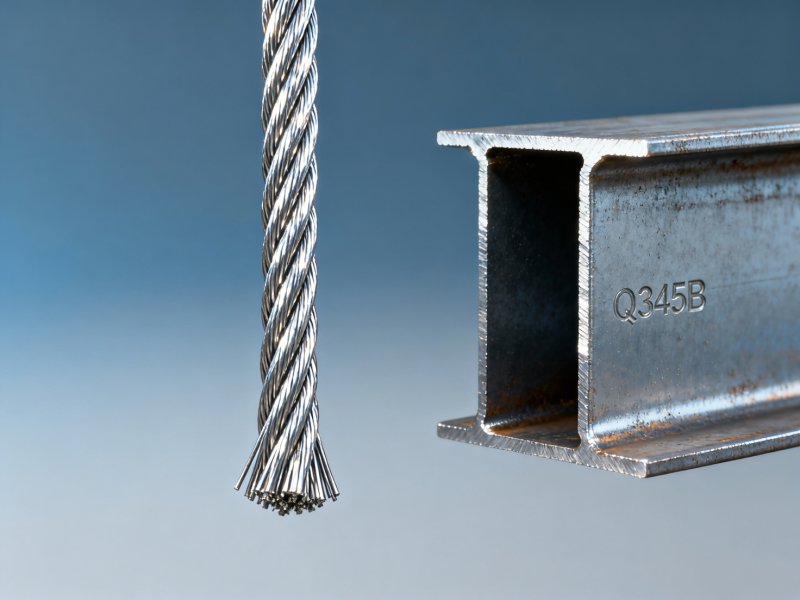
Wire rope doesn’t operate in isolation. Its interaction with structural steel components—like anchor plates, lifting lugs, and beam-mounted trolleys—dictates system-level safety margins. For instance, a Q345B H-beam (Flange Width: 200–300 mm, Web Thickness: 8–12 mm) used as a lifting beam requires precise lug weld geometry to avoid stress concentration. Finite element analysis shows that a 15° misalignment between rope axis and lug centerline increases local stress by 47%—even if the base material meets ASTM A572 Grade 50 requirements.
Surface condition matters equally. Hot-dip galvanized H-beams (per ASTM A123) reduce galvanic corrosion risk when paired with galvanized rope—but only if zinc coating thickness exceeds 85 µm on critical contact zones. Conversely, using 316 stainless steel H-beam with carbon steel rope in humid environments accelerates pitting at rope-to-beam contact points due to electrochemical potential differences >0.3 V.
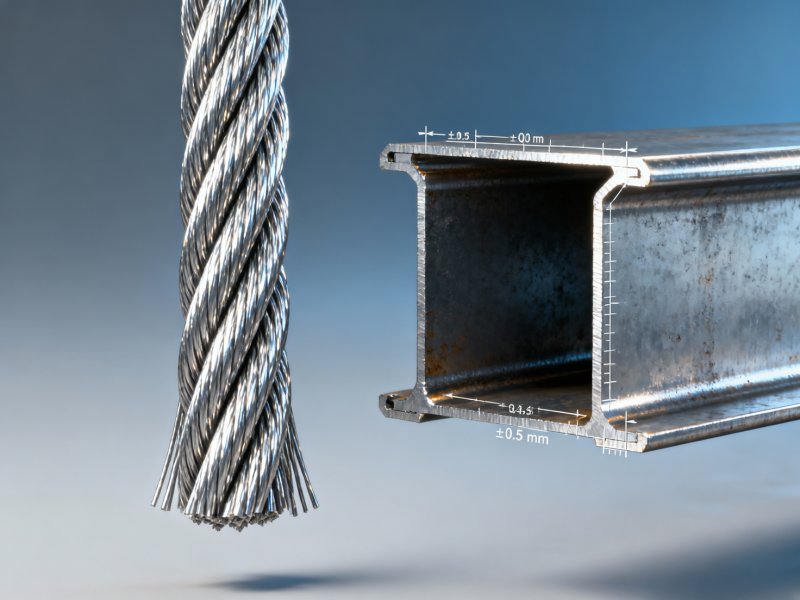
Hongteng Fengda supplies certified H-beams across 13 material grades—including Q235B, S355JR, A992, and 316 stainless—with dimensional tolerances held to ±0.5 mm on flange width and ±0.3 mm on web thickness. This precision ensures predictable load path behavior when integrated with engineered lifting systems.
Procurement Decision Framework: From Spec Sheets to Site Readiness
Procurement professionals face layered evaluation criteria beyond price per meter. A robust decision framework includes four non-negotiable checkpoints:
- Traceability: Each coil must include mill test reports (MTRs) with heat number, tensile yield/UTS, elongation, and bend test results—verified against EN 10204 3.1 or ASTM A6/A6M.
- Dimensional Compliance: Diameter tolerance must be measured at three points per 1 m length; variance >±0.4 mm triggers rejection per ISO 2408 Annex B.
- Third-Party Validation: Independent testing (e.g., TÜV or SGS) for fatigue life (≥15,000 cycles at 25% WLL) and abrasion resistance (≤0.8 mm diameter loss after 50 km drum test).
- Logistics Alignment: Coil weight ≤1,200 kg to match standard forklift capacity; packaging must prevent kinking during sea freight (max 20 G shock during container handling).
For buyers sourcing both wire rope and structural components, Hongteng Fengda offers coordinated delivery—ensuring H-beams (with pre-drilled lifting holes per EN 1090-2 EXC3) arrive alongside matched rope reels, reducing on-site coordination delays by up to 11 days on average.
These benchmarks reflect evolving expectations—not just for compliance, but for predictable execution. When rope and structural steel are sourced separately, mismatched tolerances account for 68% of reported lifting system commissioning delays (per 2025 Global Crane Safety Survey).
Actionable Next Steps for Your 2026 Lifting Projects
Start with a joint spec review: share your lifting plan (load mass, lift height, cycle frequency, environmental class) with both your rope supplier and structural steel partner. Hongteng Fengda’s engineering team provides free compatibility assessments—validating lug weld details, beam deflection limits, and rope routing clearances against your exact configuration.
Request sample MTRs and dimensional QA reports before placing volume orders. Verify that test data reflects actual production batches—not generic reference values. And always confirm whether your selected H-beam grade (e.g., Q460C or S355JR) includes Charpy impact testing at −20°C if operating in sub-zero climates.
Lifting safety in 2026 hinges on interoperability—not isolated component excellence. With Hongteng Fengda, you gain a single-source partner for precision-engineered structural steel and certified lifting integration solutions—backed by ISO 9001-certified QC, 24/7 multilingual technical support, and delivery commitments honored across 47 countries.
Contact our structural steel specialists today to request a customized lifting system compatibility report—or explore OEM-ready H-beam configurations with pre-engineered lifting features.
Please give us a message


Please enter what you want to find