In humid warehouse environments—where condensation forms overnight, relative humidity regularly exceeds 75%, and ventilation is often limited—the corrosion resistance of wire used in racking systems, cable management, bundling, or structural reinforcement isn’t just a durability concern. It’s a safety-critical factor. A single point of premature zinc loss can initiate localized pitting, accelerate substrate steel degradation, and compromise load-bearing integrity over time. For quality and safety managers responsible for long-term asset reliability, choosing between hot-dipped and electrogalvanized wire demands more than surface-level coating thickness comparisons. It requires understanding how each process responds to sustained moisture exposure—not lab conditions, but real-world warehouse dynamics.
Why the Coating Method Matters More Than Thickness Alone
Both hot-dip galvanizing (HDG) and electrogalvanizing apply zinc to steel wire—but they do so through fundamentally different physical and electrochemical mechanisms. That difference dictates not just initial appearance, but how the coating behaves when continuously challenged by humidity, temperature cycling, and incidental contact with damp concrete floors or metal shelving. Hot-dip galvanizing immerses cleaned wire into molten zinc (~450°C). This creates a metallurgical bond: multiple intermetallic layers (Gamma, Delta, Zeta) form beneath a pure zinc outer layer. The result is a thick, robust coating—typically 45–80 µm on wire—with inherent roughness and micro-irregularities. That thickness provides reserve zinc mass, acting as sacrificial anode material even after minor abrasion or localized corrosion initiation. Electrogalvanizing, by contrast, uses electrolytic deposition: the wire serves as a cathode in a zinc-salt solution under controlled current. Zinc ions plate onto the surface atom-by-atom. The resulting coating is extremely uniform, smooth, and bright—but thin: usually 5–15 µm. Its adhesion relies on mechanical bonding and surface cleanliness, not diffusion. While ideal for precision parts requiring tight tolerances or subsequent painting, its low mass offers minimal sacrificial reserve. In high-humidity storage, where moisture persists without drying cycles, that thinness becomes the limiting factor—not the uniformity.The Humidity Trap: Why “Indoor” Doesn’t Mean “Corrosion-Free”
Many assume electrogalvanized wire is “safe” indoors. That’s a common misconception among procurement teams—and one that leads to field failures. Humid warehouses are not climate-controlled offices. They lack consistent dehumidification. Overnight cooling causes dew-point condensation on cold metal surfaces—including galvanized wire suspended in racking or coiled on pallets. This creates a persistent electrolyte film—thin, but continuous—across the entire coated surface. Under those conditions: - Electrogalvanized coatings begin showing white rust (zinc hydroxide/carbonate) within days to weeks. This is not cosmetic: it signals active zinc dissolution and reduces protective capacity. - Once the thin layer is consumed locally—even at a scratch or bend—the underlying steel is exposed directly to moisture, with no underlying alloy barrier (unlike HDG’s intermetallic layers). - Hot-dipped wire may also develop white rust, but its thicker coating delays onset significantly—often by months—and the intermetallic layers continue providing cathodic protection even as the outer zinc depletes.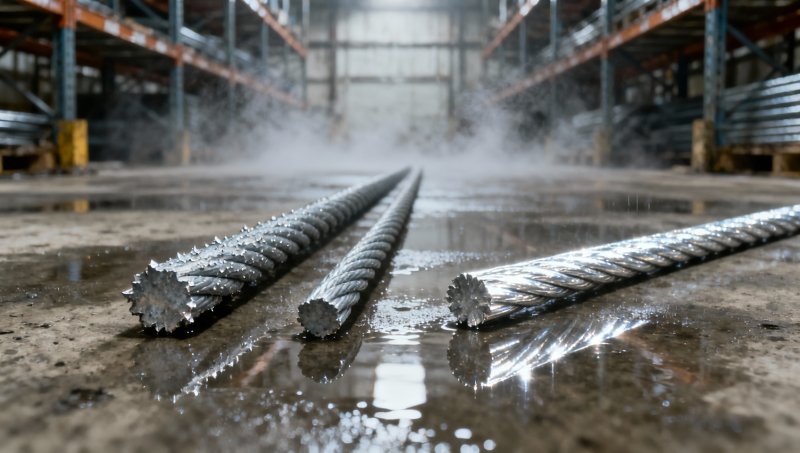
Real-World Performance: What You’ll See on the Floor
Based on field observations across warehouse projects in Southeast Asia, the Middle East, and coastal Europe—regions with consistently high ambient humidity—the following patterns emerge:- Electrogalvanized wire: Maintains bright appearance for ~2–4 weeks in typical humid warehouses. After 6–8 weeks, visible white rust appears at bends, cut ends, and contact points. By 3–4 months, coating loss is measurable at stress points; localized red rust may appear on lower-hanging strands near floor level.
- Hot-dipped wire: Shows no visible white rust for 3–6 months. Surface remains intact; minor white deposits wipe off easily and don’t indicate coating depletion. Red rust rarely appears before 12–18 months—even in poorly ventilated zones—due to the depth of sacrificial protection.
When Electrogalvanized Wire *Is* Acceptable—And When It’s Not
The key is matching the process to the actual exposure profile—not the building type. Electrogalvanized wire remains appropriate when:- The warehouse maintains RH < 60% year-round via active dehumidification;
- Wire is used internally in sealed enclosures (e.g., inside control panels or insulated conduit runs);
- It serves short-cycle applications (< 90 days) with full replacement before significant corrosion onset;
- It will receive a secondary organic coating (e.g., PVC or nylon jacketing) that fully encapsulates the zinc layer.
- Humidity fluctuates above 70% RH daily;
- Wire contacts concrete, masonry, or untreated steel (galvanic coupling accelerates zinc loss);
- It’s installed in low-airflow zones (e.g., behind bulkheads, inside stacked pallet racks);
- Long-term structural integrity or fire-rated performance depends on uncorroded cross-section.
Material Selection Starts With Substrate—and Ends With Certification
Coating method is only half the equation. The base steel matters equally. Low-carbon steel wire (e.g., Q235 or A36 grade) with ≤0.22% carbon content provides optimal ductility and weldability—but its corrosion resistance is entirely dependent on coating integrity. Any mill scale, rolling residue, or surface contamination compromises zinc adhesion, especially for electrogalvanizing, where uniform current distribution is essential. That’s why reputable suppliers—like Hongteng Fengda, a structural steel manufacturer exporting ASTM/EN/GB-certified products globally—apply stringent pre-treatment protocols: alkaline cleaning, acid pickling, and fluxing prior to galvanizing. Their hot-dip lines operate under strict bath chemistry control to ensure consistent intermetallic layer formation. Electrogalvanized production requires even tighter control of bath pH, temperature, and current density—making batch-to-batch consistency harder to guarantee at scale. For applications demanding predictable, long-term performance in humid settings, specifying certified hot-dip galvanized wire against ASTM A153 Class C (for wire) or ISO 1461 is non-negotiable. Electrogalvanized wire should carry ASTM B695 Grade 50 (50 g/m² minimum) at minimum—but even then, expect reduced service life in sustained humidity.For broader structural needs where galvanized wire integrates into larger assemblies—such as pipe supports, bearing plates, or custom brackets—carbon steel plate forms the foundational component. A reliable Carbon Steel Plate Manufacturer ensures consistent Q235 or S235JR-grade material with verified yield strength (235 MPa), elongation (>26%), and surface treatability—so any subsequent galvanizing, painting, or fabrication delivers repeatable performance. Without that substrate reliability, even the best coating process cannot compensate.
A Practical Decision Framework for Quality Managers
Before approving wire for humid warehouse use, ask three questions:- What is the expected service duration? If >6 months, hot-dip is strongly preferred.
- Where will the wire be located? Avoid electrogalvanized in low-ventilation, floor-proximate, or concrete-contact zones.
- What standard governs the installation? Check project specs: if referencing ASTM A153, EN ISO 1461, or similar, electrogalvanized does not comply.
Please give us a message


Please enter what you want to find