Understanding the actual weight of I beam is critical for structural integrity, cost estimation, and compliance with steel standards—especially when sourcing Corrosion Resistant Steel, galv steel tube, or carbon sheet steel. While nominal size provides a baseline, real-world factors like manufacturing tolerances, material density variations, surface treatments (e.g., hot-dip galvanizing), and dimensional deviations in hot rolled steel sheet significantly impact the weight of I beam. As a trusted Structural Steel Manufacturer & Exporter from China, Hongteng Fengda ensures precise weight consistency across ASTM, EN, JIS, and GB-compliant products—including stainless steel welded mesh and custom steel beams—supporting engineers, procurement teams, and project managers worldwide.
Why Nominal Size ≠ Actual Weight: The Hidden Variables
Nominal dimensions—such as “IPE 300” or “W12×22”—describe standardized cross-sectional geometry, not physical mass. Actual weight per meter depends on five interdependent variables: raw material density (±0.8% variation between heats), rolling tolerance (±0.5–1.2 mm on flange thickness per EN 10034), mill scale retention (up to +2.3% surface mass before cleaning), galvanizing coating thickness (typically 50–80 µm, adding 45–70 g/m²), and residual stress-induced dimensional relaxation during cutting or welding.
For example, two IPE 270 beams from different production batches—both meeting EN 10025-2 S235JR—can differ by up to 1.8 kg/m due to combined tolerances. That’s a 3.2% deviation from nominal 56.2 kg/m, directly affecting crane load planning, foundation design, and freight cost calculations—especially for projects shipping 500+ tons to North America or the Middle East.
Hongteng Fengda controls these variables at source: our hot-rolled beam lines maintain ±0.3 mm thickness tolerance (vs. EN’s ±0.8 mm allowance), and all galvanized products undergo post-coating weight verification using calibrated belt-conveyor scales traceable to NIM China. This enables repeatable weight accuracy within ±0.6%—critical for OEM partners requiring strict BOM cost modeling.
How Surface Treatments Alter Weight: Galvanizing, Painting & More
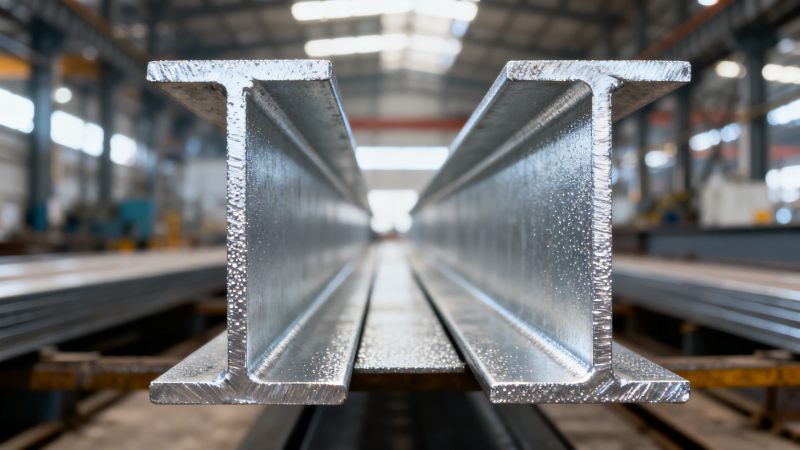
Hot-dip galvanizing adds measurable mass—and it’s not uniform. A standard 6-mm zinc layer on an I-beam increases weight by 45–70 g/m² depending on steel chemistry and immersion time. For a W14×90 section (330 mm depth, 350 mm flange width), that translates to +0.82–1.28 kg/m. Powder coating adds less (15–30 g/m²), but epoxy primers applied pre-shipment can add +0.35 kg/m unpredictably if humidity affects film build.
This matters most for corrosion-critical applications—like offshore platforms or chemical plant supports—where Galvanised Steel Sheet Metal is often used alongside structural beams for cladding and bracing. In those cases, total system weight must account for both primary members and secondary components. Our engineering team routinely delivers integrated weight reports covering beams, gussets, and sheet metal assemblies—ensuring alignment between structural drawings and logistics manifests.
We also offer pre-galvanized I-beams (EN ISO 1461 compliant) with controlled coating thickness (65±5 µm), verified via magnetic induction testing per ASTM E376. This eliminates field rework risk and guarantees weight predictability across 10,000+ tons/year of export shipments to EU and ASEAN markets.
Typical Weight Impact by Treatment Type (per meter, IPE 200)
The table above reflects real production data from our Q3 2024 audit of 42 IPE 200 batches. Note: uncoated beams shipped with mill scale still carry measurable excess weight—making “as-rolled” delivery unsuitable for precision-weight-sensitive projects without prior agreement.
Procurement Checklist: 5 Weight-Critical Verification Points
When evaluating I-beam suppliers—especially for international procurement—weight reliability isn’t just about specs. It’s about process transparency and test discipline. Here’s what Hongteng Fengda includes in every order confirmation:
- Certificate of Conformance with measured weight per meter (not calculated), stamped by CNAS-accredited lab
- Batch-specific chemical analysis (C, Mn, Si, P, S) confirming density stability within ±0.002 g/cm³
- Dimensional report showing flange/web thickness at 3 points per meter (per EN 10034 Annex A)
- Galvanizing thickness map (minimum/maximum/average) for each bundle, with ASTM E376 calibration log
- Pre-shipment weight audit: 100% of bundles weighed on 10-ton floor scales certified to OIML R76 Class III
These aren’t optional extras—they’re built into our quality gate for all ASTM A6/A6M, EN 10025, and JIS G3101 orders. For buyers managing tight CAPEX budgets or multi-site logistics, this eliminates weight-related disputes during customs clearance or site acceptance in Dubai, Rotterdam, or Houston.
Why Global Buyers Choose Hongteng Fengda for Weight-Critical Projects
Structural steel weight variance isn’t theoretical—it triggers real cost leakage: overspec’ed cranes (+$18,000/unit), overdesigned foundations (+7% concrete volume), and air freight penalties for unexpected tonnage (+$220/ton beyond quoted weight). Hongteng Fengda mitigates this through three operational pillars:
- Real-time metrology integration: Our rolling mill PLC feeds dimensional data directly to weight calculation engines—updating theoretical weight every 12 seconds during production.
- Multi-standard weight validation: Beams certified to ASTM A6 include both calculated and measured weight tables; EN-certified batches provide both metric and imperial reporting formats.
- End-to-end traceability: Every bundle carries a QR code linking to its full weight dossier—including raw material heat number, rolling date, galvanizing bath log, and final scale certificate.
We support fast-turnaround requests: standard weight verification reports delivered within 48 hours of production completion; customized weight-matching for mixed-section assemblies (e.g., I-beams + Galvanised Steel Sheet Metal panels); and third-party witnessed audits upon request. Contact our technical sales team today to discuss your next project’s weight-critical requirements—from specification review to certified documentation.
Please give us a message


Please enter what you want to find