Understanding what affects flat rolled steel coil quality during cold rolling is critical for structural steel manufacturers, procurement teams, and quality control professionals—especially when sourcing galvanised steel sheet metal, stainless steel embossed plate supplier in Europe, or wire products for fencing. At Hongteng Fengda, a leading structural steel manufacturer & exporter from China, we integrate precision cold rolling with rigorous process control to ensure consistency in flat rolled steel coil performance—key for applications ranging from can making machine China lines to architectural cladding and safety-critical infrastructure. This article explores the core metallurgical, mechanical, and operational factors influencing coil integrity, surface finish, and dimensional accuracy.
What Metallurgical Properties Determine Cold Rolling Outcome?
The base material’s chemical composition and microstructure directly govern how uniformly it responds to cold reduction. Variations in carbon content, manganese segregation, or residual elements like sulfur and phosphorus cause inconsistent deformation behavior across the strip width and length—leading to edge wave, center buckle, or thickness scatter beyond ±0.03mm tolerance.
Grain size distribution is equally decisive: coarse grains increase yield strength but reduce formability, while ultra-fine grains improve uniform elongation yet raise risk of stretcher strain in downstream stamping. For structural applications such as roofing sheet or steel structure framing, Q345B and Q390D grades offer balanced ductility (≥20% total elongation) and yield strength (345–390 MPa), minimizing post-rolling annealing needs.
Hydrogen embrittlement risk also escalates during cold rolling if pickling residues or moisture remain on coil surfaces before reduction. Our production line enforces strict dew point control (< –40℃) in tension-leveler entry zones and applies inline hydrogen bake-out at 180–220℃ for 60–90 seconds—reducing internal hydrogen content to <0.5 ppm before final coiling.
How Do Mechanical Process Parameters Impact Surface & Dimensional Stability?
Roll force, interstand tension, and reduction schedule collectively define stress distribution through the strip thickness. Over-reduction (>45% per pass) induces excessive subsurface shear, triggering micro-crack initiation that manifests as “orange peel” texture or localized pitting after galvanizing. Under-reduction (<12% per pass), meanwhile, fails to break up oxide scale remnants—compromising adhesion for PVDF or SMP top paint systems.
Tension control between stands must maintain ±2% deviation across all 5–7 rolling stands. Deviations >3% generate lateral flow asymmetry, causing width variation exceeding ±50mm specification limits—particularly problematic for window-shades and car ceiling components requiring tight nesting tolerances.
Roll surface roughness (Ra 0.05–0.12 μm) and thermal stability are calibrated daily using laser profilometry and infrared thermography. Rolls heated beyond 65℃ develop differential expansion, inducing periodic thickness modulation every 1.2–1.8 meters—detectable only via high-frequency thickness gauge data sampling at 200 Hz.
Key Cold Rolling Parameter Ranges for Structural Steel Coils
This table reflects real-time monitoring thresholds used in our ISO 9001-certified cold rolling facility. Exceeding any critical threshold triggers automatic stand shutdown and material quarantine—ensuring no out-of-spec Hot Rolled Coil Hrc enters downstream slitting or coating lines.
Why Environmental Control Matters More Than You Think
Ambient humidity above 65% RH promotes flash rust formation on cleaned coils within 90 minutes—degrading weldability and paint adhesion. Temperature fluctuations >5℃/hour induce thermal stress in coiled strips, generating latent shape defects that emerge only after uncoiling and leveling.
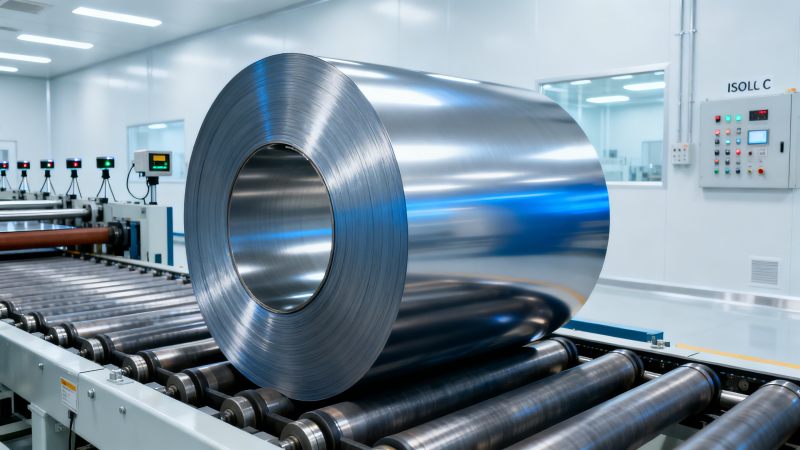
Our cold rolling plant maintains Class C environmental control (ISO 14644-1): temperature ±1.5℃, humidity 45–55% RH, and airborne particulate count <352,000/m³ (≥0.5μm). This prevents oxide reformation on freshly reduced surfaces and eliminates dust embedding into lubricant films—critical for outer shell of water machine and air conditioner applications demanding cosmetic-grade finishes.
Lubricant filtration is performed continuously through dual-stage 5μm + 1μm filters, with oil analysis conducted every 8 operating hours. Particulate counts >1,200/mL (NAS 12) trigger immediate system flush—avoiding abrasive wear on work rolls that causes longitudinal streaks visible under 30° lighting angles.
How Hongteng Fengda Ensures Consistent Quality Across Global Deliveries
As a structural steel manufacturer & exporter from China serving North America, Europe, the Middle East, and Southeast Asia, we embed quality assurance at three non-negotiable checkpoints: raw material certification (100% traceable to heat number), in-process thickness mapping (every 200m), and final coil inspection (ASTM A480 / EN 10142 compliance verification).
For customers specifying S235JR-S355JR Series or ASTM A36-A992 Series grades, our QC team performs full-spectrum testing—including tensile strength (370–550 MPa), bend test (180° around mandrel diameter = 2× thickness), and surface defect scanning at 0.1mm resolution. All reports are digitally signed and accessible via our secure portal within 24 hours of coil shipment.
We support global buyers with stable production capacity (1.2 million MT/year), consistent quality (defect rate <0.17%), and dependable lead times (standard delivery: 15–25 days ex-works). Whether you need low-carbon structural steel coils for roofing sheet or moderate-yield Q500E grade for steel structure frameworks, our OEM solutions include custom packaging, pre-shipment third-party inspection (SGS/BV/TÜV), and bilingual documentation aligned with CE, ISO, and EN standards.
Why Partner With Hongteng Fengda?
- Access to 32+ certified hot rolled coil grades—from Q195 to Q890E—with wall thickness 0.17–3.5mm and width 600–1250mm, all compliant with ASTM, EN, JIS, and GB standards
- Dedicated cold rolling line with real-time thickness control (±0.03mm), surface inspection (AI-powered defect classification), and environmental monitoring (ISO Class C)
- End-to-end support: technical consultation on cold rolling suitability, sample dispatch within 5 working days, FOB/CIF quotation within 2 hours, and logistics coordination across 12 major ports
Ready to validate cold rolling performance for your next project? Contact us today to request mill test reports, discuss custom specifications for Hot Rolled Coil Hrc, or schedule a virtual factory audit.
Please give us a message


Please enter what you want to find