The service life of Corrosion Resistant Wire depends on more than material grade alone.
In steel-related applications, durability is shaped by environment, stress, installation accuracy, and maintenance discipline.
When these factors are understood early, wire failures become less frequent and operating costs stay more predictable.
This matters across construction, industrial handling, support systems, and exposed structural components.
For any project using Corrosion Resistant Wire, service life is really the result of system-level decisions.
Basic Understanding of Corrosion Resistant Wire Service Life
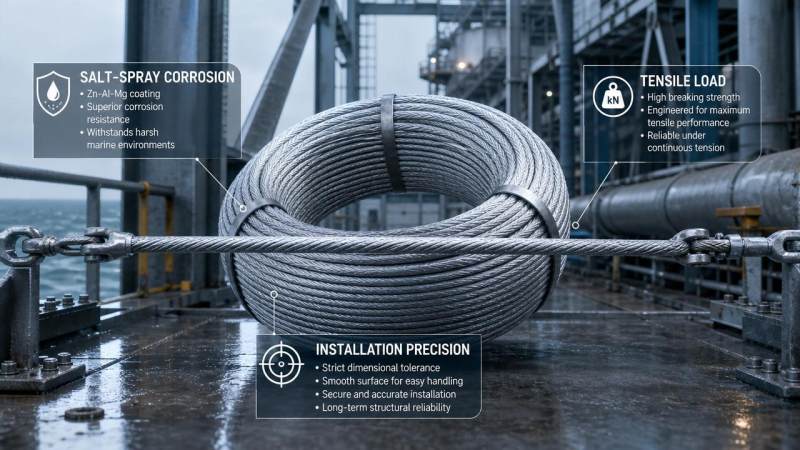
Corrosion Resistant Wire is designed to resist oxidation, moisture attack, and chemical exposure over time.
Its life span is usually measured by retained strength, surface condition, and safe operating performance.
A wire may still look acceptable while internal damage already reduces reliability.
That is why visual appearance alone should never define remaining service life.
In steel applications, common wire types include galvanized wire, stainless wire, alloy wire, and coated steel wire.
Each option performs differently under marine air, industrial fumes, cyclic loading, or abrasion.
The most important question is not which wire is strongest on paper.
It is which wire remains stable in the exact service environment for the longest period.
The Primary Factors That Affect Corrosion Resistant Wire Most
Several variables interact, but some have a much stronger impact than others.
The following factors usually determine whether Corrosion Resistant Wire lasts for years or fails early.
1. Exposure Environment
Environment is often the single biggest factor affecting Corrosion Resistant Wire service life.
Salt spray, acidic vapors, industrial pollution, and standing moisture accelerate corrosion rapidly.
Even high-performance wire degrades faster if contaminants stay on the surface for long periods.
2. Coating Quality and Material Selection
A protective layer matters, but coating thickness alone is not enough.
Uniform adhesion, surface preparation, and compatibility with the base steel are equally critical.
Poorly selected grades may fail despite having corrosion-resistant marketing claims.
3. Load, Tension, and Fatigue
Mechanical stress shortens service life when wire works near its limit too often.
Repeated bending, vibration, and shock loading create microcracks that invite corrosion and fracture.
This is especially important in structural supports and moving industrial systems.
4. Installation Method
Incorrect handling during installation can damage wire before operation even begins.
Sharp bends, scratched coatings, poor anchoring, and uneven tension create local weak points.
These defects often become the starting points for corrosion attack.
5. Maintenance Frequency
Routine inspection and cleaning greatly influence the real life of Corrosion Resistant Wire.
Deposits, trapped water, and unnoticed wear continue growing when no preventive care is applied.
Industry Conditions That Commonly Shorten Wire Durability
In the steel sector, harsh service conditions often combine rather than appear alone.
That combination effect explains many early failures.
These risks are familiar in construction, petroleum, mechanical, and industrial infrastructure projects.
Similar durability logic also applies to pipeline materials and related steel systems.
For example, Carbon Seamless Pipe is widely used in petroleum, chemical, mechanical, and construction fields.
Its balanced mechanical properties and anti-corrosion coating options show how environment and specification must be matched carefully.
Available dimensions include outer diameters from 17mm to 914mm and lengths from 5m to 14m.
Protective finishes such as galvanized, epoxy, transparent oil, and 3PE systems improve durability when selected properly.
Application Value in Structural Steel and Industrial Use
Longer Corrosion Resistant Wire life delivers more than replacement savings.
It also improves safety consistency, reduces downtime, and protects connected steel components.
In structural steel systems, wire durability affects support stability and inspection cycles.
In industrial environments, stable wire performance helps maintain smoother production continuity.
When corrosion is controlled early, the whole steel assembly often lasts longer.
- Lower total maintenance and replacement frequency
- Reduced risk of unexpected breakage
- Better compatibility with outdoor and industrial steel systems
- More predictable long-term operating performance
Typical Scenarios Where Service Life Varies Significantly
Not all service conditions age Corrosion Resistant Wire at the same speed.
The following scenarios show where differences become most visible.
Practical Measures to Extend Corrosion Resistant Wire Life
The best way to improve service life is to control the major failure causes before installation.
- Choose wire grade based on actual exposure, not general assumptions.
- Confirm coating type, thickness, and adhesion quality before use.
- Avoid sharp bending and surface damage during transport and installation.
- Keep loads within design limits and monitor vibration-sensitive locations.
- Clean contaminants regularly, especially in salt or chemical environments.
- Inspect contact points, anchors, and hidden moisture zones on schedule.
Where steel systems are interconnected, matching wire durability with adjacent materials is also important.
That approach helps prevent galvanic issues, uneven wear, and premature localized failure.
Operational Direction for Better Long-Term Results
What affects Corrosion Resistant Wire service life most is usually the environment-stress combination.
Material grade, coating, handling, and maintenance then determine how well the wire resists that combination.
For steel projects, durability improves when selection criteria are tied directly to field conditions.
Hongteng Fengda supports global structural steel applications with reliable production, quality control, and standards-based solutions.
When evaluating Corrosion Resistant Wire or related steel components, compare environment, load profile, coating system, and inspection access together.
That practical review helps reduce sourcing risk, improve safety margins, and extend real operating life.
Please give us a message


Please enter what you want to find